

What is Anchor Text Profile?
Definition
An anchor text profile is the distribution, by type, of the link text used in all the backlinks pointing to a site or page: brand names, naked URLs, generic phrases, and partial-match and exact-match keywords. Links that are earned naturally produce a varied profile, usually dominated by brand and URL anchors. An unusual concentration of exact-match keyword anchors is one of the typical traces of manipulative link building.
Also known as: anchor text distribution, exact-match anchor, partial-match anchor, branded anchor, naked URL anchor, generic anchor
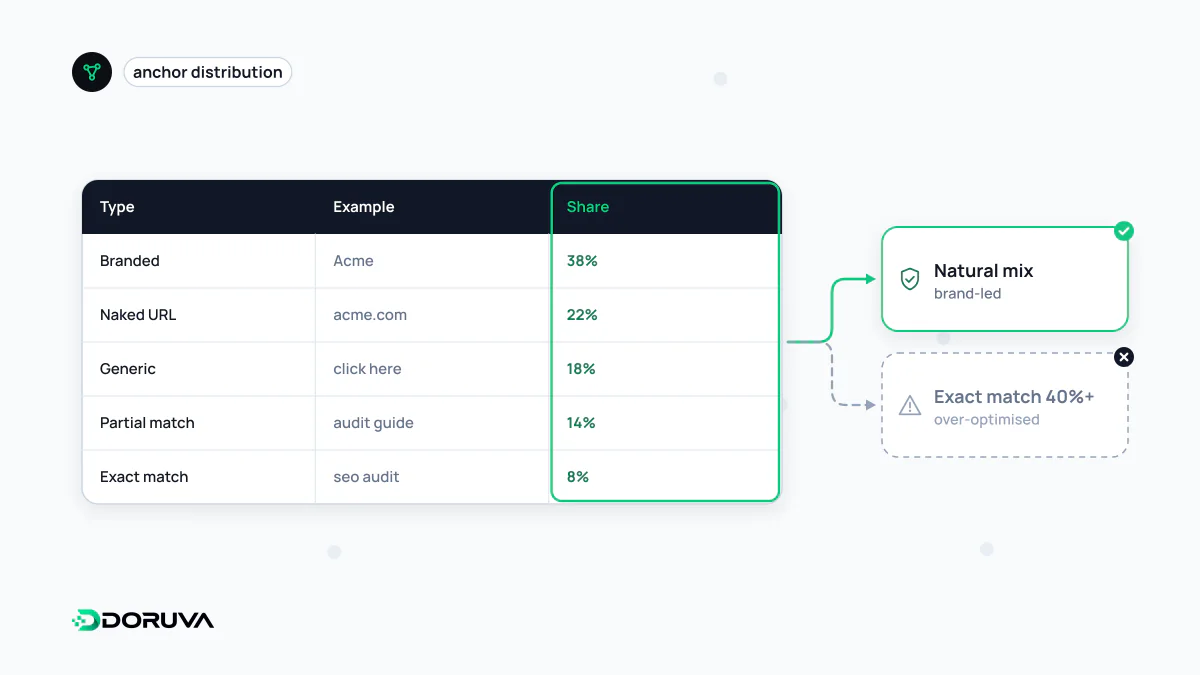
From one link to the whole picture
The text of a single link tells you how that link describes its target, which is what the anchor text entry covers. An anchor text profile answers a different question: across everyone who links to you, which words do they use? Hundreds of people linking from inside their own sentences create a pattern that no individual link reveals.
Using a fictional coffee equipment shop, "Example Coffee", the types break down like this:
| Type | Example | What it usually reflects |
|---|---|---|
| Branded | Example Coffee | The most natural way people mention a business |
| Naked URL | examplecoffee.com | Reference lists, forums, social posts |
| Generic | here, this site, read more | Carries no information, yet is everywhere on the real web |
| Partial match | Example Coffee's pour-over machine comparison | The keyword sits inside a natural phrase |
| Exact match | pour-over coffee maker | The target query itself; normal in small numbers |
| Image link | (alt text, or empty) | Logos and badges; the alt attribute stands in for text |
What a natural distribution looks like
Nobody can hand you an "ideal ratio". Google has never published one, and the percentages circulating online are observations by tool vendors. The underlying logic is simple, though. People who link to you don't coordinate; each writes in their own voice. A journalist uses your brand name, a forum member pastes your URL, a blogger links the words "this comparison". Earned profiles therefore tend to be dominated by branded, URL and generic anchors.
Dozens of unrelated sites linking to the same commercial page with the identical keyword phrase is not something that happens on its own. That kind of concentration suggests the anchor was chosen by the site receiving the link, not by the people giving it.
Over-optimization and link spam
Google's spam policies explicitly list links with optimized anchor text in articles, guest posts or press releases distributed on other sites as link spam, alongside keyword-stuffed forum signatures and keyword-rich links embedded in widely distributed widgets. Google has announced algorithmic updates designed to detect and nullify such links, stating that any credit they passed is lost. In serious or deliberate cases a manual action is also possible.
The problem is not a keyword in an anchor as such. One natural link on the words "pour-over coffee maker" from a relevant article is perfectly normal. The problem is the same wording recurring because a campaign put it there. The rules are summarised under Google spam policies.
Analysing your own profile
- Export the "Top linking text" table from the Links report in Search Console. It covers only links from outside your property, and image links without text appear as "(empty)".
- Bucket the anchors with simple rules: contains the brand, contains the domain, matches a list of generic phrases, matches your target keywords.
- Look at the distribution per important page, not just site-wide; problems usually cluster on one commercial page.
- Watch the timeline: a sudden wave of links carrying the same text deserves a closer look.
Most sites will find spammy links in languages they don't use, with unrelated keyword anchors. Google generally ignores those already.
Can a profile be fixed?
There is no point trying to change the wording of links other people gave you naturally. The links that need action are the ones you built or paid for: have them removed or qualified with rel="sponsored". If you have a manual action and can't get such links removed, that is the situation the disavow tool exists for. The only anchor text you fully control is on your own internal links, and there it is enough to be descriptive and consistent.