

What is Disavow?
Definition
To disavow links is to ask Google, through a tool in Google Search Console, not to take certain backlinks or whole domains into account when assessing your site. Google says the tool should only be used when a site has a considerable number of spammy, artificial or low-quality links that have caused, or are likely to cause, a manual action, and that most sites never need it.
Also known as: disavow tool, disavow links, disavow file, Google disavow
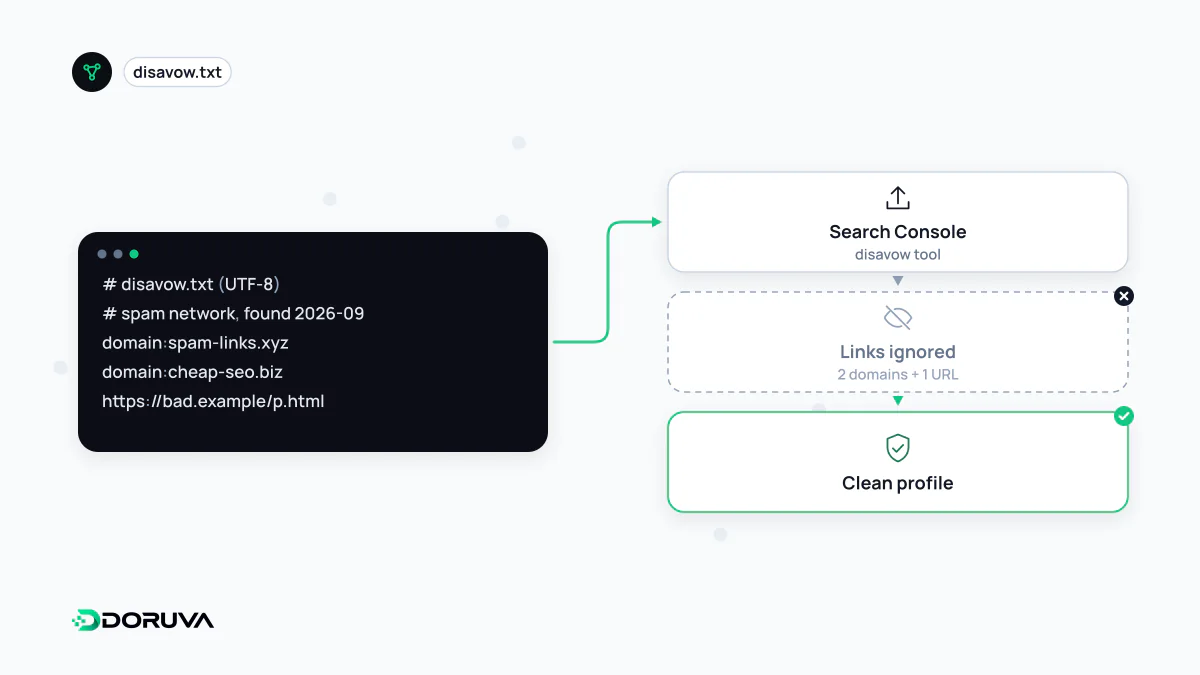
What disavowing does and does not do
A disavow file tells Google: ignore these links when evaluating my site. It does not delete anything; the linking page stays where it is. The Links report in Search Console also keeps showing disavowed links, so seeing them there does not mean the file failed. Google processes the list as it recrawls the web, and it can take a few weeks to take effect.
There is also a practical restriction: the tool does not support Domain properties, so the file must be uploaded through a URL-prefix property in Google Search Console. Each property holds one list, and uploading a new file replaces the old one entirely.
When it is warranted
Google's bar has two parts that must both be true: you have a considerable number of spammy, artificial or low-quality links pointing to your site, and those links have caused a manual action or are likely to. The classic case is a history of bought link packages, link networks or press releases stuffed with optimised anchors, followed by an "Unnatural links to your site" action in Search Console.
Outside that scenario, Google says it can generally work out which links to trust on its own, and most sites will not need the tool. Every site collects odd links from scrapers, auto-generated directories and domains nobody recognises; on their own they are not a reason to disavow. "Toxicity" scores from third-party tools are vendor estimates, not Google signals.
File format and limits
Use a plain .txt file encoded in UTF-8 or 7-bit ASCII, one URL or one domain: entry per line, with # for comments:
# 2025 paid link campaign - removal requests unanswered
domain:spammy-directory.example
domain:network-blog-1.example

# A single sponsored post; the rest of the site is fine
https://news.example.net/promo/product-review-12- up to 100,000 lines, including blank and comment lines, and 2 MB,
- a maximum URL length of 2,048 characters,
- "Cancel disavowals" removes the whole list.
A sensible workflow
- Review the Links report and your own records to identify problem sources, especially paid, reciprocal or automatically created links.
- Try removal first: contact site owners, or ask them to qualify the links with
rel="sponsored". - Add what cannot be removed, at domain level where appropriate.
- If there is a manual action, document all of this in the reconsideration request. Google warns that disavowing everything without attempting removal may lead to rejection.
The cost of overusing it
Disavow is a last resort, not routine hygiene. Disavowing natural links because they "look suspicious" throws away link equity the site genuinely earned. Broad domain: lines deserve particular care, especially if they could catch reputable publications. For ongoing monitoring, unusual spikes in referring domains are a more useful signal than a reflex to disavow. Google keeps the current rules on its disavow help page.