

What is External Link?
Definition
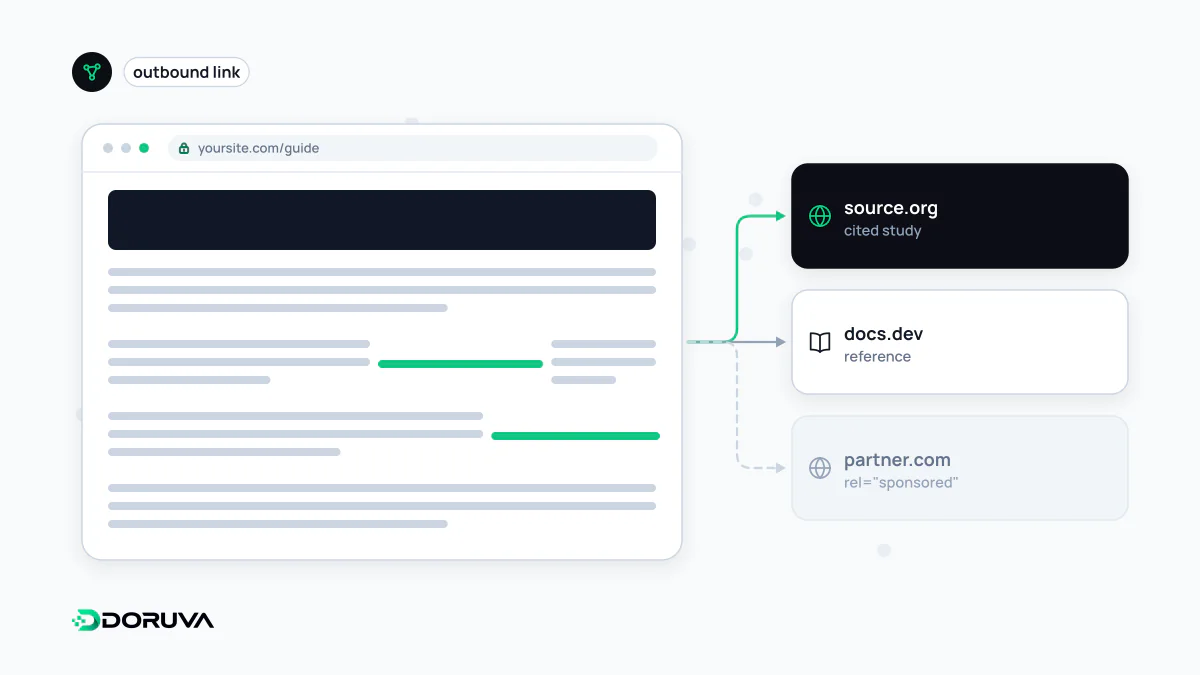
An external link is a hyperlink from a page on one site to a page on a different domain. For the linking site it is an outbound link; for the site receiving it, the same link is a backlink. External links are used to cite sources, point readers to deeper information and make claims verifiable, while paid, user-generated or untrusted links are qualified with rel attribute values.
Also known as: outbound link, outgoing link, external hyperlink, outlink
Linking out is not a loss
For years a common SEO belief held that linking to other sites "leaks" value. Google's own linking guidance says the opposite: linking to other sites isn't something to be scared of, and citing your sources can help establish trustworthiness. Linking a statistic, a regulation or a study to its primary source lets readers verify the claim themselves, which fits the trust dimension of E-E-A-T.
The same guidance asks you to give readers context about what they will find. A sentence naming the source and what it contains is more useful to people and to search engines than a link on the word "here".
Qualifying the relationship with rel
Not every outbound link means the same thing. Google asks site owners to describe the relationship with three rel values on the a element:
| Value | Use it for |
|---|---|
sponsored | Ads, sponsorships and any link given in exchange for compensation |
ugc | Links added by users, such as comments and forum posts |
nofollow | Other cases where you'd rather not associate your site with the target |
<a href="https://example-brand.com/" rel="sponsored">Example Brand</a>
<a href="https://member-site.example/" rel="ugc nofollow">Member's site</a>
Several values can be combined, separated by spaces. Since 2019 Google has treated these values as hints about how to consider a link rather than strict directives. Leaving a paid link unqualified, on the other hand, is listed as link spam in Google's spam policies.
Should every outbound link be nofollow?
No. Some sites automatically add nofollow to every external link just in case. Google's advice is different: use nofollow when you don't trust the source, not for every external link on your site. A normal link to a source you chose editorially is part of how the web is supposed to work, and it can pass link equity to the target. It takes nothing away from your own pages.
Opening in a new tab, and the opener issue
Opening external links in a new tab with target="_blank" is a usability choice with no SEO effect. It used to carry a security risk: the newly opened page could use window.opener to navigate the original tab elsewhere, which is why adding rel="noopener" was recommended. Current browsers apply noopener behaviour to target="_blank" links by default, though writing it explicitly does no harm.
Keeping outbound links healthy
External links point to pages you don't control, and over time those pages break, redirect or change. A cited page that has turned into an unrelated site can look worse than a broken link. For long-lived content, check outbound links periodically, replace dead ones with current sources and remove links to domains that have changed hands. Google's rules and examples are in its documentation on qualifying outbound links.