

What is People Also Ask?
Definition
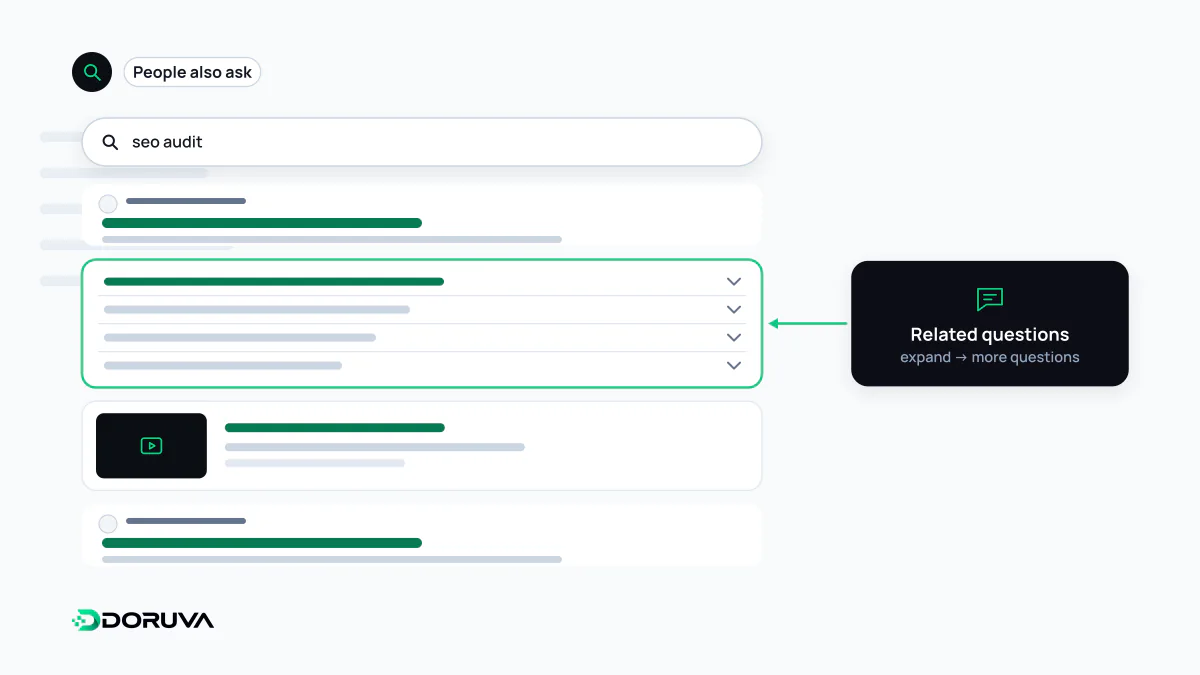
People Also Ask (PAA) is a Google search results feature that shows questions related to the original query as an expandable list; Google calls it a related questions group. Expanding a question reveals a featured snippet taken from a web page, with a link to the source. The questions are generated automatically, and site owners cannot control which ones appear.
Also known as: PAA, PAA box, related questions, related questions group
How the box behaves
In its visual elements gallery, Google files this box under exploration features and calls it a related questions group: a cluster of questions related to what the user originally searched for.
Each question starts collapsed. Expanding it reveals a featured snippet taken from a web page, together with a link to that page. In practice, opening one question often adds further questions to the list, leading the searcher deeper into subtopics. Google says plainly that site owners cannot control what shows up there, while noting that the related questions can be a useful source of topic ideas.
Becoming the answer
Because the expanded answer is a featured snippet, the requirements are the same: the page must be indexed, must allow snippets, and must contain a passage that answers the question directly and makes sense on its own. The writing principles that apply to a featured snippet carry over: put the question in a heading and answer it in the first sentence underneath.
A common mix-up is to connect PAA with FAQ markup. FAQPage markup powered a separate rich result, which Google stopped showing in May 2026. The People Also Ask box was never a feature triggered by a schema type.
Using it for content research
The lasting value of PAA lies in what it reveals about the questions surrounding a topic. A search for "boiler service" might surface questions like these, each pointing to a different content decision:
| Question in PAA | What it signals | Content decision |
|---|---|---|
| How often should a boiler be serviced? | Timing concern | A short, direct answer section on the main page |
| How long does a boiler service take? | Practical planning | Add to the process section |
| What happens if you don't service a boiler? | Risk, pre-purchase research | A dedicated section or a related article |
| Is a landlord required to service the boiler? | A specific audience with its own rules | A separate page for that audience |
Questions like these show how search intent branches out and can expose points competitors leave unanswered, in other words a content gap. Creating a separate page for every question is usually a mistake, though: many short, near-identical pages produce thin content and compete with one another for the same queries.
Limits and misreadings
- The questions vary by device, location, language and time; a list you saw once is not a fixed fact.
- A question appearing in PAA says nothing about its search volume.
- PAA datasets in third-party tools come from their own scraping, not from Google.
- AI-assisted search applies a similar idea at a larger scale. Google explains that AI Overviews and AI Mode may run several related searches across subtopics while building an answer, an approach known as query fan-out, which is one more reason content that covers the surrounding questions holds up well.