

What is Source Authority?
Definition
Source authority is the degree to which a website, author or document is recognized as a trustworthy and competent source on a particular topic. Search engines and AI answer systems do not assess it with a single score but through a combination of signals such as links, mentions in other sources, original content, author expertise and consistency over time. Authority is topic-specific: a site strong in one field can be weak in another.
Also known as: authoritative source, source credibility, source trustworthiness
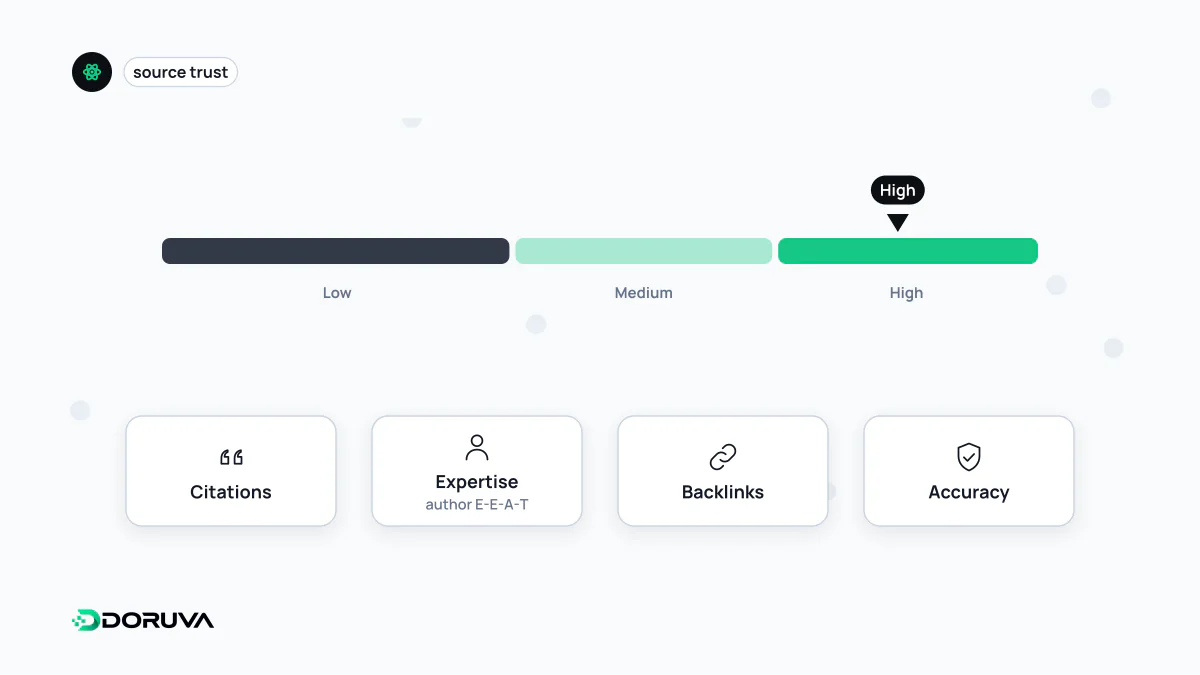
A bundle of signals, not a number
“Authority” sounds like a score, yet neither Google nor the major AI providers assign websites a public authority number. Google's guide to its ranking systems names several systems that touch on it: reliable information systems that try to surface more authoritative pages and demote low-quality content, link analysis systems and PageRank that use how pages link to each other, and original content systems meant to show original reporting ahead of pages that merely cite it.
Google's guidance on helpful content points the same way. E-E-A-T is not itself a specific ranking factor; Google's systems use a mix of factors that identify content with good E-E-A-T, and of its four parts trust matters most. For YMYL topics, those that could significantly affect health, financial stability or safety, these signals carry even more weight.
Three levels that get blurred together
- Publisher: the overall standing of an organization or site. A regulator's page on a regulation starts from a stronger position than an anonymous blog explaining the same rule.
- Topic: a site is strong where it has covered a field in depth for a long time. A software company's blog may be trusted on databases while carrying no weight on medical advice. That dimension has its own entry as topical authority.
- Document and author: on the same site, a page built on primary data and signed by a named expert is judged differently from an unsourced roundup.
Reading third-party scores
Domain Authority, Domain Rating and similar figures in SEO tools are estimates computed by those vendors from their own link data. They are not Google signals; Google neither computes them nor documents any use of them. They can be handy for a rough comparison with competitors, but chasing them as a goal pulls effort in the wrong direction: low-quality links bought to lift a score add nothing to real authority and can run into spam policies.
How authority accumulates
- Original contribution: your own measurements, case data and documented experience. Information other people want to quote is the most durable source of authority.
- Others citing you: natural backlinks from relevant sites and unlinked brand mentions are outside confirmation of the expertise you claim.
- Visible identity: author names and credentials, organization details, contact information and a corrections policy.
- Consistency and upkeep: publishing accurate, current and corrected content in the same field over years.
Authority inside AI answers
Answer systems do not explain how they weigh authority when choosing sources. What can be observed is that sensitive topics tend to draw on public institutions, academic publications and established publishers, while narrow technical questions are often answered from a small site focused on exactly that subject, because authority does not substitute for relevance. A strong domain that does not actually answer the question has no automatic claim to beat a specialist page that does.