

What is Indexability?
Definition
Indexability describes whether a page is eligible to be added to a search engine's index. An indexable page can be crawled, returns a 200 status code, carries no noindex rule, declares itself as canonical, produces readable content when rendered and offers distinct value. Meeting these conditions does not guarantee indexing; it removes the technical and content barriers in its way.
Also known as: indexable page, index eligibility, page indexability
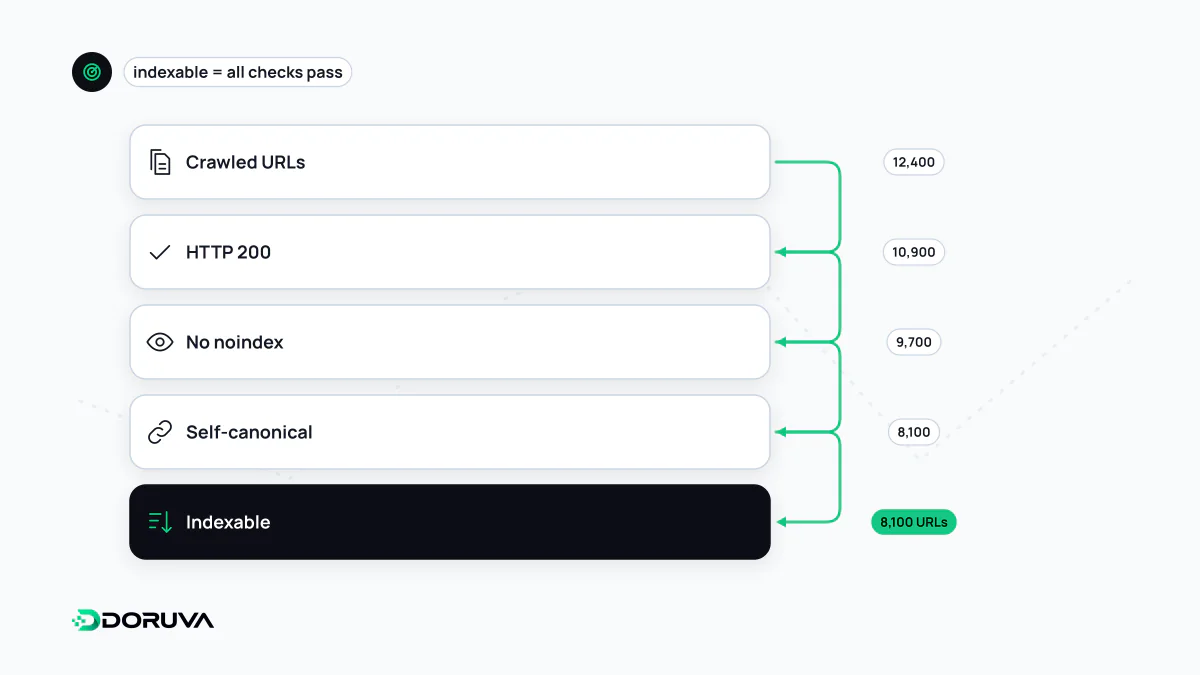
Eligibility is not the outcome
Indexing is a search engine actually storing a page in its index. Indexability is the set of preconditions a page must meet before that decision can even be made. Google states plainly that meeting its technical requirements does not guarantee indexing. So treat indexability as a pass/fail checklist: if any item fails, the page is out of the running; if all pass, it becomes a candidate, and the rest depends on the value of its content.
The six conditions
- Crawlable. Robots.txt does not block it, and the server and security layer let the bot in. A blocked page's content cannot be read, so crawlability comes first.
- Returns 200. The URL itself answers
200 OK. A redirecting URL hands its place to the target; 4xx and 5xx responses hand it to nothing. - No noindex. Neither the
<meta name="robots">tag nor anX-Robots-Tagheader carries noindex. Check both, because a header rule never shows up in the page source. - Self-referencing canonical. The page's canonical URL points to itself, or there is none. A page whose canonical points elsewhere is asking for that other URL to be indexed instead.
- Renderable content. The main text really appears once the page is rendered, rather than an empty shell left behind by a failing script.
- A real page with distinct value. The content is not an error message such as "product not found", not a copy of another page, and not thin content. Pages that look like error pages while returning 200 are treated as soft 404s.
What Search Console reports when a condition fails
The Page indexing report groups non-indexed URLs by reason. The most common mappings are:
| Failed condition | Typical reason in the report |
|---|---|
| Crawlable | URL blocked by robots.txt |
| Returns 200 | Not found (404), Server error (5xx), Page with redirect |
| No noindex | URL marked 'noindex' |
| Canonical | Alternate page with proper canonical tag; Duplicate, Google chose different canonical than user |
| Real page | Soft 404 |
| Value and priority | Crawled - currently not indexed |
The last row deserves attention: a page that is "Crawled - currently not indexed" may well pass every technical check. In that case the cause usually lies in the content itself or in how much weight the site gives the page.
Not every page should be indexable
Indexability is a decision, not a target. Cart, account and internal search pages are deliberately kept out. On a healthy site, the list of indexable pages and the URLs in the XML sitemap match almost one to one. A sitemap that lists noindexed, redirecting or canonicalized-away URLs is sending search engines a message that contradicts itself.
Checking at scale
For a single URL, URL Inspection in Search Console is enough. Across a site you need to crawl the pages and see status code, robots rules, canonical target and content length side by side. The SEO Checker reports these signals and the conflicts between them on a sample of pages. Google's minimum conditions are listed in its technical requirements.