

What is Local SEO?
Definition
Local SEO is the work of making a business with a physical location, or one that serves a defined area, more visible in location-based searches and map results. It covers a complete and accurate Google Business Profile, location pages on the website, consistent name, address and phone details, customer reviews and links or mentions from local sources.
Also known as: local search optimization, local search engine optimization, Google Maps SEO, map pack SEO
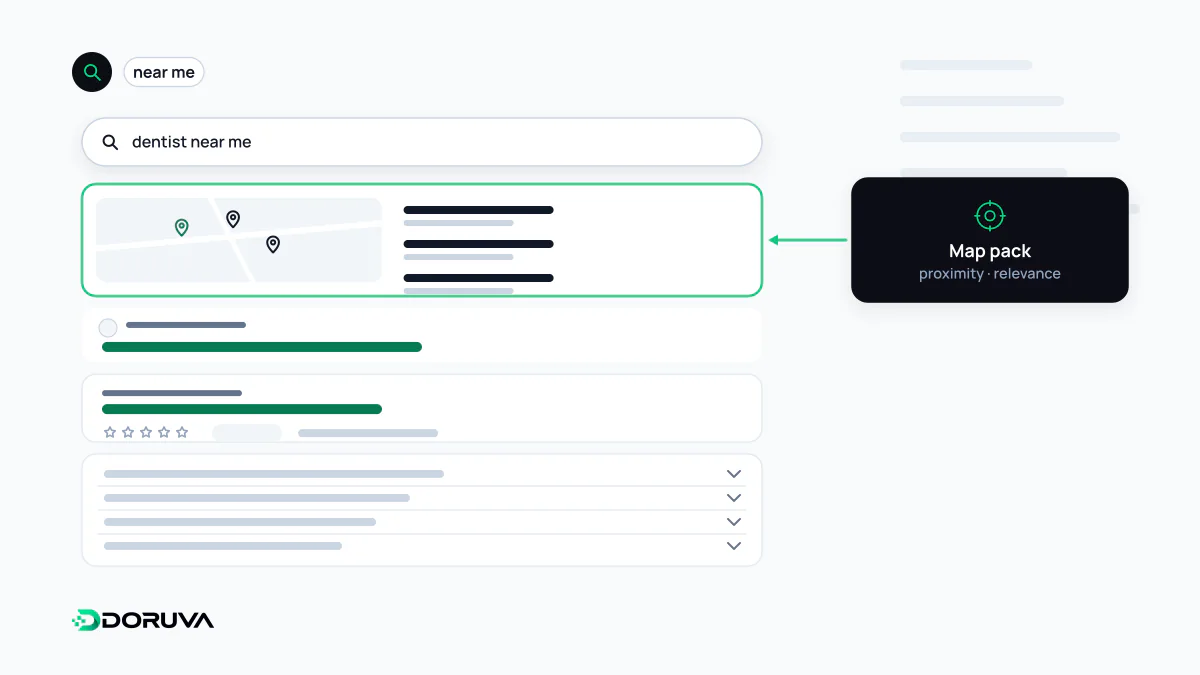
How local results differ
For queries with local intent, such as "emergency plumber", "hairdresser near me" or "dentist Shoreditch", Google often shows a map with a short list of businesses. Those listings are drawn from Google Business Profile records rather than web pages, while ordinary organic results continue below. Local SEO works on both at once: the business listing on the map and the location-specific pages of the website.
Plenty of queries are treated as local without the words "near me". Someone typing "pharmacy" plainly does not want one in another city.
The three factors Google names
In its Business Profile help pages, Google says local results are mainly based on three factors:
| Factor | What it means | What you can influence |
|---|---|---|
| Relevance | How well a profile matches what someone searched for | The right category, complete services and products, a clear description |
| Distance | How far the business is from the searcher; if no location is shared, Google uses what it knows about their location | Very little |
| Prominence | How well known the business is, including links to it from other sites and its review count and ratings | Reviews, local press, links, real-world reputation |
The same page states that there is no way to request or pay for a better local ranking. Google's explanation is on its local ranking help page.
Work on the website
- Real location pages: one page per branch with the address, opening hours, directions, the services offered there and the people who work there.
- Consistent contact details: the business name, address and phone number (NAP) written identically on the site, the profile and directories.
- Structured data:
LocalBusinessmarkup, or one of its more specific subtypes, on each location page. - Local sources: mentions and links from local news sites, trade associations, sponsorships and event listings.
{
  "@context": "https://schema.org",
  "@type": "Dentist",
  "name": "Example Dental Practice",
  "address": {
    "@type": "PostalAddress",
    "streetAddress": "12 Curtain Road",
    "addressLocality": "London",
    "postalCode": "EC2A 3AA",
    "addressCountry": "GB"
  },
  "telephone": "+44 20 0000 0000",
  "openingHours": "Mo-Fr 09:00-18:00"
}
The markup has to match what visitors can see on the page. Structured data describes visible content; it does not stand in for it.
Mistakes that get profiles suspended
Google's Business Profile guidelines prohibit several common shortcuts, and breaking them can lead to suspension:
- Adding taglines, keywords, store codes or phone numbers to the business name ("Example Dental – Best Implants London").
- Using a virtual office or mailbox address where customers are not received.
- Creating more than one profile for the same location.
The website has its own version of this trap: dozens of pages that are identical except for the town name. Google's spam policies list pages targeted at specific regions or cities that funnel users to one page as an example of doorway abuse.
Measuring local performance
The Business Profile performance view shows the searches a profile appeared for, direction requests, calls and website clicks. Search Console shows which local queries bring impressions to your location pages. Because distance shapes the results, a rank check from a single spot says little; the grid-style maps produced by third-party tools are their own estimates, not Google data.