

What is Google Business Profile?
Definition
Google Business Profile is a free profile through which a business manages the name, address, phone number, opening hours, categories, photos and reviews shown in Google Search and Google Maps. It was formerly called Google My Business. It is the main data source behind the map-based local pack in local searches and behind business listings in Maps, and a business must be verified before it can manage the information.
Also known as: Google My Business, GMB, GBP, Google Business listing, local pack
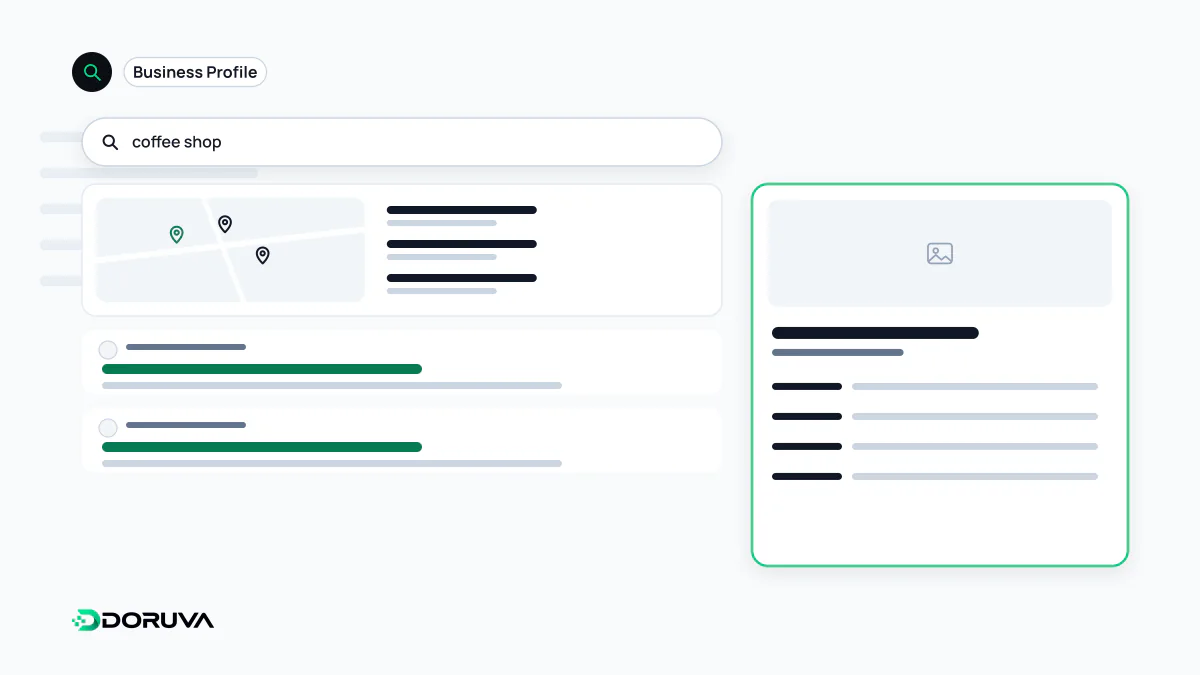
Where the profile shows up
Search for something with local intent, such as "emergency plumber near me" or "dentist Camden", and Google often puts a map with a short list of businesses above the regular results. That block, usually called the local pack, is fed by Business Profile data. The same profile powers the listing in Google Maps and the business panel that appears when someone searches for the brand by name. Many people get the phone number, directions or opening hours without ever visiting the website, which is why the profile sits at the center of local SEO.
The product dropped the Google My Business name in 2021. Single-location businesses now manage their profile directly from Google Search and Maps, while multi-location brands have a separate management dashboard.
How local results are ranked
Google describes three main factors:
- Relevance: how well a profile matches what someone searched for. The primary category and complete service details carry a lot of weight here.
- Distance: how far the business is from the searcher, or from the location named in the query.
- Prominence: how well known the business is, which includes links on the web, the number of reviews and ratings.
Google is explicit that there is no way to request or pay for a better local ranking. What you control is complete and accurate information, responding to reviews and earning genuine ones. Distance you cannot change, so expecting a single profile to top results across an entire city is not realistic.
The guidelines businesses break most often
Google's guidelines for representing a business are detailed. The problems that come up most in practice:
- Keyword-stuffed names. The name should match the real-world name used consistently on the storefront, website and stationery. Taglines, city names, opening hours and phone numbers don't belong in it.
- Virtual offices and mailboxes. P.O. boxes and rented addresses the business does not operate from are not eligible. An office in a co-working space qualifies only with clear signage, customers received during business hours and the business's own staff on site.
- Showing an address as a service-area business. A plumber working from home should hide the address and set a service area instead.
- Call-center numbers. Use a local number that reaches the specific location whenever possible.
- Category sprawl. Categories should complete the sentence "This business IS a…", not list every service offered.
Verification
A business has to be verified before it can edit its information or interact with customers. Google decides which methods are available based on the business type and location; they can include phone or text, email, a recorded video, a live video call and a code sent by post. Google notes that verification reviews can take up to five business days.
Connecting the profile to your website
The profile is not an island. When the name, address and phone number match the contact page, directories and social accounts, a principle known as NAP consistency, it is easier for systems to tie these records to the same business. LocalBusiness structured data on the site repeats the same facts in machine-readable form; Google requires the name and address properties for it. When you move, change numbers or close for a holiday, update the profile first and the site straight after, so stale details don't circulate for months.