

What is NAP (Name, Address, Phone)?
Definition
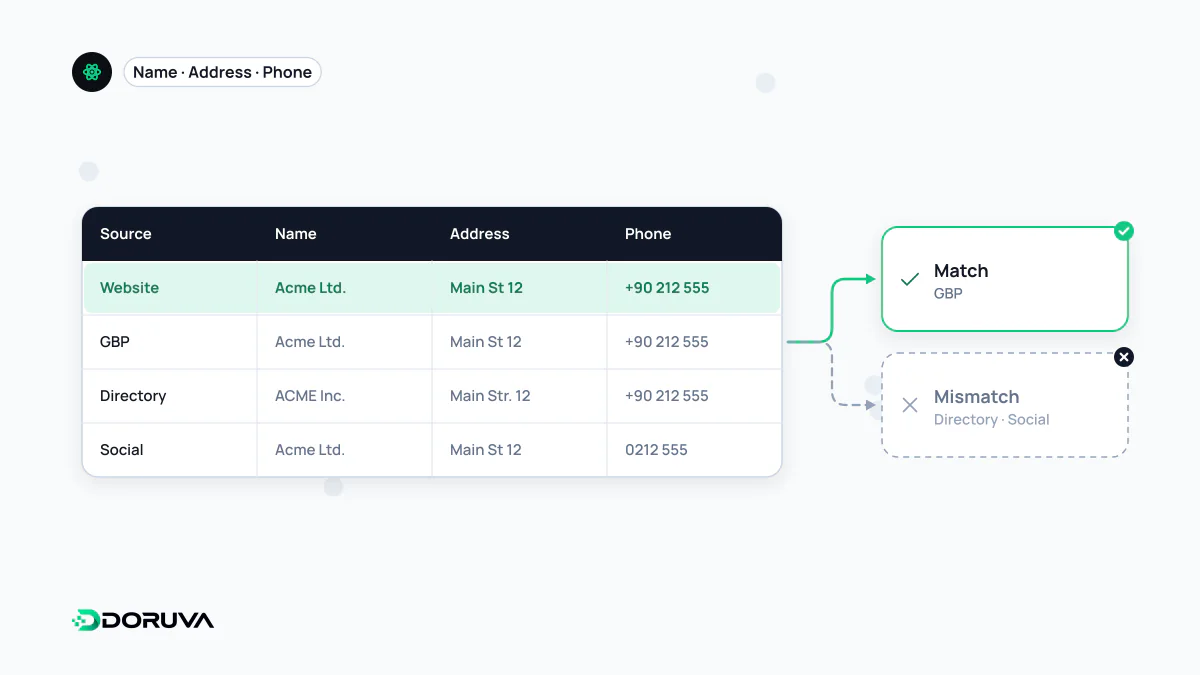
NAP stands for Name, Address, Phone and refers to keeping these core business details identical across the website, Google Business Profile, directories and social profiles. A mention of a business's NAP details on another website is called a local citation. Consistent NAP data makes it easier for search engines and AI systems to recognize the business as one accurate record rather than several conflicting ones.
Also known as: NAP consistency, NAPW, local citation, citation consistency
Why consistency matters
Information about a business lives in dozens of places: the website, its Google Business Profile, map apps, industry directories, social accounts and local news sites. A system reading those records has to decide whether they all describe the same business, and name, address and phone number are the strongest clues it has.
If one source shows the old address, another a new phone number and a third an abbreviated legal name, matching them gets harder, and one business can end up looking like two. The same problem leaks into AI answers, which may repeat the pre-move address from a forgotten directory listing. How systems pick the right record is covered under entity disambiguation.
What counts as a local citation
Any appearance of a business's NAP details on another website is a local citation. There are two broad kinds:
- Structured citations: directories, map services, industry listings and trade association registers with dedicated fields for each detail.
- Unstructured citations: a news story, blog post or event page that mentions the business together with its address or phone number.
A citation doesn't need a link, which is what separates it from a backlink. Unlinked mentions in general fall under the wider idea of a brand mention. Google says prominence in local results takes into account links and reviews from across the web; it has not said that the number of citations is a ranking factor in its own right. The real value of citations is that correct information is the same everywhere.
Pick one canonical format
Most inconsistencies are formatting drift rather than wrong facts: "Street" versus "St.", a suite number written three ways, a phone number with and without the country code. Decide on one version and use it everywhere:
| Field | Chosen format | Variants to retire |
|---|---|---|
| Name | Northside Dental | Northside Dental Care Ltd (keep for legal documents) |
| Address | Unit 4, 12 Mill Lane, Leeds LS1 4AB | 12 Mill Ln #4, Leeds; Mill Lane 12, Unit Four |
| Phone | +44 113 000 0000 | 0113 000 0000; 113-000-0000 |
If the registered company name differs from the name on the sign, use the name customers know as your NAP name and keep the legal name for legal text. Some teams add the website URL and call the set NAPW.
Making NAP machine-readable
Besides visible text on the contact page, the same details can be expressed as LocalBusiness markup in JSON-LD. The values must match what the page says, character for character:
{
  "@context": "https://schema.org",
  "@type": "Dentist",
  "name": "Northside Dental",
  "address": {
    "@type": "PostalAddress",
    "streetAddress": "Unit 4, 12 Mill Lane",
    "addressLocality": "Leeds",
    "postalCode": "LS1 4AB",
    "addressCountry": "GB"
  },
  "telephone": "+44 113 000 0000",
  "url": "https://www.example.com/"
}
Running a NAP audit
- Search for the business name and the phone number to list the places where the business appears.
- Compare each source with the canonical format; flag old addresses and disconnected numbers.
- Fix records at the source, and use each platform's correction process for listings you don't control.
- Repeat the check after any move or number change. Stale details tend to survive longest in the least-visited directories.