

What is Meta Title (Title Tag)?
Definition
A meta title is the text in a web page's title element, inside the HTML head. It appears in the browser tab, in bookmarks and usually as the clickable headline of a search result. Strictly speaking it is not a meta tag, but the industry calls it one. Google builds most result headlines from it, yet may use other on-page sources when they describe the page better.
Also known as: title tag, title element, page title, SEO title
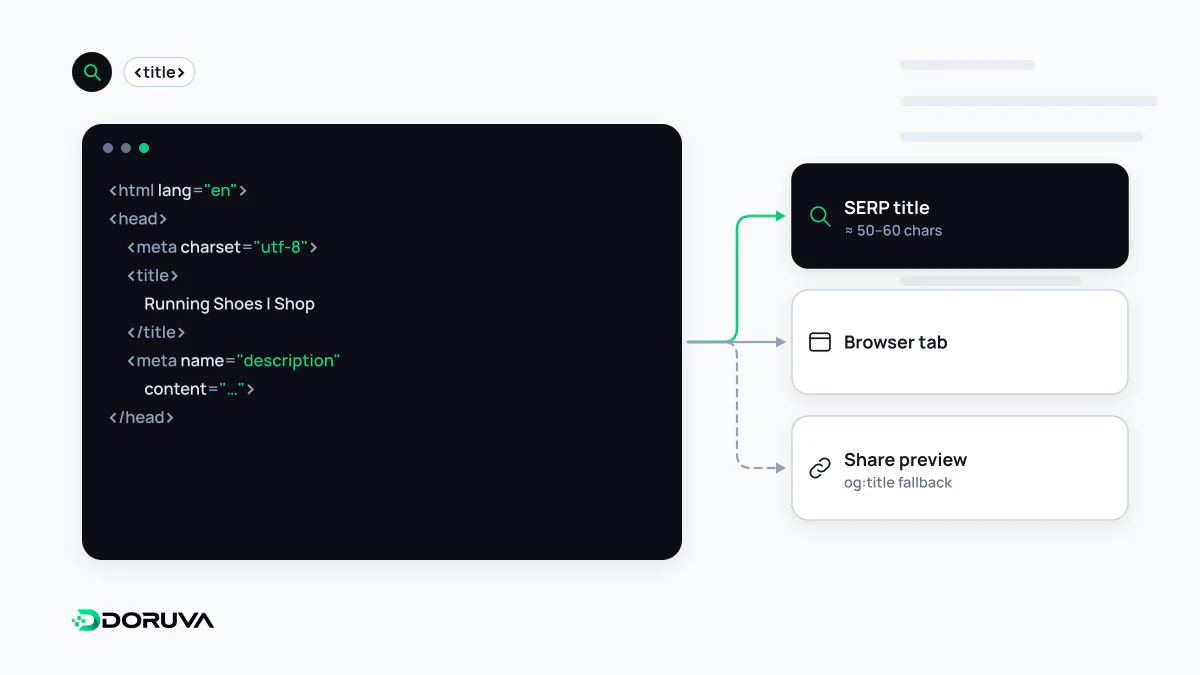
Called meta, but it isn't one
“Meta title” is a common label but technically inaccurate: the page title is not a <meta> tag but the <title> element in the <head>. Each page should have exactly one:
<head>
  <title>Women's Running Shoes | Example Sports</title>
</head>
The text shows up in browser tabs, bookmarks, some share previews (when no Open Graph title is set) and, most visibly, as the blue headline on the search results page. It is the first thing people read when choosing between results.
Why Google rewrites titles
Google calls the headline it displays a “title link” and generates it automatically. Its documentation lists the <title> element as the main source, but it can also draw on the main visual title, heading elements, og:title, prominent text, anchor text pointing to the page and the site name. Rewrites are most likely when the title:
- is missing, or is boilerplate repeated across pages (“Home”, “Product”)
- is stuffed with keywords
- no longer matches the content, such as last year's date
- runs long and buries the useful part at the end
There is no setting to opt out. The only lever is writing a title so clear and accurate that Google has no reason to replace it.
How long should it be?
Google publishes no character limit; it truncates titles that do not fit the device width. The widely quoted 50–60 characters is an industry rule of thumb for avoiding truncation on desktop, not an official limit. Longer titles are allowed, only the end may be cut, so putting the distinctive part first matters more than the exact length.
What a good title looks like
| Weak | Better |
|---|---|
| Home | Example Sports: Running and Outdoor Shoes |
| Shoes, running shoes, cheap shoes, best shoes | Women's Running Shoes and Prices | Example Sports |
| Blog Post 42 | How to Choose Your Running Shoe Size |
- Unique per page. Dozens of pages sharing one title are hard for people and search engines to tell apart.
- Honest about the page. The title is a promise to the user's search intent; the content must keep it.
- Brand once, with a separator. Usually at the end, after
|or-. - Consistent with the H1. They need not match word for word, but they should describe the same thing.
Searchers read the title together with the meta description, so it pays to plan the two as a pair.
How to check it
Look at the <title> in the page source and use a site crawler to list duplicates. To see what Google actually displays, run a search that returns the page. Google's own guidance lives in its title link documentation.