

What is Meta Description?
Definition
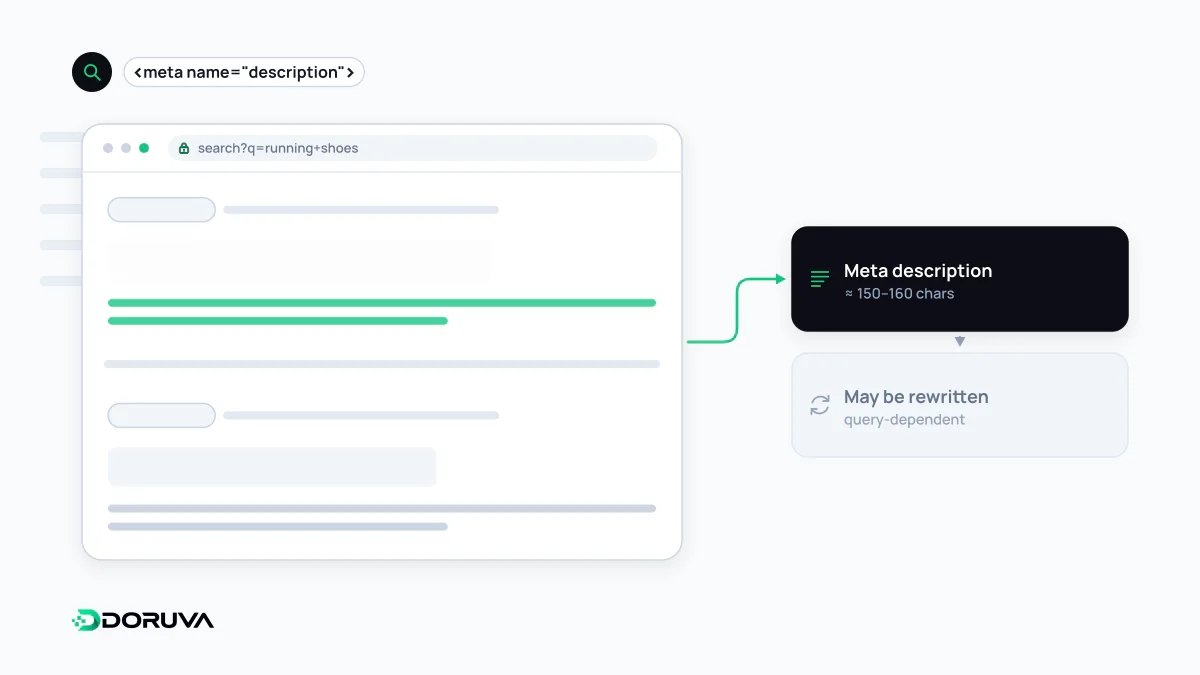
A meta description is the short summary of a page placed in a name=description meta tag in the HTML head. Search engines may use it as the snippet shown under a result, but they can also generate a snippet from the page text that better fits the query. Google has stated it does not use the meta description as a ranking factor; its effect is on how the result reads.
Also known as: meta description tag, description meta tag, page description, meta desc
The tag itself
A meta description is text visitors never see on the page but often see in search results:
<meta name="description" content="Size guide for women's running shoes, free exchanges and delivery in 2 business days. Over 40 models with customer reviews.">The one or two lines beneath a result's headline are called the snippet. Google generates snippets automatically, and the meta description is one of several sources it draws on.
No ranking effect, real visibility effect
Google has said plainly that it does not use the meta description in web ranking, so adding keywords to it will not move a page up. It still matters: on the results page it is often the text people read when deciding which result to click. A good description sets accurate expectations; a misleading one may earn a click and then lose the visitor straight away.
Why Google may ignore yours
Per Google's snippet documentation, the meta description is used when it gives a more accurate summary than text taken from the page. When a query relates to one specific part of the page, Google may prefer to quote that part instead. The same page can therefore show different snippets for different searches, which is intended behavior rather than a bug.
A description is more likely to be passed over when it:
- is shared by many pages across the site
- is a comma-separated list of keywords
- contradicts the page or contains stale details
- is empty
The length question
Google sets no character limit for meta descriptions; snippets are trimmed as needed to fit the device. The common target of roughly 150–160 characters is a convention for reducing truncation, nothing more. Leading with the most useful information matters more than hitting an exact count. If you want to measure a draft, the Word Counter shows character length.
Writing one that works
- Make it page-specific. Large sites can generate descriptions programmatically from page data such as product name, price range, author or date.
- Be concrete. Replace “the best products are here” with what the page actually contains.
- Answer the query. Consider the search intent: someone researching wants a summary, someone ready to buy wants price and delivery details.
- Pair it with the title. The meta title says what the page is; the description says why it is worth the click.
Controlling the snippet
To limit snippets, use the nosnippet or max-snippet:[number] rules in the robots meta tag, or mark a specific section with the data-nosnippet attribute. These restrict what Google may show; they cannot force it to display your description. Details are in Google's snippet documentation.