

What is SEO Audit?
Definition
An SEO audit is a systematic review that identifies what prevents a website from being found, understood and ranked by search engines. It checks layers such as crawlability and indexability, technical infrastructure, on-page elements, content quality, links and performance, and turns the findings into a fix list prioritised by impact.
Also known as: site audit, technical SEO audit, SEO health check, website SEO analysis
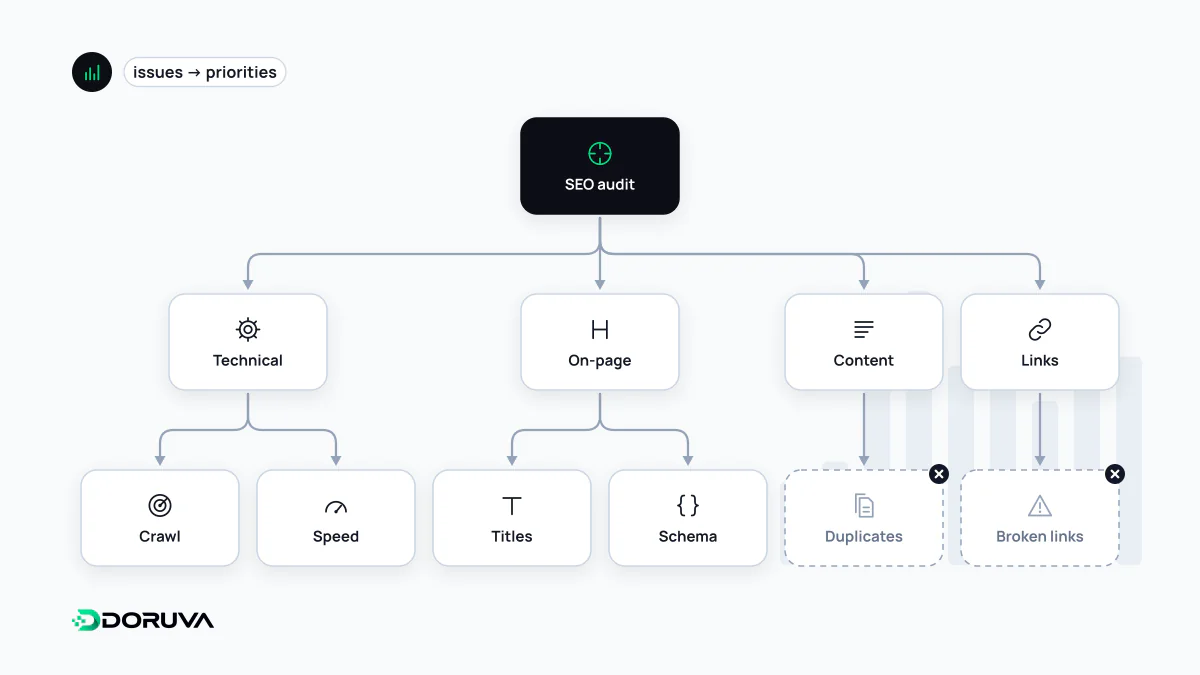
Audit in the order search engines work
A useful audit follows the sequence a search engine goes through with a page rather than a random checklist, because a problem at one stage makes later stages irrelevant. Polishing the title tag of a page that cannot be indexed achieves nothing.
| Layer | Typical checks |
|---|---|
| Access and crawling | robots.txt rules, server responses, redirect chains, internal link depth |
| Indexing | noindex, canonical targets, duplicate and thin pages, sitemap consistency |
| On-page | Titles and descriptions, heading hierarchy, alt text, structured data |
| Content | Fit with search intent, coverage gaps, cannibalisation, freshness |
| Links | Broken links, orphan pages, risks in the backlink profile |
| Experience and performance | Core Web Vitals, mobile rendering, HTTPS and mixed content |
| International and local | hreflang, language signals, consistent business details |
The first two rows, crawlability and indexability, are the backbone. Until they are sound, investment in content and links pays back only partially.
Where crawlers stop and judgement begins
Crawling tools visit thousands of URLs in minutes and catch anything measurable: missing tags, 404s, redirect chains, slow templates. They cannot tell you whether a page genuinely answers the query it targets, whether two categories compete for the same intent, or whether the information architecture reflects what the business actually sells. That takes a person.
A thorough audit therefore combines three data sources: crawler output, index and performance data from Google Search Console, and, where available, server logs. Log file analysis shows where Googlebot really spends its time, which on large sites closes the gap between assumption and fact.
Turning findings into a work queue
An audit is judged by its ordering, not by how many issues it lists. A hundred-line report that does not say what to fix first becomes a burden for the team. Three questions make prioritisation practical:
- Impact. How many pages, and how much traffic potential, does the issue touch? A bug that drops an entire product template from the index outranks a missing alt attribute on one post.
- Certainty. Has the finding been confirmed, or could it be a false positive from the tool?
- Cost. Is the fix a configuration change or a development sprint?
An audit never promises rankings. It removes obstacles that stop search engines from finding and understanding the site; how visible the site then becomes depends on competition, content quality and the intent behind each query.
When to run one
Full audits typically happen at the start of an engagement, before and after a site migration, after a redesign or platform change, and whenever traffic drops without an obvious cause. Between them, lighter recurring checks on the things that break most often (status codes, canonicals, noindex, broken links) are enough.
For a quick first pass, the SEO Checker samples up to 20 pages of your site, runs 139 checks across 13 categories and adds a mobile lab performance run. An automated pass like this surfaces technical and on-page issues on the sampled pages with evidence; Search Console data, the backlink profile and content strategy still need to be assessed separately.