

What is 404 Not Found?
Definition
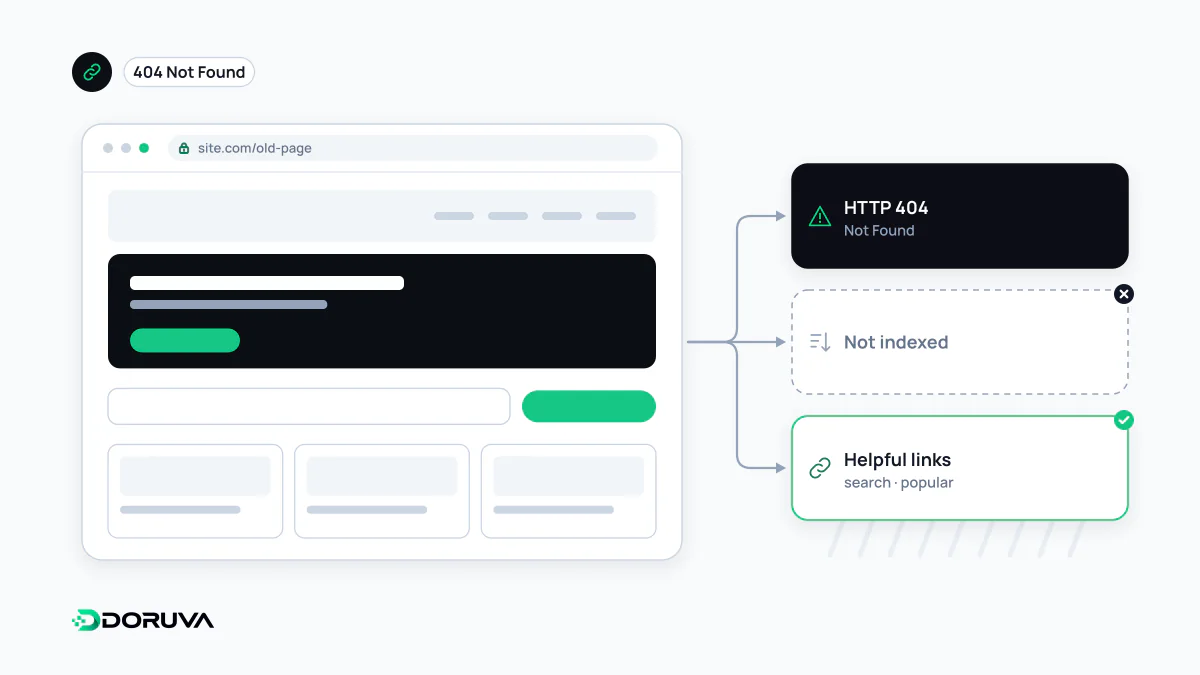
404 Not Found is the HTTP status code meaning the server found no current content for the requested URL, or is not willing to disclose that it exists. It does not say whether the condition is temporary or permanent. Google does not index URLs that return 404 and removes previously indexed ones; 404 responses have no effect on a site's crawl rate.
Also known as: 404 error, HTTP 404, page not found, not found error
404, soft 404 and 410 compared
| Response | What the server says | For search engines |
|---|---|---|
| 404 Not Found | Nothing here; I don't know if that is permanent | Not indexed; removed if previously indexed |
| 410 Gone | Removed on purpose, most likely for good | Google handles it the same as 404 |
| Soft 404 | The page says "not found" but the status is 200 | Google infers the error from the content and reports it in Search Console |
Per RFC 9110, a 404 says nothing about permanence; if the server knows the removal is permanent, 410 Gone is preferred. A soft 404 is not a status code at all but the result of a wrong one: an error message delivered with a success code.
Which 404s are actually a problem?
Mistyped URLs, paths invented by bots and content removed without a replacement should return 404. Google says these responses don't affect crawl rate, that newly encountered 404 pages aren't processed and that crawling of such URLs gradually decreases. Hundreds of 404s in Search Console are not, by themselves, a reason to panic.
The trouble starts when a 404 cuts off something valuable:
- Broken links from your own navigation, copy or sitemap.
- A page with backlinks from other sites deleted without a redirect even though an equivalent page exists; that case calls for a 301 to the closest match.
- Live pages suddenly returning 404 en masse after a release broke the routing or the redirect map.
A 404 page that helps
A good 404 page works like a signpost rather than a dead end: a short explanation, a site search box, links to the main sections and the most visited pages. But the page itself must always be served with status 404. In Nginx, error_page 404 /404.html; keeps the code; error_page 404 =200 /404.html; turns every missing URL into a 200 and manufactures soft 404s. Likewise, hosting a single-page application with a catch-all that serves index.html with 200 for every path makes missing pages look successful. Redirecting every deleted page to the homepage is no fix either; Google may treat such irrelevant redirects as soft 404s.
Finding 404s
Search Console's Page indexing report lists the 404s Google ran into, though it doesn't always show which page linked to them. Server logs show which URLs real visitors and bots hit with a 404, and log file analysis surfaces the most requested missing addresses. The SEO Checker tests whether your site answers a non-existent URL with a real 404 or a soft 404, and flags broken internal links.