

What is HTTP Status Code?
Definition
An HTTP status code is the three-digit number a server returns with every response to report the outcome of a request. The first digit gives the class: 2xx success, 3xx redirection, 4xx client error and 5xx server error. Search engines use these codes to decide whether to index a page, whether to follow a redirect and how fast to crawl a site.
Also known as: HTTP response code, status code, server response code
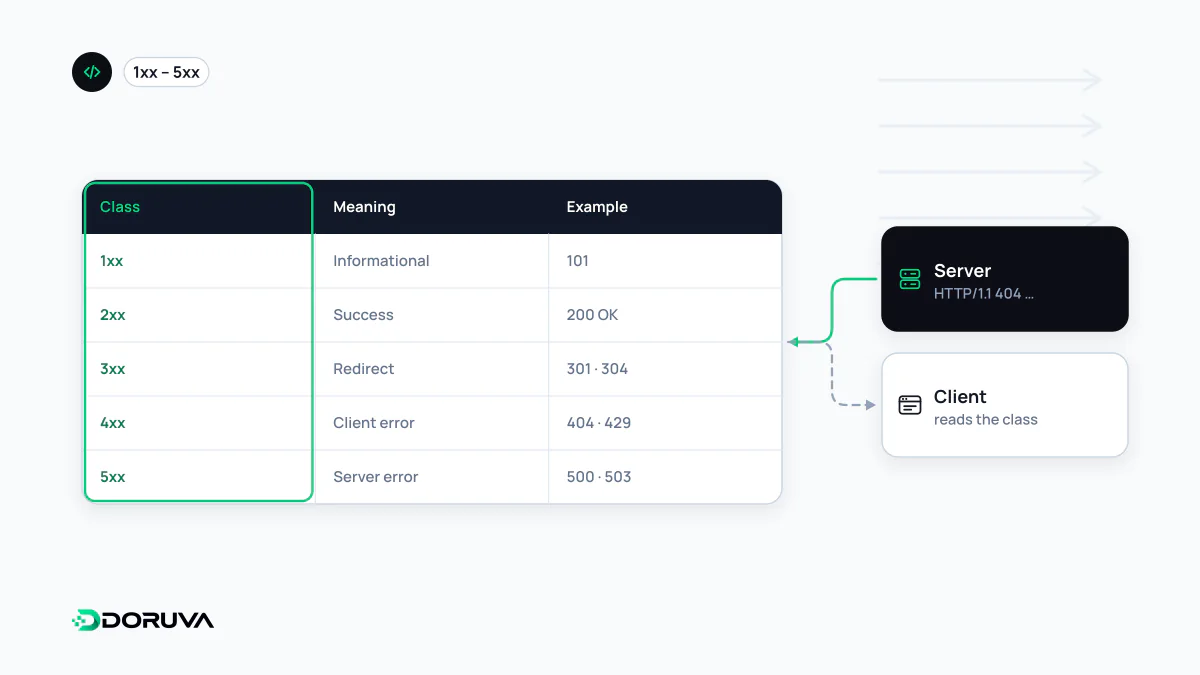
Five classes at a glance
When a browser or Googlebot requests a URL, the server returns a status line before any content. Users rarely see it, but for a search engine it is the first fact that decides what happens to the page.
HTTP/1.1 404 Not Found
Content-Type: text/html; charset=utf-8
Codes fall into five classes: 1xx informational, 2xx success, 3xx redirection, 4xx client error and 5xx server error. These are the ones that matter most for SEO.
Key codes and how Google treats them
| Code | Meaning | Google's handling |
|---|---|---|
| 200 OK | Request succeeded | Content is passed to indexing; indexing is not guaranteed |
| 301 Moved Permanently | Permanent move | Redirect is followed; strong signal that the target should be canonical |
| 302 Found | Temporarily elsewhere | Redirect is followed; weak signal, the old URL may stay indexed |
| 304 Not Modified | Unchanged since last crawl | Tells Google the content is the same; no effect on indexing |
| 404 Not Found | Not found | URL is eventually dropped from the index; no effect on crawl rate |
| 410 Gone | Permanently removed | Handled much like 404; states the removal intent explicitly |
| 429 Too Many Requests | Rate limited | Treated as a sign of overload and as a server error; crawling slows |
| 500 Internal Server Error | Server-side failure | Crawling slows temporarily; persistent errors can drop URLs from the index |
| 503 Service Unavailable | Temporarily unavailable | Same as 500; the right code for short maintenance windows |
4xx codes other than 429 have no effect on crawl rate. 5xx and 429 responses make Google slow down, which matters for crawl budget on large sites. By default, Google's crawlers follow up to 10 redirect hops.
Is a 404 bad?
No. Returning 404 for a page that genuinely does not exist is correct and does not harm the rest of the site. The problems are 404s in the wrong places: internal links pointing at broken URLs, a page with valuable backlinks deleted without a redirect, or the reverse, missing pages returning 200.
That last case is a soft 404: the page says "Product not found" while the server answers 200 OK. Google detects this and reports it in Search Console. Redirecting every deleted page to the homepage is often treated as a soft 404 too; if there is no relevant replacement, a 404 or 410 is the honest answer.
Maintenance and outages
Serving a "We're down for maintenance" page with status 200 risks that text being indexed. Return 503 instead, ideally with a Retry-After header. A 503 that lasts for days, however, puts URLs at risk of being dropped.
How to check
The Network tab in browser DevTools shows the status of every request; on the command line, curl -I https://example.com/page/ fetches headers only. The Page indexing report in Search Console groups 404s, soft 404s and server errors. Google's full handling of each code is documented on Google Search Central.