

What is Crawl Depth?
Definition
Crawl depth is the minimum number of clicks needed to reach a page from a site's starting point, usually the homepage, by following internal links. The homepage sits at depth 0 and pages it links to directly sit at depth 1. Deeper pages tend to be discovered and recrawled more slowly, which is why important pages are best kept within a shallow structure.
Also known as: click depth, page depth, link depth
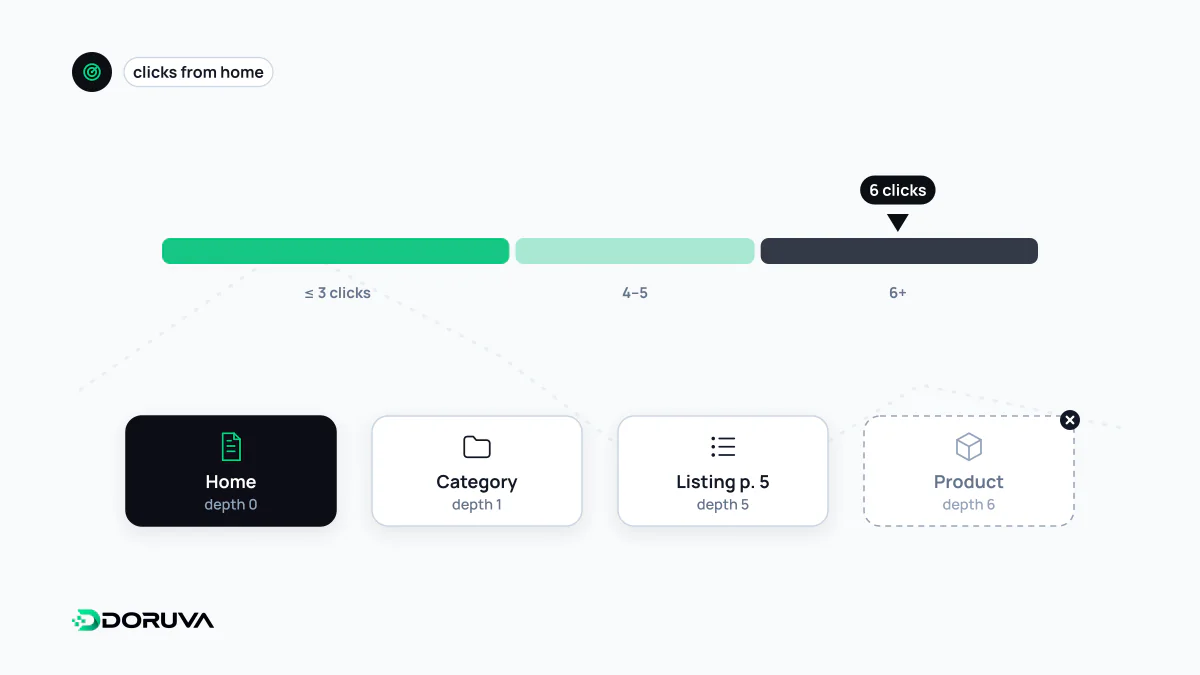
How depth is measured
A crawler starts at the homepage, follows its links and records the shortest path by which it first reaches each URL. The length of that path is the page's depth. A small example:
Homepage                                   depth 0
└── /blog/                                 depth 1
    └── /blog/page/2/                      depth 2
        └── /blog/page/3/                  depth 3
            └── /blog/an-old-post/         depth 4
If the homepage's "featured" block also links to that post, its depth drops to 1, because the measure always takes the shortest route. A URL with no internal links at all has no depth: it cannot be reached by following links. Crawl depth is not a metric Google reports. It is an indicator that crawling tools compute to assess site structure.
Click depth is not folder depth
/products/shoes/running/men/model-x/ has four directory levels, yet if a homepage banner links to it, its crawl depth is 1. Conversely, a short root-level URL such as /model-y/ that is only linked from page thirty of a listing is buried deep. What counts is the paths created by links, not the URL structure.
Why it matters
Pages close to the homepage usually collect more internal links, and crawlers revisit them more often. Deep pages require a crawler to follow a long chain all the way down, so a new product or an updated article can take longer to be noticed. On sites with millions of URLs this compounds into a crawl budget problem. Depth is also an indirect statement of importance: if a key page is five clicks away, your linking says something different from your priorities.
The popular "three clicks" rule is a rule of thumb, not a threshold Google has set. Depth 4 can be fine on a small site, while depth 3 on a large store may already cover thousands of pages.
Structures that push pages deeper
- Next-only pagination. Pagination that only links to the following page pushes the end of a long list dozens of clicks away.
- Chronological archives. On blogs, every new post nudges older ones one step further down.
- Filter-only paths. A product that only appears under one specific filter combination has a path that is both long and fragile.
- Disconnected sections. Retired categories and campaign pages dropped from the menu gradually become orphan pages.
Bringing important pages closer
- Build a broad but logical hierarchy of categories and subcategories; this is a direct outcome of information architecture decisions.
- In pagination, link to several pages ahead and to the last page, not only to "next".
- Open sideways paths with related-content blocks and breadcrumbs.
- Link pages that matter for revenue or traffic from the homepage or top-level categories.
An XML sitemap helps deep pages get discovered, but it does not change the link structure. The sitemap speeds up discovery; a page's position on the site and the internal links it receives are still decided by links alone.