

What is UX Research?
Definition
UX research is the systematic study of a product's intended users: who they are, what they need and how they actually behave when using a website or app. It combines qualitative and quantitative methods such as interviews, usability tests, surveys and analytics so that design decisions rest on observation and measurement rather than assumption, and problems are found before they become expensive to fix.
Also known as: user research, usability testing, design research, UXR
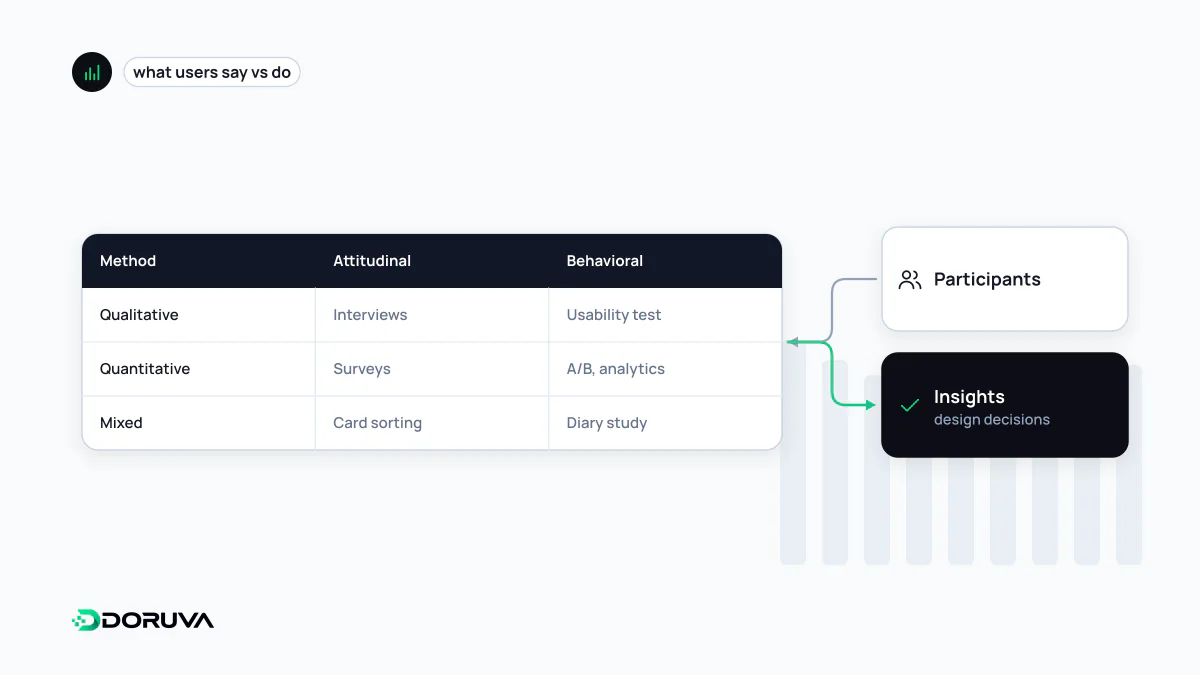
Matching the method to the question
Pick the method after you have written down the question. Two distinctions help: what people say versus what they do, and whether you need to know why something happens or how often. Interviews reveal motives but cannot measure behaviour; analytics measure behaviour but never explain it.
| Method | Question it answers | Type |
|---|---|---|
| User interviews | What job is the person trying to get done, and where do they get stuck today? | Qualitative, attitudinal |
| Usability testing | Can people complete a specific task with this interface, and where do they struggle? | Qualitative or quantitative, behavioural |
| Surveys | How widespread is an attitude or preference across the audience? | Quantitative, attitudinal |
| Analytics and heatmaps | Where do real visitors click, scroll and drop off? | Quantitative, behavioural |
| Card sorting, tree testing | Do our content groups and menu labels match how users think? | Mixed |
| A/B testing | Which of two versions moves the target metric more? | Quantitative, behavioural |
Strong research plans chain methods together. Analytics show that many people abandon the checkout; a handful of usability sessions show why (say, shipping costs appear only on the last step); measurement then confirms whether the fix worked.
Running a usability test
- Write tasks from real goals. Not "Click Services in the menu" but "Find out roughly what a company website would cost you." If the task wording repeats the interface labels, participants simply match words instead of navigating.
- Recruit the right people. Participants should resemble the actual audience. Colleagues and existing power users distort results; user personas can double as recruiting criteria.
- Ask them to think aloud, and do not rescue them. Helping a stuck participant hides exactly the problem the session was meant to find.
- Record observations, not opinions. "Looked for the pricing link three times, then scrolled to the footer" is an observation. "The pricing page is bad" is a conclusion that needs evidence.
- Rank issues by severity. Anything that blocks the task comes before things that merely annoy.
None of this requires a finished product. Testing a clickable prototype catches the same problems before any code exists, which is usually the cheapest moment to fix them.
How many participants?
It depends on what kind of study you are running. Nielsen Norman Group's well-known guidance for qualitative usability testing is to test with around five users from one user group, fix what you find, and test again. That advice assumes a fairly homogeneous group and repeated small rounds; it is not a claim that five people reveal everything. If the product serves clearly different groups, such as buyers and sellers, each group needs its own participants.
Once you are measuring a quantitative metric such as success rate or time on task, five is far too few. NN/g recommends roughly 40 participants for most quantitative studies, together with a calculated margin of error. Its older guideline for card sorting is 15 participants for most projects. Treat these as starting points: the sample for a survey or an A/B test should be calculated from the expected effect size and the error you can accept.
Habits that skew findings
- Leading questions. "Was that page easy to use?" invites a yes. "What were you looking for on that page?" leaves less of a fingerprint.
- Asking about future behaviour. Answers to "Would you use this feature?" predict real usage poorly. Ask what people did the last time they faced the problem.
- Reading a single number. A high bounce rate can also mean visitors found what they needed immediately. Quantitative data needs a qualitative finding next to it before it means much.
- Letting findings die in a report. Research pays off only when it changes UX design decisions and the backlog. A short, prioritised summary with evidence attached (clips, quotes) gets read; a forty-page deck rarely does.