

What is User Persona?
Definition
A user persona is a fictional but research-based profile that represents a typical or target user of a product or website. It describes that person's goals, the jobs they are trying to get done, how they decide, what worries them and the context they use the product in. Personas give design, content and development teams a shared, concrete picture of who they are building for; personas built on assumptions alone can steer a team in the wrong direction.
Also known as: persona, UX persona, design persona
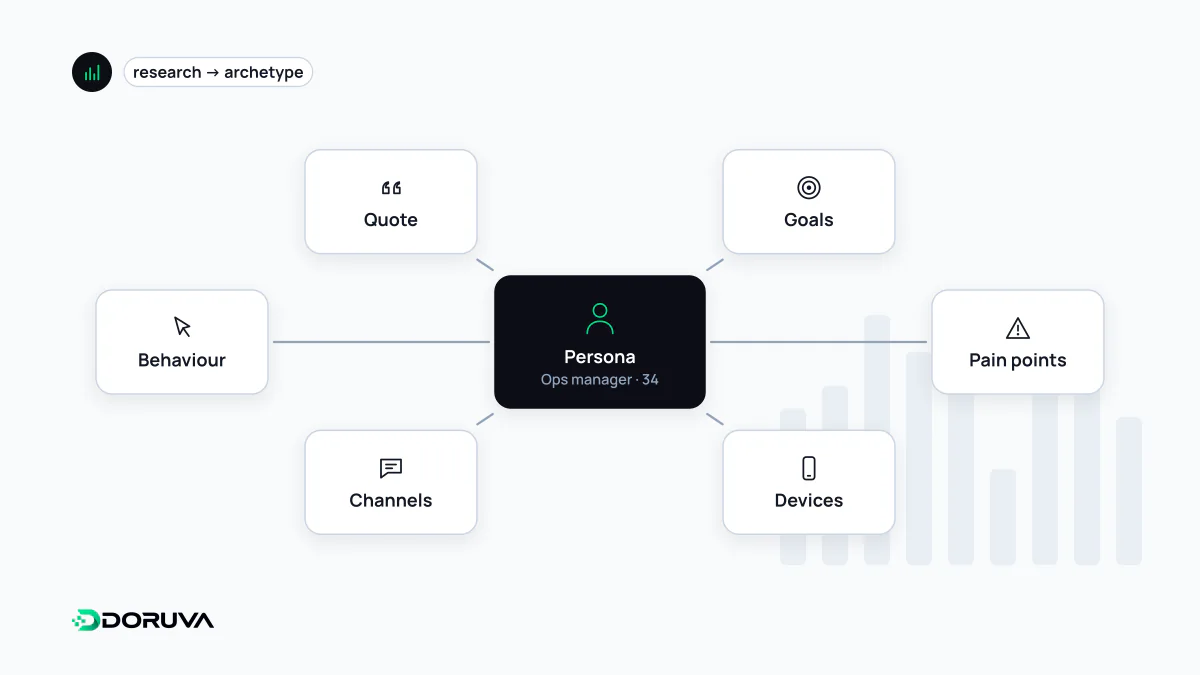
A made-up person built from real evidence
The name, photo and backstory of a persona are invented. The behaviors, needs and obstacles behind them should not be. Software designer Alan Cooper popularized the technique in the late 1990s to replace the word “user”, which every team member pictures differently, with one specific person everyone pictures the same way. “Users want this” invites endless debate; “If Elif can't find the lead time on this page, she leaves without requesting a quote” is a design problem you can solve.
Personas come out of UX research: interviews, field observation, surveys, support tickets, sales call notes and on-site search logs. Patterns that recur across participants are clustered, and each distinct pattern becomes a persona. Two to four are enough for most products. A deck of ten personas tends to have the same effect as having none.
What belongs in a persona
- Context: role, industry, devices and the situation in which they use the product.
- Goals: the task they come to complete, stated concretely (“compare lead times from three suppliers”), not vaguely (“get information”).
- Decision criteria: price, proof, technical documentation, speed.
- Barriers: what makes them give up, such as surprise costs, long forms or missing specs.
- Their own words: one or two quotes from research that stick in the team's memory.
Hobbies, favorite brands and age only earn a place if they change a decision. A useful test for every line: which design choice would be different without it?
A worked example
Elif, procurement specialist, 34. Works at a mid-sized manufacturer. Visits supplier sites on a desktop during working hours with a technical specification open next to the browser. Wants to find a matching part and request a quote the same day. If the product page has no dimension table or certificate, she closes the tab and tries a competitor. “If I have to phone to ask, the supplier is making my job harder.”
Even this short profile drives decisions: spec tables and downloadable datasheets move up on product pages, the quote form shrinks to a handful of fields, and the category structure and information architecture follow the vocabulary used in specifications rather than internal product names.
Proto-personas, buyer personas and segments
Teams without research budget sometimes write a proto-persona from internal assumptions. It can kick off a discussion, but it should be labeled as unvalidated and replaced once real user data arrives. Marketing's buyer persona focuses on who purchases and which message persuades them; a UX persona focuses on who uses the product and how. A demographic segment such as “25–34, urban” is not a persona at all, because people in the same segment arrive with completely different goals.
Turning personas into decisions
A persona only pays off when it is used. In prioritization, ask which persona and which goal a feature serves. In content planning, map the phrases a persona actually searches for and the search intent behind them. In journey mapping, the persona is the actor whose steps you trace through the user journey. And when results come in, revisit the profiles: a persona that has not been updated since launch slowly turns into fiction in the bad sense of the word.