

What is UTM Parameters?
Definition
UTM parameters are query-string tags added to a link's URL that tell analytics tools which source, medium and campaign a visitor came from. The five classic parameters are utm_source, utm_medium, utm_campaign, utm_term and utm_content; Google recommends always using the first three on campaign links. Values are case-sensitive, and UTMs belong only on inbound links from outside the site, never on internal links.
Also known as: UTM codes, UTM tags, campaign parameters, UTM tracking, utm_source
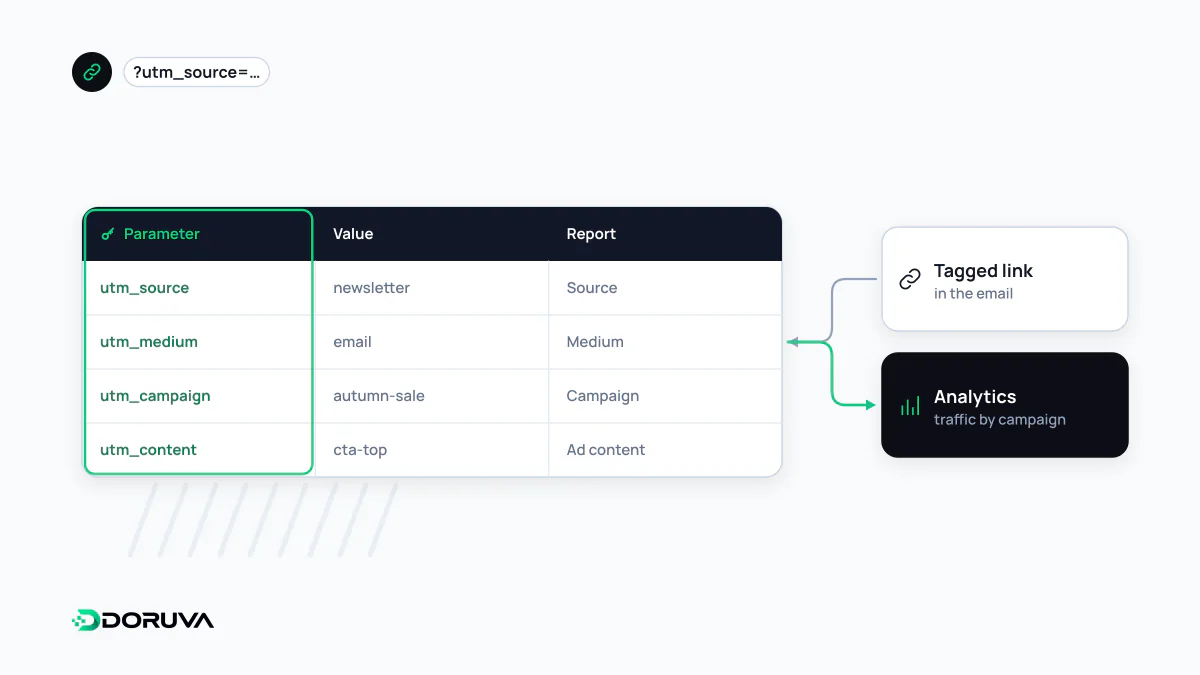
The parameters
| Parameter | Records | Example |
|---|---|---|
utm_source | Who sent the traffic | newsletter, linkedin |
utm_medium | The type of channel | email, cpc, social |
utm_campaign | The campaign name | 2026-10-web-redesign |
utm_term | Paid search keyword | b2b-website |
utm_content | Which creative or link within a campaign | hero-banner, footer-button |
Google Analytics 4 also recognises utm_id, utm_source_platform, utm_creative_format and utm_marketing_tactic; according to Google's documentation the last two are not currently shown in reports. Google recommends that every tagged link carries at least utm_source, utm_medium and utm_campaign.
https://example.com/services/?utm_source=newsletter&utm_medium=email&utm_campaign=2026-10-web-redesign&utm_content=footer-buttonWhere tagging pays off
UTMs matter wherever an analytics tool cannot work out the origin on its own. Email clients often send no referrer, so untagged newsletter clicks land in "direct". The same applies to QR codes on printed material, links on partner sites, social posts and SMS campaigns. Ad platforms with auto-tagging, such as Google Ads, usually do not need manual UTMs at all.
Consistency beats cleverness
Values are case-sensitive, so utm_source=Newsletter and utm_source=newsletter appear as two different sources. When three people on a team label the same channel "e-mail", "email" and "Email", the data becomes unusable within a quarter. The practical fix is a shared naming sheet listing allowed values: lowercase only, hyphens instead of spaces, no special characters, one date format.
utm_medium deserves extra care because GA4 relies heavily on it when sorting traffic into default channel groups such as Organic Search, Paid Search or Email. A non-standard medium can leave sessions labelled "Unassigned". Clean tagging is what makes attribution worth reading at all.
Never on internal links
Adding UTMs to a homepage banner to see whether people click it is a common and damaging habit. When a visitor follows a tagged internal link, the analytics tool may replace their real origin, say organic search, with your internal campaign values. A visitor who arrived from Google and converted then shows up as if your own banner had acquired them. Measure on-site clicks with event tracking instead.
SEO and privacy side effects
Tagged URLs make the same page reachable at many addresses. If those versions are shared and crawled, they become duplicate URLs. A canonical URL pointing to the clean address helps search engines pick the right version, and keeping tagged URLs out of XML sitemaps and internal navigation avoids the problem at the source.
UTM values also sit in plain view in the address bar and in referrer data. Never put personal or confidential information, such as a customer's name or email address, into a campaign value.