

What is Machine-Readable Content?
Definition
Machine-readable content is content whose meaning and structure software can extract reliably without human interpretation. On the web this means text served as real text rather than images, meaningful HTML elements, consistent formats for dates, prices and units, and structured data that matches the visible page. Search engines, AI systems and agents all read pages through this layer.
Also known as: machine-readable data, machine readable content, machine-readable web content
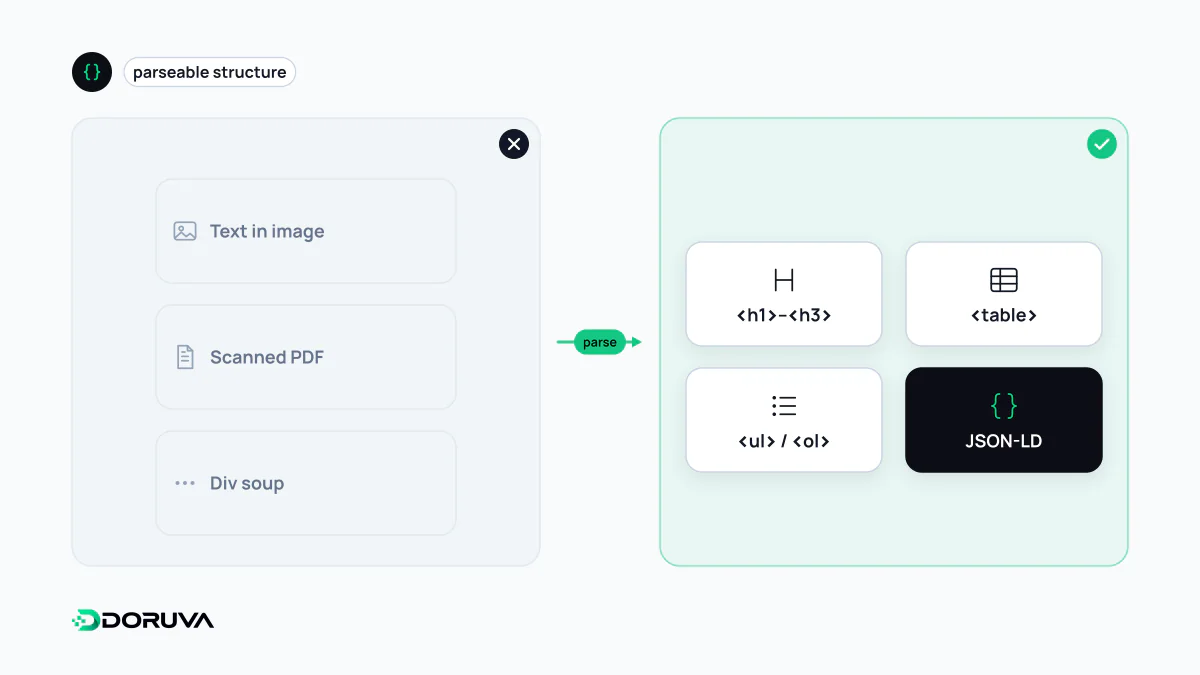
Readable by people is not enough
A person instantly understands that the price is written on a banner image, that a table is really a screenshot, or that "Mon–Fri 9–6" describes opening hours. For software, the same information is either missing or a fragment of text it has to guess about. Machine readability means the information also exists in a form a program can parse with certainty.
The idea comes from data publishing, where a CSV or JSON file counts as machine-readable and a scanned PDF table does not. On a web page the same distinction applies at every layer.
The layers that matter
| Layer | Machine-readable | Unreadable or ambiguous |
|---|---|---|
| Text | Real text in the HTML | Words baked into images; video without a transcript |
| Structure | Headings, lists, real <table> elements | Bold text posing as headings; tables drawn with divs |
| Values | Consistent dates, currencies and units | Three date formats on one page |
| Meaning | Structured data that mirrors visible content | Markup describing things the page never shows |
| Delivery | Content present in the server's HTML | Content that exists only after client-side JavaScript runs |
The last row is easy to miss. Googlebot generally renders client-side rendered content, but crawlers that do not execute JavaScript, including many AI bots, only ever see the raw HTML.
A small before-and-after
<h2>Boiler service price</h2>
<p>A standard service costs <strong>TRY 1,800</strong> including VAT.
Prices apply from <time datetime="2026-09-01">1 September 2026</time>.</p>
Had the same information lived only on a promotional image, nothing would change for a sighted visitor, but crawlers, screen readers and AI systems would lose both the price and the date it applies from. The datetime value on <time> gives software an ISO 8601 date regardless of how the date is written for humans.
What search engines, AI systems and agents expect
Google's documentation on AI features lists making important content available in textual form, and keeping structured data consistent with the visible text, among the fundamentals that carry over. The same page stresses that you do not need new machine-readable files, AI text files or special markup. The goal is a readable page, not an extra file next to it.
web.dev's guide to agent-friendly websites explains that agents read a page in three ways: screenshots, raw HTML and the accessibility tree. Buttons built with semantic HTML, form fields with properly associated labels and correct ARIA roles give screen reader users and agents the same clean map of the page.
Common mistakes
- Publishing price lists, opening hours or specifications only as images or PDFs.
- Declaring ratings, prices or claims in JSON-LD that do not appear on the page, which is both a trust problem and a policy problem.
- Writing the same value differently across pages (1800 TL, ₺1.800,00, 1.8k).
- Leaving accordion or tab content out of the HTML until a user clicks.