

What is Entity-Based Content?
Definition
Entity-based content is an approach that organises a page around real-world entities rather than keyword strings. People, organisations, products, places and concepts are named explicitly, and their attributes and relationships are stated in plain sentences. The aim is for search engines and language models to understand without ambiguity what, and whom, a page is about.
Also known as: entity-first content, entity-oriented content, entity-centric content, entity SEO content
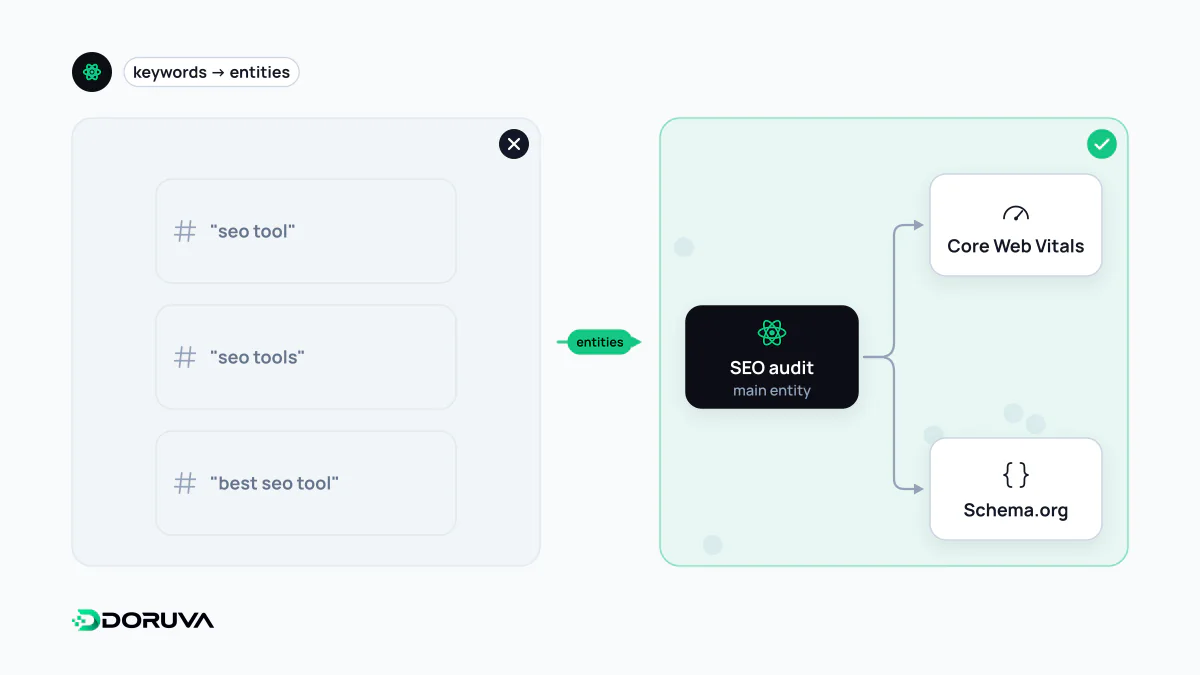
From strings to things
Keyword-led planning starts with "which phrase are we targeting?". Entity-based planning starts with "what is this page about, and what would a reader want to know about it?". The "what" is an entity: a distinguishable thing with a name, a type and relationships to other things. "Istanbul", "the Champions League", "Mitsubishi Electric" and "dental implant treatment" are all entities.
Search engines have long tried to understand queries and pages through entities and their connections rather than word matching alone, with Google's Knowledge Graph as the best-known example. Google's AI guidance notes that its systems can understand a page's relevance even when there is no exact match between the query and the page's primary content. Under those conditions the job of content is not to repeat the right words but to identify its subjects beyond doubt.
Keyword-led versus entity-based
| Keyword-led | Entity-based | |
|---|---|---|
| Unit of planning | A search phrase | An entity and its relationships |
| Scope | Variations of the phrase | The entity's attributes and the related entities readers expect |
| Test of success | The phrase appears in the text | It is unambiguous what the page describes |
| Typical failure | Keyword stuffing | Context-free lists of names |
Applying it to a real page
Take a dental clinic's page on implants. An entity-based outline answers four questions explicitly:
- What is the main entity? Dental implant treatment. The opening paragraph defines it and states its type: a dental procedure.
- What are its attributes? Who it suits, how many stages it involves, what the healing time depends on.
- Which entities is it connected to? The clinic (organisation), the treating dentist (person), bone grafts and bridges (related procedures), the district where the clinic is (place).
- Who is who? The dentist's name, title and speciality, and the clinic's official name and address, written the same way everywhere.
Relationships are stated in full sentences rather than left to pronouns: "Dr Ayşe Yılmaz is an oral and maxillofacial surgeon who performs implant treatment at X Dental Clinic in Bornova." A sentence like that hands four entities and their links to a human reader and to a named entity recognition system alike. Structured data and sameAs links then tie the same identities to trusted records elsewhere, but they complement clear prose; they do not replace it.
Habits that reduce ambiguity
- Refer to an entity by the same name throughout; do not abbreviate the brand in one place and spell it out in another.
- When a name is shared (a city and a football club, say), settle the context in the first sentence; entity disambiguation covers this in depth.
- Keep the page's main entity at the centre and introduce secondary entities by explaining what they add to it.
- Write attributes such as figures, dates and specifications in a verifiable way.
Common misreadings
Entity-based content does not mean scattering as many proper nouns as possible through the text; a list of entities without context is just a new form of stuffing. Nor is it simply schema markup: markup restates, in a standard vocabulary, relationships the text should already make explicit. And it does not make keyword research obsolete. Knowing which words people use to search for an entity still helps you decide how to name it on the page.