

What is Entity Salience?
Definition
Entity salience is a measure of how central each entity mentioned in a text is to that text as a whole: the entity the piece is really about scores high, one mentioned in passing scores low. Version 1 of Google Cloud's Natural Language API returns it as a score between 0 and 1 for each entity. Google has not documented salience as a ranking signal in Google Search.
Also known as: salience score, entity importance, entity centrality
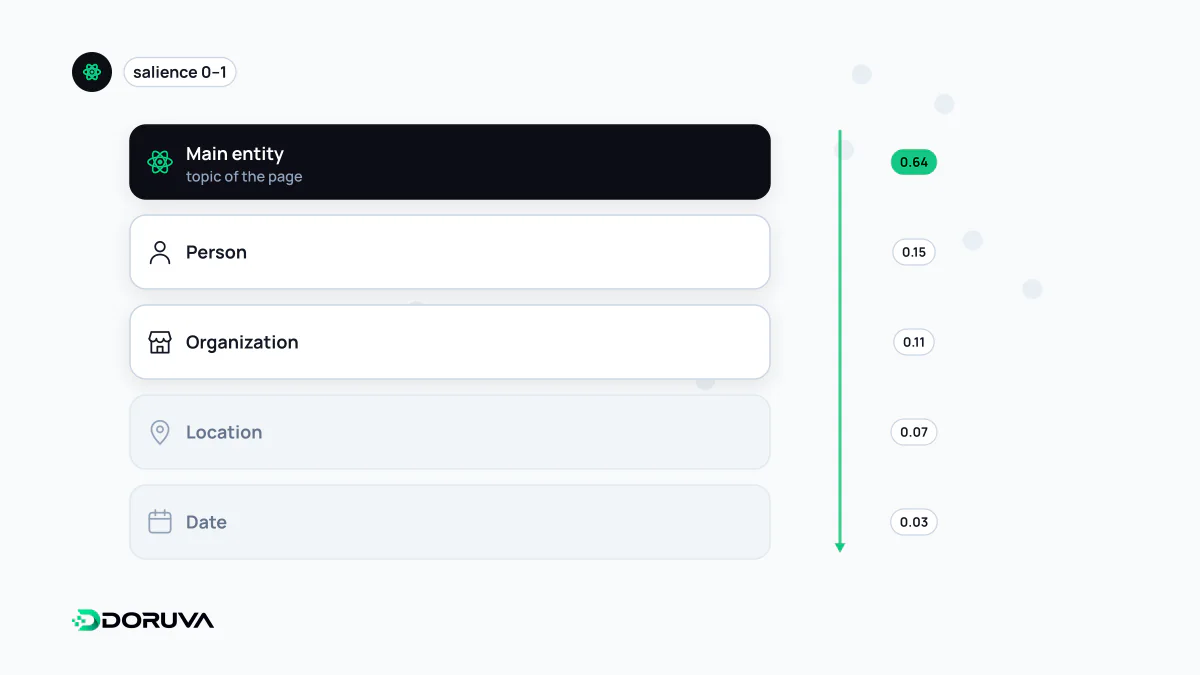
Centrality, not frequency
A news story might mention five companies, three cities and two people, yet it is usually about only one of them. Salience tries to capture that "aboutness". How often an entity is mentioned is only part of it. Appearing in the headline or opening sentence, being the grammatical subject and sitting at the center of the relationships described all add to it.
Take this sentence: "The cooperative doubled olive oil output at its new plant near Izmir, using presses imported from Italy." Italy is mentioned, but the story is about the cooperative and its plant. A natural language processing model would give Italy low salience and the cooperative high salience. Google researchers framed salience prediction as a task of its own in 2014 and built a training set with millions of examples for it.
Salience in the Natural Language API
Google Cloud's Natural Language API returns the entities in a text through its analyzeEntities method, along with their type, their mentions and, where available, metadata such as a Wikipedia URL and a Knowledge Graph MID. In v1 each entity carries a salience field, which the API reference describes as the importance or centrality of the entity to the entire document, on a scale from 0 to 1.0. The response below is shortened and the values are illustrative:
POST https://language.googleapis.com/v1/documents:analyzeEntities

{
  "entities": [
    { "name": "cooperative", "type": "ORGANIZATION", "salience": 0.62 },
    { "name": "olive oil",   "type": "CONSUMER_GOOD", "salience": 0.21 },
    { "name": "Italy",       "type": "LOCATION",      "salience": 0.04 }
  ]
}
Two details are easy to miss. The entity object in the API's v2 does not include a salience field; the score belongs to v1. And the API's language support page lists a limited set of languages for entity analysis, so not every site can test its content this way.
What it means for SEO and GEO
The Natural Language API is not Google Search, and Google has not documented salience as a ranking factor. Targets like "get your salience score to 0.8" are therefore meaningless. The concept is useful for a different reason: what a page is about should be obvious to readers and machines alike. Any system that summarizes a page has to separate the main entity, and the facts about it, from everything mentioned along the way.
- Name the main entity in the title and the opening paragraph rather than starting with pronouns.
- Deliver key facts in sentences where the main entity is the subject.
- Keep each page focused on one main entity instead of bundling unrelated topics, which is also the idea behind entity-based content.
- State the page's subject in structured data with
aboutormainEntity.
How the idea gets misused
Repeating the main entity's name to push salience up is a new form of keyword stuffing, and it hurts readability. Scores also change with the model, its version and the language and length of the text, so comparing numbers from different tools is misleading. Salience works as a diagnostic, for example to check whether a page really is written around the intended entity, not as a target in its own right.