

What is Natural Language Processing (NLP)?
Definition
Natural language processing (NLP) is the field of artificial intelligence and linguistics concerned with enabling computers to analyse, interpret and generate human language, both written and spoken. Typical NLP tasks include text classification, sentiment analysis, entity recognition, machine translation, summarisation and question answering. The field began with hand-written rules and now relies mostly on machine learning and Transformer-based language models.
Also known as: NLP, natural language understanding, NLU, computational linguistics, language processing
From grammar rules to language models
Early NLP systems were built from hand-written grammar rules and dictionaries. They worked in narrow domains and broke quickly when language got messy. Statistical methods followed: word frequencies, n-gram probabilities and weightings such as TF-IDF. The next step was representing words as vectors that capture similarity of meaning. The current era belongs to large pre-trained models based on the Transformer, which can handle many tasks with one general capability instead of a separately engineered system for each.
The classic pipeline
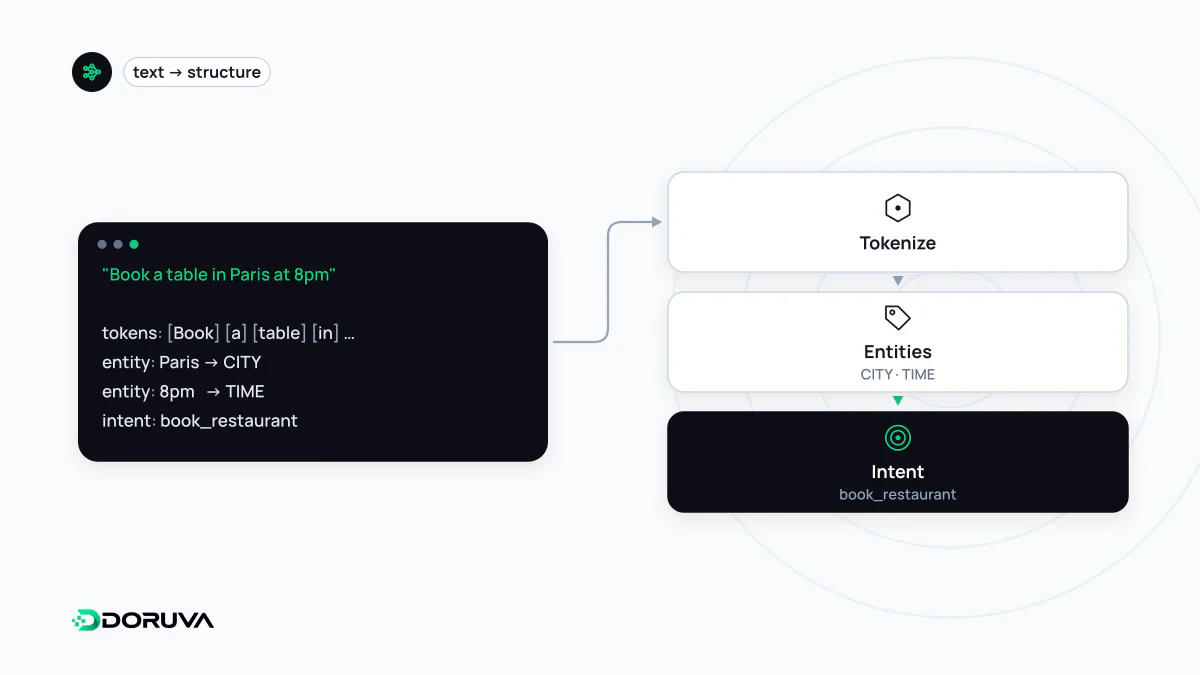
Modern language models do most of these steps implicitly, but knowing the traditional pipeline helps you see where errors creep in:
- Tokenisation: splitting text into words, sub-words or characters.
- Normalisation: reconciling case, accents and spelling variants.
- Morphological analysis: separating a word's stem from its affixes.
- Part-of-speech tagging and parsing: deciding which words are nouns or verbs and who did what to whom.
- Semantic tasks: entity recognition, relation extraction and sentiment analysis build on that foundation.
Where languages make it harder
English gets away with fairly simple word handling. Morphologically rich languages do not. Turkish, for example, stacks suffixes onto a stem: “evlerimizden” (“from our houses”) is one word containing the stem, a plural, a possessive and a case ending. A bag-of-words method designed for English treats hundreds of such forms of one stem as unrelated words. Sub-word tokenisation eases the problem but does not remove it.
Normalisation has traps too. Turkish has a dotted and a dotless i, so language-unaware lowercasing produces the wrong word:
"IŞIK".toLowerCase()             // "işik"  (wrong)
"IŞIK".toLocaleLowerCase("tr")   // "ışık"  (correct)
In any software that handles multilingual text, from site search to form validation, mistakes like this surface as records that never match and products nobody can find.
How search engines and assistants use it
Search engines use NLP to move beyond exact keyword matching: recognising synonyms, correcting typos, working out whether a query is informational or commercial (its search intent) and identifying which passage on a page actually answers the question. Semantic search is the vector-based form of that idea. AI assistants carry the same abilities into generating answers.
For anyone publishing content the lesson is simple. Text that uses language plainly, defines its terms and doesn't leave the subject of a sentence ambiguous is parsed more accurately by people and machines alike. Mechanically repeating a keyword gains nothing against modern language processing.
NLP, NLU and LLMs
NLP is the umbrella. Natural language understanding (NLU) focuses on extracting meaning; natural language generation (NLG) focuses on producing text. Large language models are a powerful family of tools that do both, but they are not the whole field. For a narrow, high-volume classification or extraction job, a small purpose-trained model can still be faster, cheaper and more predictable.