

What is E-commerce SEO?
Definition
E-commerce SEO is the work that helps an online store's category and product pages appear in search results and on Google's shopping surfaces. Its main concerns are managing filter and variant URLs, product structured data and product feeds, handling out-of-stock and discontinued items, avoiding duplicated manufacturer descriptions and giving category pages genuinely useful content.
Also known as: ecommerce SEO, online store SEO, eCommerce search optimization, shop SEO
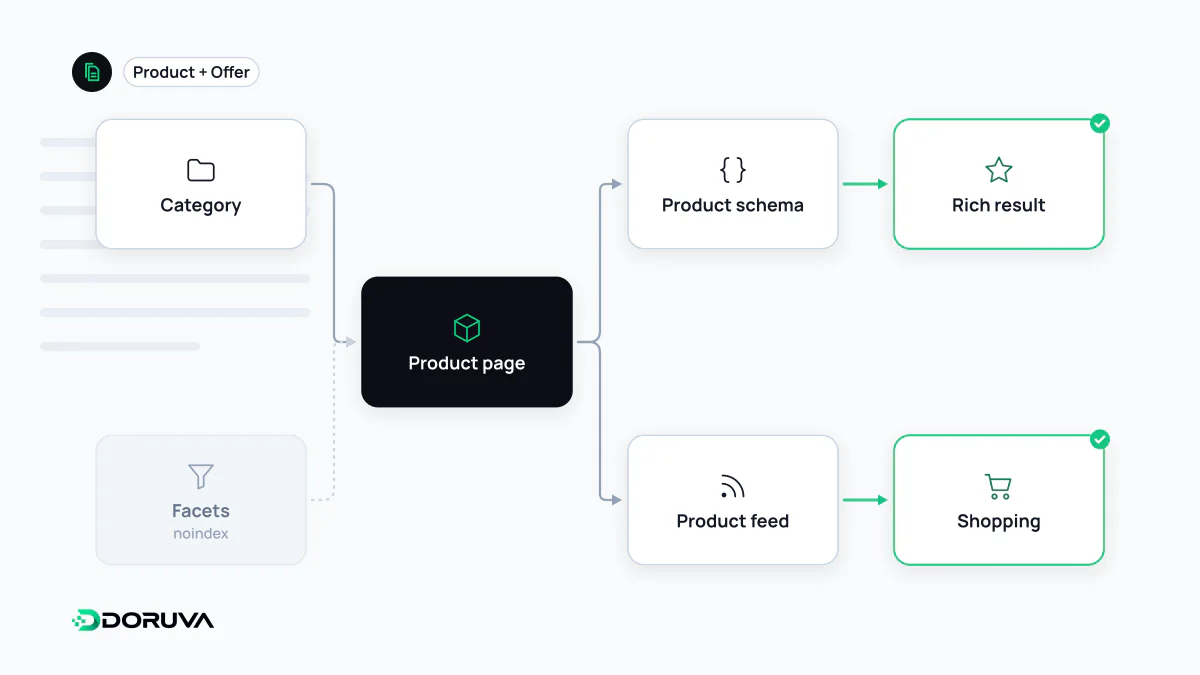
Matching page types to searches
Each template in a store serves a different kind of search. Without a clear division of labour, the shop ends up with several pages competing for the same query.
| Page type | Typical query | Intent |
|---|---|---|
| Category | "men's running shoes" | Compare options; broad commercial intent |
| Product | A model name or model number | Buy one specific item |
| Brand | "[brand] trail shoes" | Browse one maker's range |
| Guide or comparison | "how to choose running shoes" | Research before deciding |
In many shops, category pages attract more organic traffic than any other template, yet they are often nothing but a product grid. A short, original passage that helps people choose, placed above or below the listing, explains what the page offers to shoppers and search engines alike.
Variants, filters and URLs
Google's URL guidance for online shops is unusually concrete. Each product variant, such as a colour or size, should be identifiable by its own URL, either as a path segment or a query parameter. Fragment identifiers are not used for indexing, so /t-shirt#black and /t-shirt#white count as one page. Parameters should take the ?key=value form, and internal links should avoid session IDs, tracking codes and other short-lived values.
Good:  /t-shirt/green    or    /t-shirt?color=green
Bad:   /t-shirt#green    (fragment ignored for indexing)
Bad:   /t-shirt?green    (no key)
Bad:   /t-shirt?session=8f2c1a   (a new address on every visit)
The scale problem comes from filters. Every combination of size, colour, price band and sort order can create another URL. Deciding which combinations deserve indexing and which should not be crawled at all is the job of faceted navigation management, and on large catalogues that decision directly shapes how crawl effort is spent.
Getting product data to Google
Google recommends two channels: Product structured data on product pages and a product feed uploaded to Google Merchant Center. Neither is required to appear in search results, but markup increases eligibility for product rich results, and Merchant Center participation is required for some surfaces such as the Shopping tab. Google also notes that crawling is not guaranteed to find every product on a site, which a feed helps to cover. Prices or stock that disagree between the page and the feed are among the mistakes shoppers notice first.
Out of stock versus gone for good
- Temporarily unavailable: keep the page live with a 200 status, show availability accurately on the page and in markup (
OutOfStock), and link to close alternatives. - Discontinued, with a direct successor: a 301 redirect to the new model serves the visitor.
- Discontinued, no equivalent: a 404 or 410 is the honest answer. Redirecting everything to the homepage risks being treated as a soft 404.
Duplicated and thin content
Pasting the manufacturer's description means publishing the same words as hundreds of other retailers, which gives a search engine no reason to prefer your page. Store-specific information creates the difference: size charts, hands-on notes, original photos, delivery and returns terms, answers to real customer questions. Hundreds of near-empty category and tag pages cause a related problem of duplication and index bloat. Google collects its guidance for online shops in the ecommerce section of Search Central.