

What is Domain Name?
Definition
A domain name is a unique, human-readable name registered in the DNS hierarchy that lets people reach a website or service without knowing its IP address. In example.co.uk, “uk” is the country-code top-level domain and “example” is the registered name. Domains are not bought outright: they are registered through a registrar for a fixed period and must be renewed before they expire.
Also known as: domain, website domain, domain address, web address
Reading a domain from right to left
Domain names form a tree with the root at the top. Take shop.example.co.uk and read it backwards:
- uk: the top-level domain (TLD). Country-code TLDs (ccTLDs) such as .uk, .de or .tr sit next to generic TLDs (gTLDs) such as .com, .org and .net, plus newer gTLDs like .shop or .app.
- co.uk: a second-level namespace the registry created for commercial use.
- example: the name you register.
- shop: a subdomain you create yourself. Subdomains need no separate registration, just a DNS record.
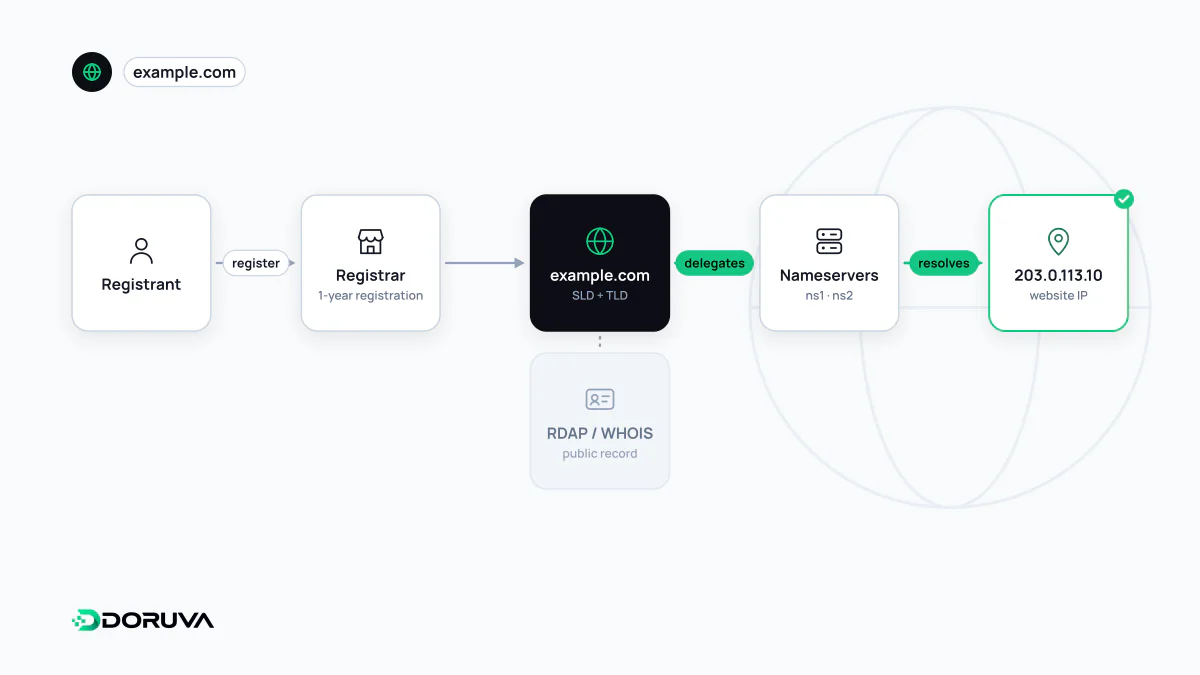
A domain's real job is to tell the world, through DNS, which IP address, mail server or verification record belongs to that name. The website itself does not live in the domain; it lives with your web hosting.
Registry, registrar, registrant
Three parties are involved in every registration. The registry operates the database for a TLD such as .com or .tr. The registrar is the company that sells you the domain and handles registration, renewal and transfers on your behalf. The registrant is the person or organization the domain is registered to. That last line is the one that causes real-world trouble: the domain should be registered to the business itself, in an account the business controls, not to the agency that built the site or an employee's personal login.
A local example: how .tr registration works today
Rules differ by TLD, and Türkiye's .tr namespace changed substantially in recent years. Since 14 September 2022, .tr domains have been allocated through TRABİS, the national registry system, via accredited registrars. With that switch, com.tr, net.tr and org.tr, which for decades required documents such as a trade registration or trademark certificate, became first-come, first-served with no paperwork. Direct second-level names like example.tr opened to first-come, first-served applications on 4 September 2024, after priority phases for existing .tr holders.
Extensions reserved for government bodies, universities or specific professions, such as gov.tr and edu.tr, remain subject to documented or restricted allocation. Registrations run for one to five years at a time, and a dispute resolution mechanism handles names that conflict with trademarks. According to TRABİS announcements, Law No. 7590, published in the Official Gazette on 31 July 2026, transferred domain name management duties from the Information and Communication Technologies Authority (BTK) to the Cyber Security Presidency, with existing processes continuing under current legislation. Because these rules move, check the registry's current notices before registering.
What a domain does and does not do for search
A keyword in the domain is not a meaningful advantage next to content quality and technical health; a short, memorable name that matches the brand pays off longer. A country-code TLD, on the other hand, is a strong signal of which country a site targets, so a .tr or .co.uk site is naturally treated as focused on that market.
Changing domains is one of the riskiest moves in SEO. It needs a planned site migration in which every old URL permanently redirects to its new equivalent. Before buying an expired domain with an unknown past, review what it used to host and who links to it.
Keeping control of your domain
- Turn on auto-renewal and keep payment details current; a lapsed domain can be registered by someone else shortly after it is released.
- Protect the registrar account with multi-factor authentication. Whoever controls it can repoint DNS and take over both your website and your email.
- Keep the registrar's transfer lock enabled.
- Do not use a contact email on the same domain; if the domain stops resolving, the expiry warnings will not reach you.