

What is Conversion Funnel?
Definition
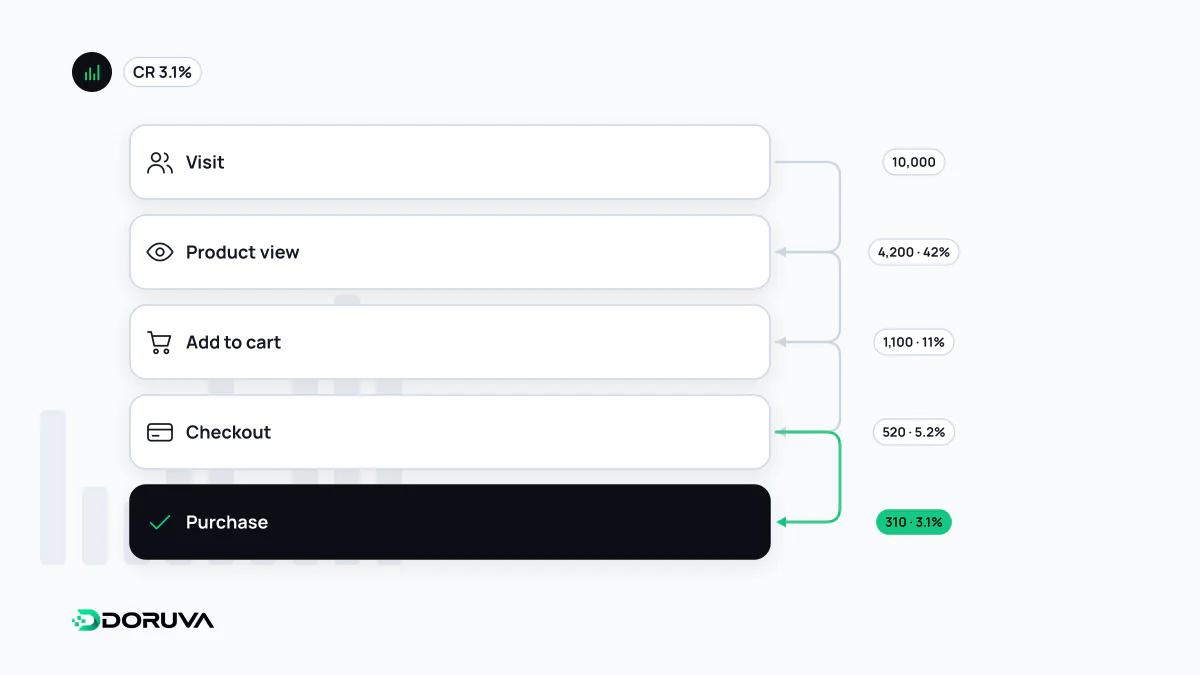
A conversion funnel is an ordered model of the steps a visitor takes on the way to a target action, together with an analysis of how many people remain at each step. Product page, cart, checkout details and order confirmation are typical steps of an e-commerce funnel. Because some users leave at every step, the chart narrows from top to bottom, and the step with the largest loss shows where improvement work should start.
Also known as: sales funnel, funnel analysis, marketing funnel, funnel exploration
Two kinds of funnel
The word gets used in two senses. In marketing, a funnel is a conceptual model of stages such as awareness, interest, consideration and decision, useful for planning content. In analytics, it is the sequence of concrete, measurable steps on a site: viewed product → added to cart → started checkout → completed purchase. This entry is about the second kind, because that is where improvement decisions get made.
A funnel is the measurable slice of a wider user journey that leads to one specific goal.
Reading the drop-off
A simplified month of e-commerce data:
| Step | Users | Continued from previous step |
|---|---|---|
| Product page | 20,000 | — |
| Add to cart | 2,400 | 12% |
| Checkout started | 1,300 | 54% |
| Order completed | 520 | 40% |
End to end, that is 2.6%. The biggest absolute loss sits on the product page, but most people there are browsing prices, which is normal. The more telling number is that 60% of people who reached checkout, and so had already shown buying intent, left without paying. Shipping costs revealed late, forced account creation, unexpected form errors and a checkout that misbehaves on mobile are the usual suspects. Items left behind in the basket are analysed separately as abandoned carts.
Open versus closed funnels
In a closed funnel, a user only counts if they enter at the first step. In an open funnel, they can enter at any step: if an ad sends people straight to checkout, they appear from step three onwards. The funnel exploration in GA4 supports both. The choice can shift the percentages considerably, so state it on the report.
Mistakes that distort the picture
- Assuming journeys are linear. People hop between products and leave to compare prices before returning. A funnel is a simplified projection of messy behaviour.
- Unreliable step tracking. If "checkout started" is an event that fails to fire in some browsers, the funnel shows a loss that never happened. Steps need a solid event tracking plan behind them.
- No segmentation. A checkout that works on desktop may jam on mobile. Break the funnel down by device, channel and new versus returning users.
- Looking for the cause in the numbers. A funnel tells you where people drop off, not why. Usability tests, session recordings and customer feedback supply the why, and fixes are validated through conversion rate optimization.