

What is Abandoned Cart?
Definition
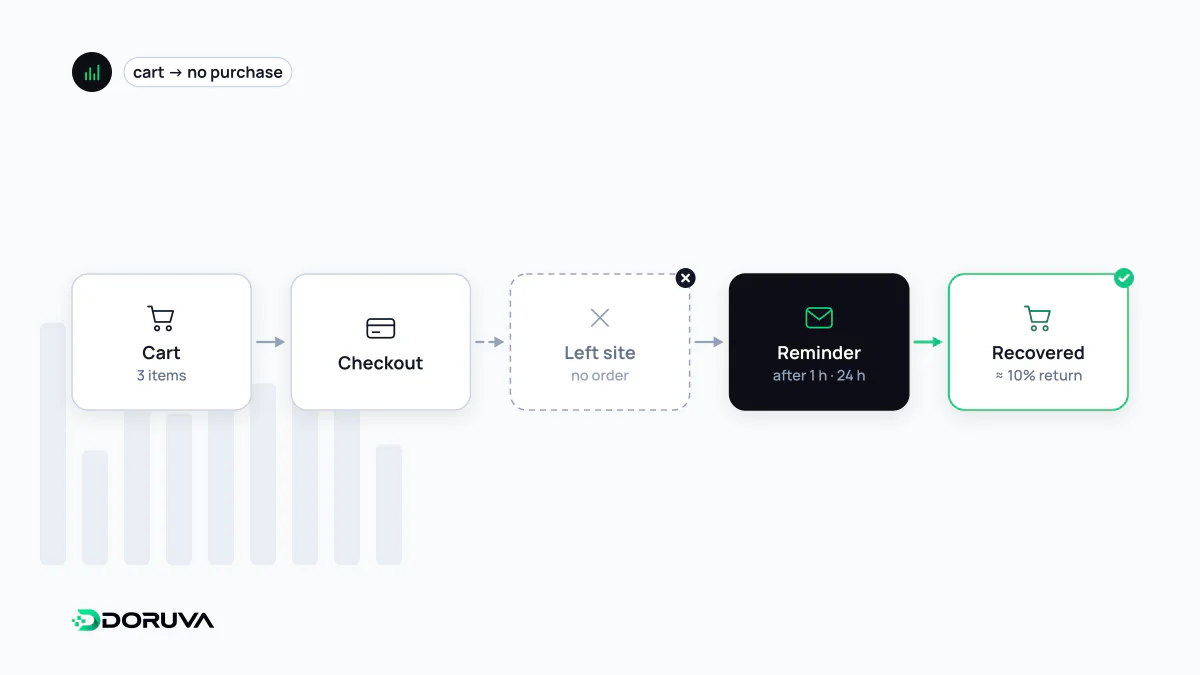
An abandoned cart is a shopping cart that a visitor fills with at least one product and then leaves without completing the order. The abandonment rate shows what share of created carts never become orders, which helps locate problems in the cart and checkout steps, and stores try to recover part of those carts with tactics such as reminder emails.
Also known as: cart abandonment, shopping cart abandonment, abandoned basket, cart abandonment rate, checkout abandonment
Calculating the rate
The usual formula is cart abandonment rate = 1 − (completed orders ÷ carts created). If 1,000 carts were created in a month and 280 turned into orders, the abandonment rate is 72%. The number only means something if "cart created" is clearly defined, typically as a session in which at least one item was added. Test orders, internal traffic and bots inflate the rate unless they are filtered out.
Two different measures are often blurred together. Cart abandonment is when items are added but checkout never starts. Checkout abandonment is when the shopper enters checkout and still does not finish. The second is usually more urgent, because it means losing people who were very close to buying.
Not every abandoned cart is a failure
Plenty of shoppers use the cart as a wish list: to see the total with shipping, to compare options or to come back later. That is why "industry average" abandonment figures, produced by third parties with differing methods, make poor targets. What is useful is your own rate over time, and the difference before and after a specific change.
Finding the cause
An abandonment rate on its own does not say what is broken. You need each step measured separately: viewing the cart, beginning checkout, adding shipping details, adding payment details and purchasing. Tracked as distinct events, these show which link in the funnel is leaking. From there, a few segments usually reveal the reason:
- Device and browser: a sudden drop confined to one mobile browser is almost always a bug.
- Payment method and bank: monitor gateway decline codes and timeouts in the 3D Secure step on their own.
- Cart value and shipping threshold: higher abandonment just below a free-shipping threshold is a pricing signal.
- New versus returning customers: new visitors forced to register leave more often.
Reminder messages and consent
The best-known recovery tactic is an email or notification reminding the shopper what they left behind. That requires contact details, and harvesting an email address typed into a form the user never submitted is a trust and privacy problem in itself. Marketing rules differ by country. In the EU, sending marketing email generally depends on consent or a narrow existing-customer exception, and processing the data falls under the GDPR. In Turkey, commercial electronic messages generally require the recipient's prior approval under Law No. 6563 on the Regulation of Electronic Commerce, with approvals managed through the national Message Management System (İYS), while personal data processing falls under KVKK. A reminder that includes a discount or promotion is likely to count as a commercial message. This is general information, not legal advice.
Prevention beats recovery
Reminders bring back only a fraction of lost orders. What moves the rate for good is removing the causes: show shipping costs early on the product page or in the cart, allow guest checkout, keep carts across devices, put clear error messages next to the field that caused them, and strip unnecessary scripts from the checkout pages.