

What is Canonicalization?
Definition
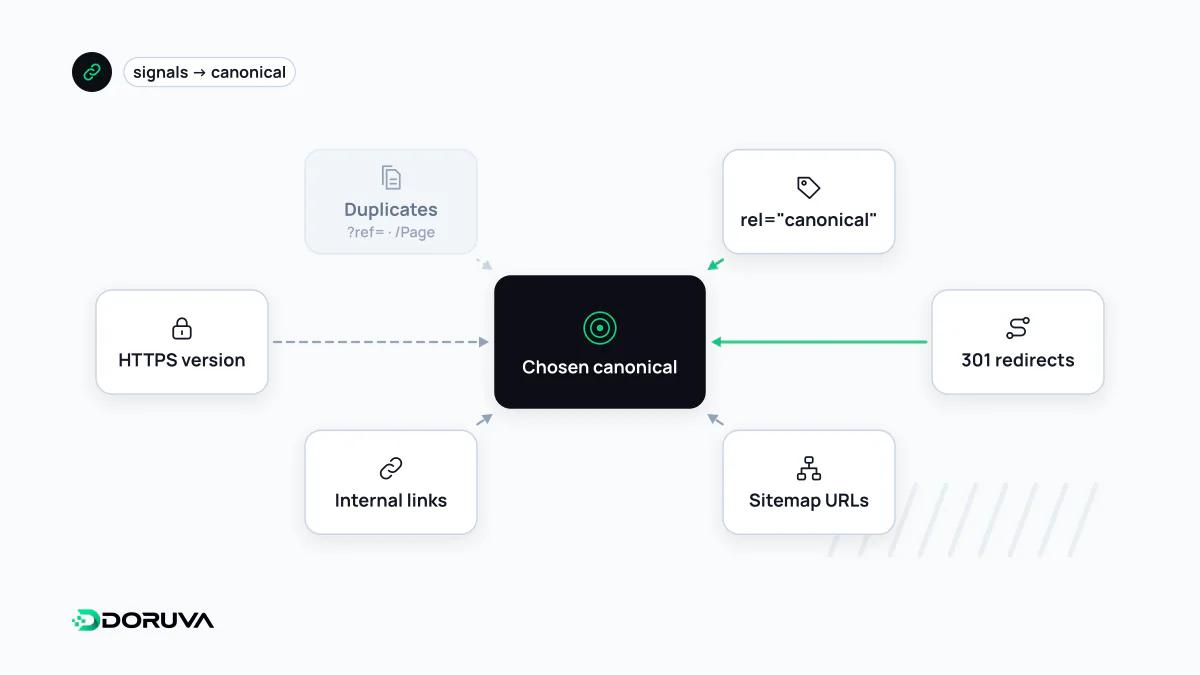
Canonicalization is the process by which a search engine groups URLs with the same or very similar content and selects one of them as the representative, or canonical, version. Google weighs signals such as redirects, rel=canonical annotations, sitemap inclusion, HTTPS and hreflang to make that choice; the site owner's preference is a strong signal, but the final decision belongs to the search engine.
Also known as: canonicalisation, URL canonicalization, cross-domain canonical, canonical selection
A selection process, not a tag
A canonical URL tag is an input: the site owner's statement that "this is the main address for this content". Canonicalization is the selection process the search engine runs, with that tag as one of its inputs. During indexing, Google compares content, clusters URLs that can be treated as duplicates of one another and picks a single member of each cluster to represent it in results. The others become alternates and are crawled less often. Google says this evaluation happens both before and after rendering, so a site that sets its canonical with JavaScript should not contradict the value in the initial HTML.
How duplicate clusters form
Google's documentation lists these typical sources of duplication:
- Protocol and host variants:
httpversushttps,wwwversus non-www. - Site functions: query parameters added for sorting, filtering or tracking, and trailing slash variants.
- Device variants: separate mobile and desktop URLs.
- Regional variants: near-identical pages in the same language for different countries.
- Accidental copies: test or demo sites left publicly accessible.
Versions in different languages count as duplicates only when the main content is in the same language. A Turkish page and its English counterpart are not duplicates; they are connected with hreflang.
Signals that shape the choice
Google weighs these signals by strength:
- Redirects. A permanent redirect such as a 301 redirect is a strong signal that the target should become canonical.
- rel="canonical" annotations. Set in an HTML element or an HTTP header; also a strong signal.
- Sitemap inclusion. A weak, supporting signal.
- Preferences. Google prefers HTTPS pages over equivalent HTTP pages and favours URLs that are part of an hreflang cluster.
When every signal points to the same URL, the outcome is almost always what you expect. Trouble starts when they contradict each other: if the canonical tag names URL A while internal links and the sitemap favour URL B, Google may pick B. Don't use robots.txt, noindex or the URL removal tool to steer canonical selection; Google advises against all three for this purpose.
Cross-domain canonicals and syndication
rel="canonical" can point to a URL on another domain. That works for a page published identically on two sites owned by the same company. Syndication, where other publishers republish your content, is a different case. Google does not recommend the canonical element for avoiding duplication with syndication partners, because their pages are often very different once their own surrounding content is added. If the original should be the one that ranks, the most effective approach is for partners to put noindex on their copy.
In rare cases Google may pick an external site that copied your content without permission as the canonical. The remedy then is to contact that host or file a copyright removal request. Hacked sites receiving injected cross-domain canonical tags that point to spam are another known pattern.
Reading the outcome
The Page indexing report in Search Console surfaces canonicalization decisions under three statuses. "Alternate page with proper canonical tag" is usually expected and healthy: the page has been folded into the URL you pointed to. "Duplicate without user-selected canonical" means the page was clustered but you never stated a preference. "Duplicate, Google chose different canonical than user" means your other signals contradict your declared preference, and this is the status worth investigating. Google's guidance is in its article on fixing canonicalization issues.