

What is AEO (Answer Engine Optimization)?
Definition
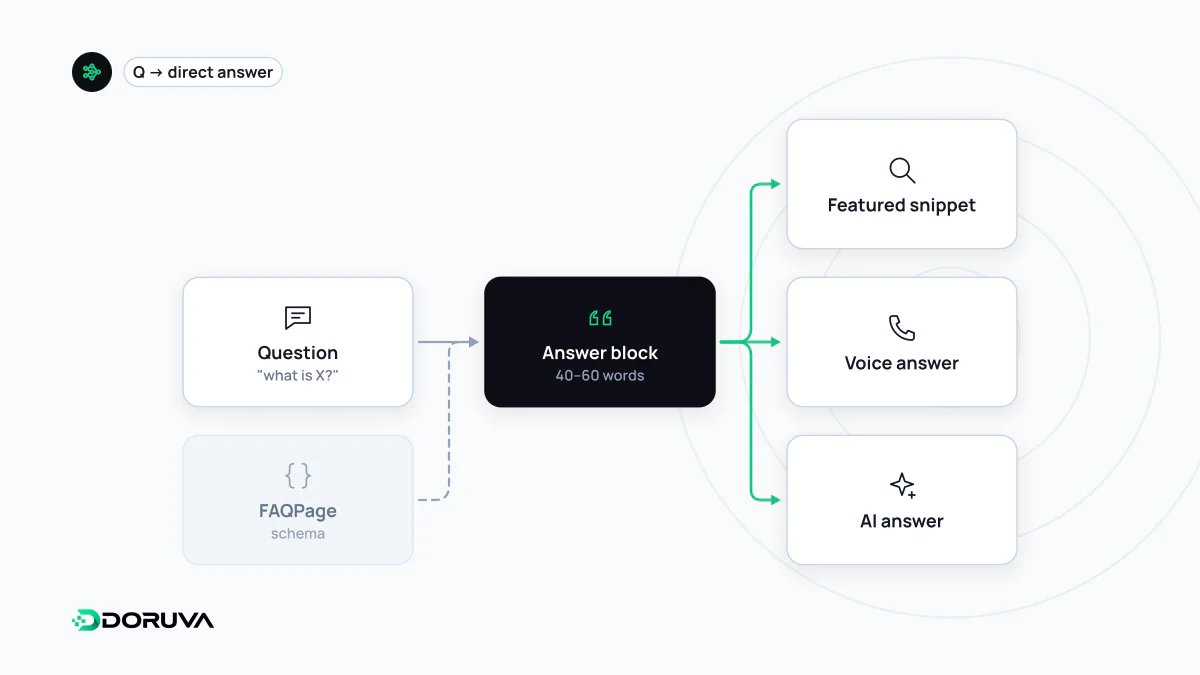
AEO (Answer Engine Optimization) is an industry term for work aimed at getting content used as the source in systems that answer questions directly: featured snippets, voice assistants and AI-powered search answers. It is not a standard defined by any official body, and it overlaps heavily with GEO, featured snippet optimization and conventional SEO rather than replacing them.
Also known as: Answer Engine Optimization, answer engine optimisation, AEO SEO
What the term covers
AEO is a marketing and SEO label for the situations where a search system shows an answer rather than a list of links. The idea predates large language models. Featured snippets that answer in a paragraph above the results, and voice assistants that read out a single answer, were the first "answer engines" people optimized for. As AI summaries and conversational search spread, the term stretched to cover those surfaces too.
No standards body owns AEO, and there is no official checklist. Google's documentation doesn't use the term at all; on AI Overviews and AI Mode it says there are no additional requirements or special optimizations, and that SEO best practices still apply. It is more accurate to treat AEO as a way of organizing existing work around questions and answers than as a separate set of techniques.
AEO, GEO and SEO side by side
| SEO | AEO | GEO | |
|---|---|---|---|
| Focus | Crawling, indexing, rankings and clicks | Being the source of a direct answer to a question | Being described accurately and cited in generated answers |
| Typical surfaces | Classic results pages | Featured snippets, People Also Ask, voice assistants, AI answers | AI search and chat assistants |
| Unit of work | Pages and queries | Questions and answer passages | Entities, sources and passages |
The boundaries blur in practice, and many people use the terms interchangeably. The fuller framework for brand representation in generated answers lives on the GEO page, and how those answers are assembled is explained under AI search. What sets AEO apart is its starting point: a concrete question a person asks, not a keyword.
The work in practice
- Collect real questions. Support tickets, sales calls, on-site search logs and People Also Ask boxes show which questions people ask and in what words.
- Lead with the answer. Sections that use the question as a heading and answer it in the first sentence still make sense when lifted out of the page.
- Match format to question. Steps as a numbered list, comparisons as a table, definitions as one clear sentence.
- Make claims checkable. Dates, sources and named authors; outdated figures corrected.
- Get the basics right. A page that can't be crawled or indexed can't be the source for any answer engine.
All of this aims at content that is easy to quote accurately, which is the subject of answer extractability.
Realistic expectations
No tag turns a page into "the answer". Google says its systems choose featured snippets automatically and that you cannot mark a page as one. The reverse does work: nosnippet or a low max-snippet value can remove a page from these surfaces. AI answers vary for the same question over time and between users.
When the answer appears on the results page, clicks can drop; that pattern is known as zero-click search. Judge AEO by how often and how accurately your brand appears in the right answers, not by traffic alone. Search Console doesn't break out AI feature traffic; it is counted within the overall Web search performance data. The most practical way to track progress is to run the same list of questions on several systems at regular intervals and log the results with dates.