AI Visibility
What Is GEO? How Generative Engine Optimization Differs from SEO
GEO (generative engine optimization) aims to get your brand understood correctly and chosen as a source in AI-generated answers. SEO competes for a place in a list of results, while GEO competes for a place inside the answer; both rest on the same technical and content foundation.
By Mehmet ÇalışırPublished 10 min read

Contents
People no longer take every question to a search box. Many now ask an AI assistant instead and settle for a single synthesised answer. This guide is for business owners, marketing leads and agency teams who want to know how their brand shows up in those answers: what GEO actually is, where it departs from SEO, and where to start.
What is GEO, and where does the term come from?
GEO means making content easy for generative AI search and answer systems to find, understand and cite. A "generative engine" is any system that responds with an answer written in its own words rather than a list of links: ChatGPT's search feature, Google's AI Overviews and AI Mode, Perplexity, Microsoft Copilot and similar tools.
The term caught on after a 2023 academic paper examined which sources generative engines tend to surface. Since then the industry has used several overlapping labels: AEO (answer engine optimization), LLM optimization, or simply AI search optimization. The boundaries are still debated, but the underlying question is the same: when an AI system answers a question in your field, does it know you, understand you correctly and point to you as a source?
GEO is not a trick or a shortcut. Nobody controls what a model says. What you can do is strengthen the signals these systems rely on, and make sure the information about your brand is accurate, consistent and easy to reach.
How do generative search engines build an answer?
Generative search engines draw on two things: what the model learned during training, and pages fetched from the web at the moment the question is asked. A large language model (LLM) on its own only knows its training data, which is frozen at a point in time and may be thin or out of date about your business. That is why search-enabled assistants run web searches first and use what they find to ground the answer.
The details vary by product and change often, but the broad flow looks like this:
- Interpreting the question: the system works out what the user wants to know and in what context.
- Breaking it into sub-queries: a complex question may be turned into several searches, an approach known as query fan-out.
- Retrieving sources: relevant pages, and the relevant passages within them, are pulled from a search index or the live web.
- Selecting and synthesising: the passages that look most relevant and trustworthy are combined, and the model writes an answer based on them.
- Citing: many systems show links to the pages they used, either beside the answer or inside it.
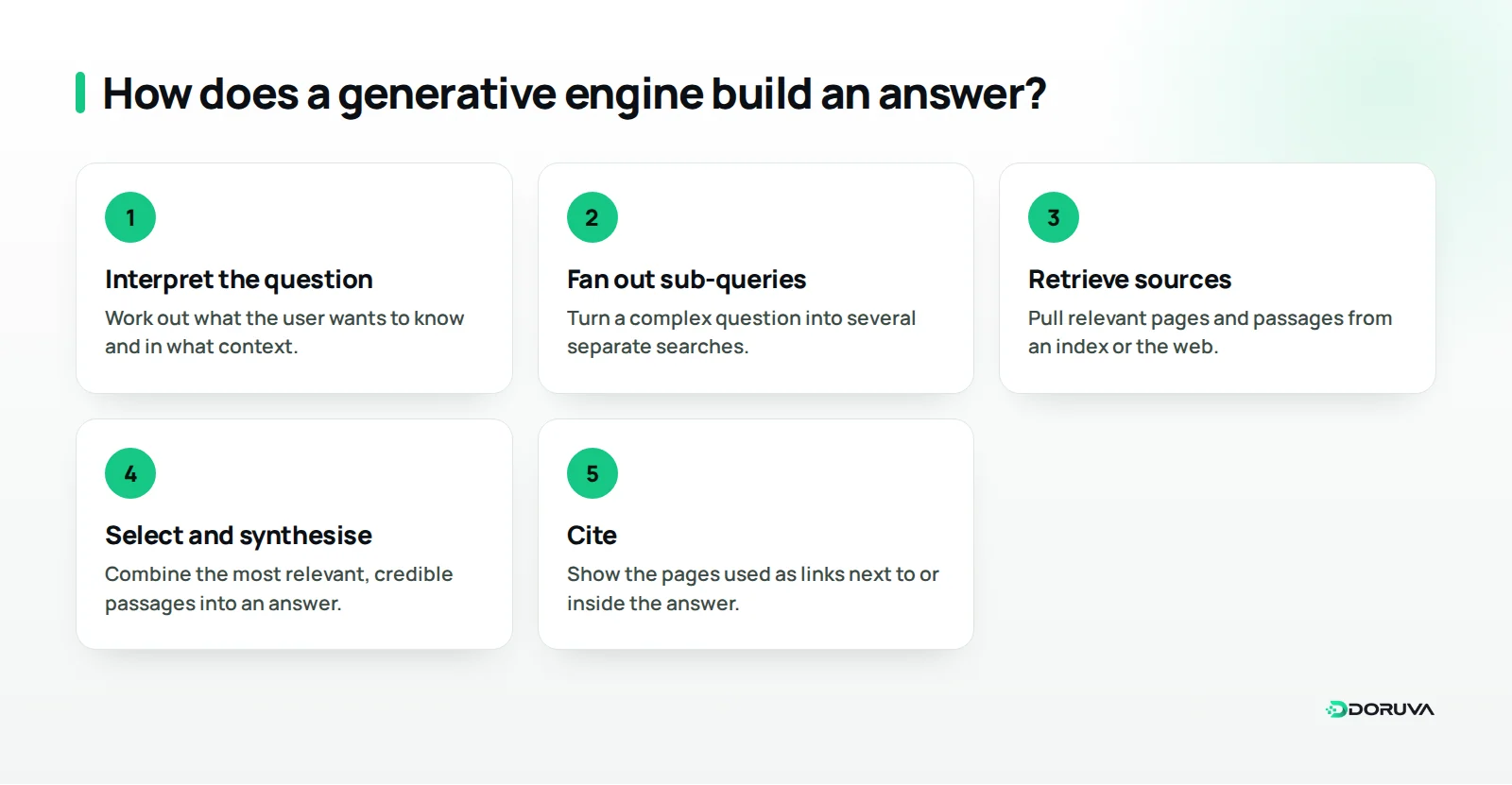
One consequence matters a great deal: competition now happens at the level of passages, not just pages. A system may lift the two or three sentences on a long page that answer a question most clearly and ignore everything else. In GEO, how you write matters as much as how your site is built.
How does GEO differ from SEO?
The main difference is the outcome you are aiming for: SEO targets a position on a results page, while GEO targets a place inside the generated answer. In classic search, a user scans a list of links, picks one and lands on your site. In generative search, they read a summary first; clicking through to a source is a separate, optional decision.
| Criterion | SEO | GEO |
|---|---|---|
| Goal | Rank high in search results | Be mentioned and cited in the generated answer |
| Unit of competition | Page and query | Passage, fact and brand entity |
| User behaviour | Chooses between links | Reads the summary, visits a source if needed |
| Key signals | Relevance, links, technical health, page experience | All of those, plus clear passages, consistent entity data and verifiability |
| Measurement | Rankings, impressions, clicks, conversions | Mentions, citations, accuracy, AI-referred traffic |
| Stability of results | Relatively stable rankings | The same question can get different answers at different times |
These differences are real, but easy to overstate. Both disciplines rest on the same foundation: a crawlable site, content that genuinely answers the user's question, and a brand people can trust. If you'd like a refresher on the basics, our guide to how search engine optimization works is a good place to start.
Will GEO replace SEO?
No. GEO doesn't replace SEO; it builds on it. Most generative systems rely on a search index or a live web search when they write an answer. If your page can't be crawled, isn't indexed or never turns up for relevant queries, its chances of being cited in an AI answer fall with it.
Google says much the same about its own AI features: no special optimization is required, and standard SEO best practices still apply. Its documentation on AI features and your website explains that a page has to be indexed and eligible to appear in Google Search with a snippet before it can be shown as a supporting link.
In practice, check your technical footing before you start any GEO work. The crawling, indexing, speed and structured data items in our technical SEO checklist are prerequisites for GEO as well. Once that foundation is solid, GEO works as an extra layer that makes the same content easier for AI systems to understand and quote.
What content do generative engines choose as sources?
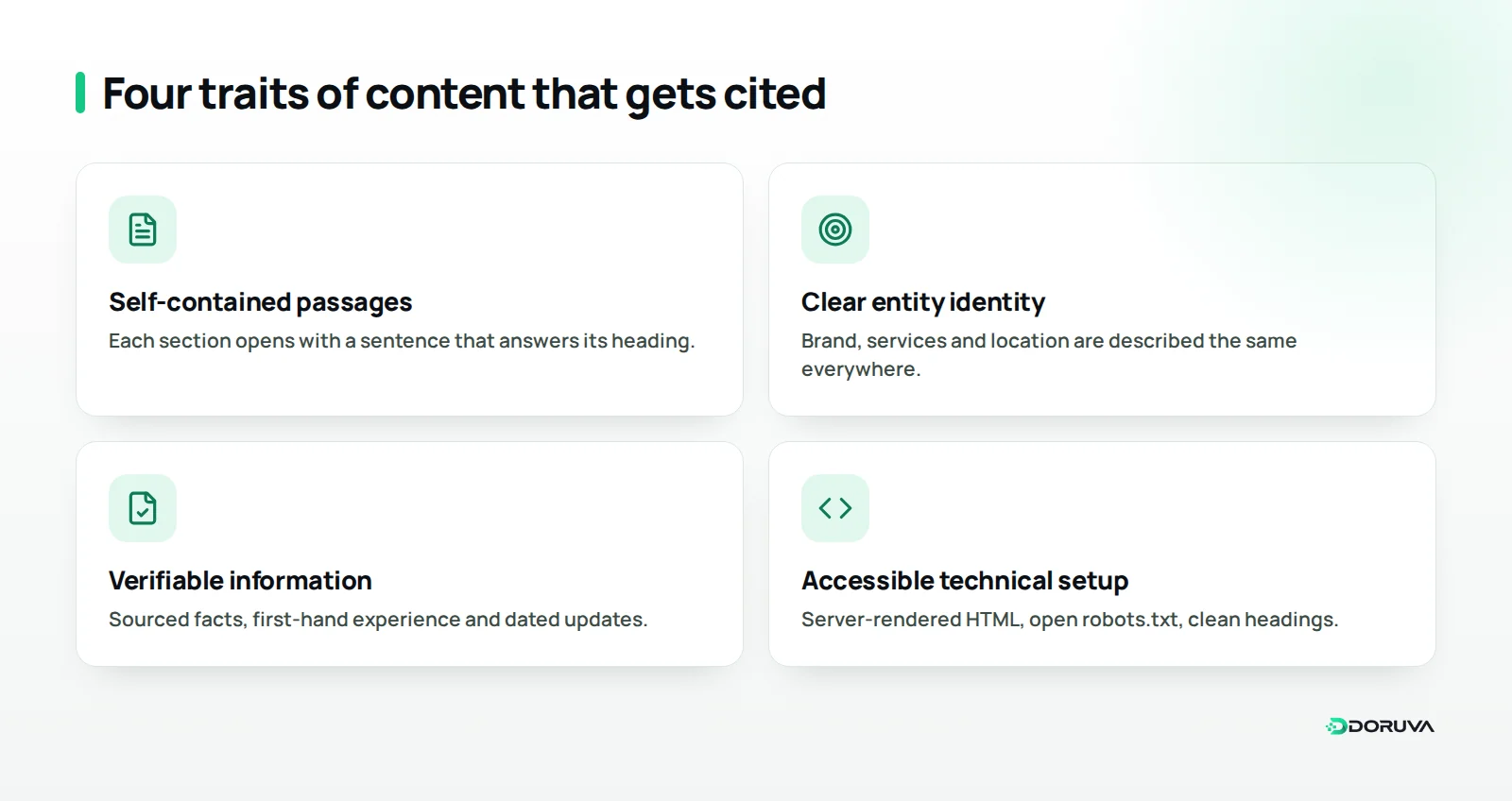
Generative engines tend to favour content that matches the question closely, makes sense on its own and clearly comes from a credible source. Each system has its own selection logic and none of them publish it in full, but good sources share some recognisable traits.
Passages that stand on their own
A paragraph that opens with "As mentioned above" loses its meaning the moment it is lifted out of context. When the first sentence of each section answers its heading directly, a system can pick up that passage and use it as it is. A dental practice's section titled "How many sessions does teeth whitening take?" should give a general answer in its opening sentence, then explain what affects it.
A clear entity identity
AI systems organise knowledge around entities (people, organisations, products, topics) and the relationships between them. What your brand is as an entity, what it offers and where it operates should be described the same way on your website, social profiles, directory listings and any other page about you. If your address is out of date in one place and your list of services differs in another, the system can't tell which version to trust.
Verifiable, original information
Sourced figures, concrete examples, the author's first-hand experience and dated updates all make content more trustworthy. Generic pages that reshuffle what other sites already say add nothing new to a synthesis, so a system has little reason to cite them.
An accessible technical setup
If your content isn't delivered as server-rendered HTML, if key text only appears after JavaScript runs, or if robots.txt rules block AI crawlers without you realising, even excellent writing can stay invisible. A clean heading hierarchy, lists and tables also make it easier to split content into meaningful chunks.
What are the first practical steps in GEO?
The best way to start is to see where you stand and begin with the pages that field the most questions. Working through the steps below in order keeps both the effort and the results manageable, rather than trying to change the whole site at once.
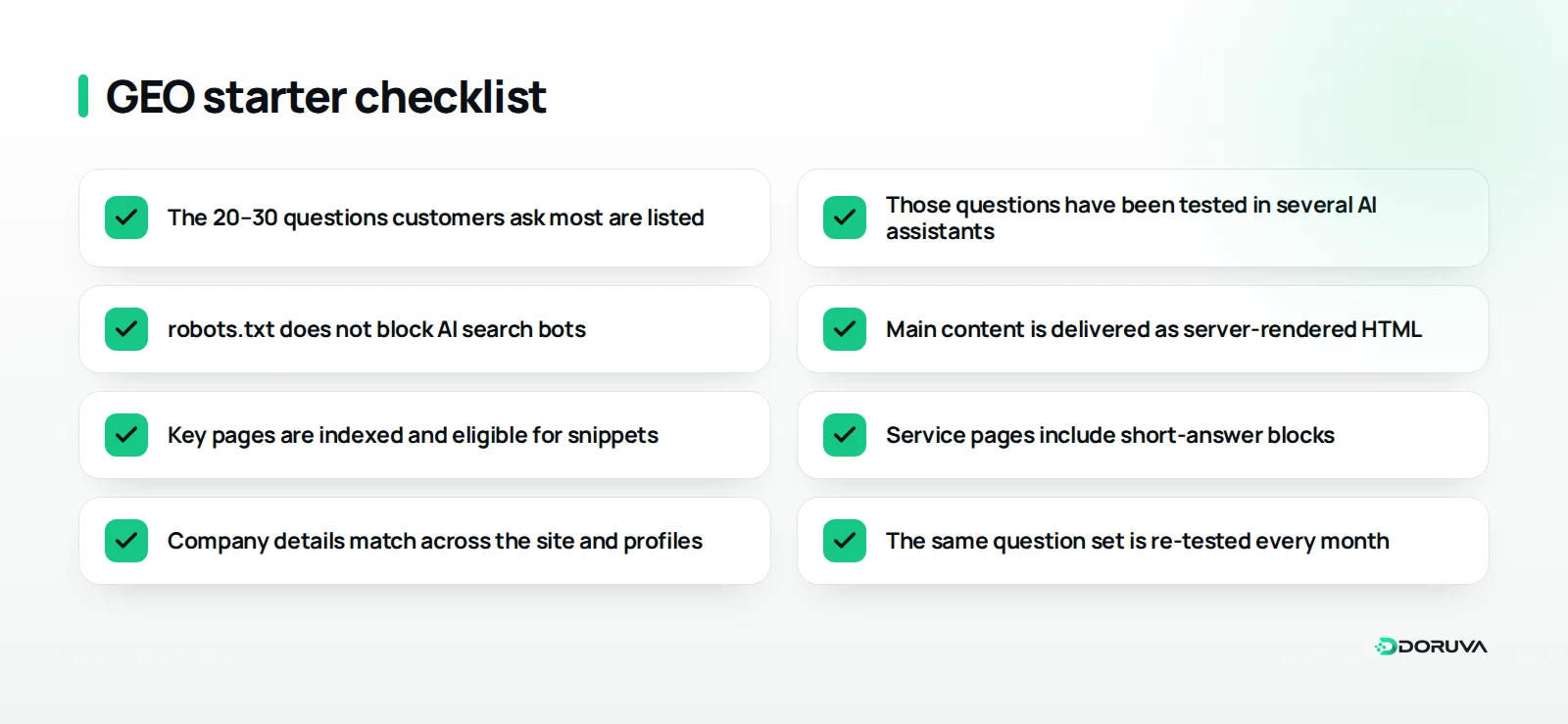
- List the questions: gather the 20 to 30 questions customers ask before they buy. Sales emails, support tickets and your site's internal search are good sources.
- Test today's answers: put those questions to a few AI assistants and note whether your brand is mentioned and which sources are cited.
- Check technical access: review your robots.txt file, how much content is rendered on the server and whether key pages are indexed.
- Restructure key pages: add short-answer blocks, question-style headings and clear definitions to your service and product pages.
- Make entity information consistent: align your company details, structured data and external profiles around one description.
- Track regularly: re-run the same set of questions every month and record what changes.
A coffee roaster, for example, might show up often for informational questions like "how do I brew pour-over coffee at home?" yet never be mentioned for commercial ones such as "where can I buy freshly roasted beans online?" That gap tells you exactly which pages to work on first.
For a quick view of your technical readiness, try our free GEO checker. It reviews readiness signals such as AI crawler access, entity definitions, structured data and quotable content. It assesses readiness rather than measuring visibility, but it makes the starting point clear.
Which GEO mistakes should you avoid?
The most common mistake is treating GEO as a technical trick that delivers quick wins. Because AI systems try to surface reliable, useful sources, shortcuts usually backfire.
- Mass-producing generic content: publishing hundreds of near-identical AI-written pages offers nothing original, so it doesn't improve your chances of being cited and can drag down the perceived quality of the whole site.
- Blocking crawlers wholesale: shutting out every AI bot in robots.txt lumps model training and AI search together. Decide bot by bot, knowing what each one is for.
- Relying on a single file or tag: proposals like llms.txt, or structured data on its own, don't guarantee visibility. They support content and trust signals; they don't replace them.
- Keyword stuffing: repeating the same phrase over and over helps neither search engines nor language models, and it makes the page harder to read.
- Believing guarantees: no provider can promise that your brand will appear in a particular AI answer.
How do you measure the impact of GEO?
GEO is measured by tracking several signals together rather than a single ranking number. Because AI answers can vary by person, location, time and model version, there is no fixed position to report, no equivalent of "we're number three".
The main signals to watch are: how often your brand is mentioned across a fixed set of questions, which of your pages are cited, whether the facts in those answers are correct, your share of visibility compared with competitors, and visits from AI platforms in your analytics. We'll cover each of these measurement methods in detail later in this series.
What matters is the trend, not any single answer. Appearing one month and disappearing the next is normal for these systems; a steady rise over several months is what tells you the work is paying off.
Summary: where should you start with GEO?
GEO is the work of making sure AI systems understand your brand correctly and cite you as a source, and it complements SEO rather than replacing it. It stands on four legs: a solid technical foundation, passages that answer questions directly, a consistent entity identity and verifiable information.
Start small: pick your most important questions, test where you stand and restructure your most critical pages. If you'd like to plan this with an experienced team, take a look at our AI visibility (GEO/AEO) service or get in touch to talk about your brand's AI visibility.
Frequently Asked Questions
Do I need a separate website or separate content for GEO?
No. GEO is about making your existing site and content easier to understand, reach and quote. In most cases the biggest gains come from restructuring the service and product pages you already have.
Can a small business benefit from GEO?
Yes. A local dental practice or a small coffee roaster can appear in the same answers as much larger brands if its content answers questions in its niche clearly and its business details are consistent. Clarity and credibility matter more than the size of the site.
How long does it take to see results from GEO work?
There is no reliable timeline, because recrawling, index updates and model changes all happen at different speeds. That is why it makes sense to track the same set of questions over several months.
Does blocking AI bots in robots.txt affect visibility?
It can. If you block the bots that power AI search features, those systems may be unable to use your pages as sources; whether to allow bots used for model training is a separate decision. Writing separate rules based on what each bot does is the safest approach.
Is an llms.txt file required for GEO?
No. llms.txt is a proposed format for summarising a site's key content for language models, but it is not a standard that every system supports. It can be a useful extra; it doesn't replace content quality or technical access.
Are GEO and AEO the same thing?
They are closely related and often used interchangeably. AEO focuses more on being the source for the answer to a specific question, while GEO covers how a brand is understood and represented across generative systems in general.