AI Visibility
What Is AEO? How to Get Cited in AI Overviews, ChatGPT and Perplexity
AEO (answer engine optimization) aims to make your pages more likely to be cited in AI-generated answers. That takes crawlable pages, a clear answer in the first sentence, information that can be verified and visible signs that the content comes from a credible source.
By Mehmet ÇalışırPublished 10 min read
Contents
Ask "How long does it take to build a business website?" and you will often see a summarised answer before any list of links. The handful of sources shown inside or beside that answer is the new shop window for the topic. This guide is for businesses, marketing teams and agencies who want their content in that window: what AEO is, and how to put it into practice step by step.
What is AEO, and how is it different from GEO?
AEO means preparing content so that it becomes the source of a direct answer to a question. The idea predates AI assistants: Google's featured snippets and the one-line replies of voice assistants were early answer engines. Generative AI made those answers longer, had them combine several sources and made citations far more visible.
GEO and AEO are often used interchangeably, but the emphasis differs. GEO is the wider frame: how generative systems understand your brand, which topics they associate it with and how they describe it. AEO zooms in on something more concrete: when a specific question is asked, is your page the one chosen for the answer? We covered the wider frame in our guide What Is GEO?; this article focuses on the practical side of getting cited.
How do AI Overviews, ChatGPT and Perplexity show their sources?
All of these systems ground their answers in web pages and show the sources they used as links, but they differ in where they find those sources and how they display them. These products change often, so treat the table below as a summary of general behaviour at the time of writing and check each provider's current documentation for details.
| System | Where it finds sources | How it shows them | Your first check |
|---|---|---|---|
| Google AI Overviews and AI Mode | Google's search index | Links within and beside the summary | Googlebot access, indexing and snippet eligibility |
| ChatGPT (search) | A web search run when needed | Source links inline and at the end of the answer | OAI-SearchBot isn't blocked in robots.txt |
| Perplexity | Its own web search and index | Numbered citations and a source list | PerplexityBot can reach your site |
| Microsoft Copilot | Bing's search infrastructure | Source links attached to the answer | Bingbot access and a verified Bing Webmaster Tools account |
The common thread is simple: every answer engine has a search or crawling layer underneath. If that layer can't reach your page, the page won't make the source list, however good it is. OpenAI, for instance, states plainly in its documentation on its crawlers that sites need to allow OAI-SearchBot to appear in ChatGPT's search results.
What do answer engines look for when choosing a source?
Answer engines tend to choose passages that match the question best, are stated clearly and come from a credible source. The choice is usually made section by section rather than page by page. This is known as passage retrieval: the system splits a long page into meaningful chunks and surfaces the one most relevant to the question.
The main factors that influence source selection are:
- Relevance: does the passage answer the actual question, or just circle around the topic?
- Clarity: is the answer stated plainly in the opening sentences, or buried at the end of a long introduction?
- Credibility: is it clear who is speaking, is the source recognised in its field, and can the claims be checked?
- Freshness: if the topic is time-sensitive, does the page reflect the current situation?
- Accessibility: is the text delivered as HTML that crawlers can actually read?
How much each factor weighs depends on the system and the question, and no provider publishes its formula in full. Taken together, though, they paint a consistent picture of what a good source looks like.
How do you write answer-ready content?
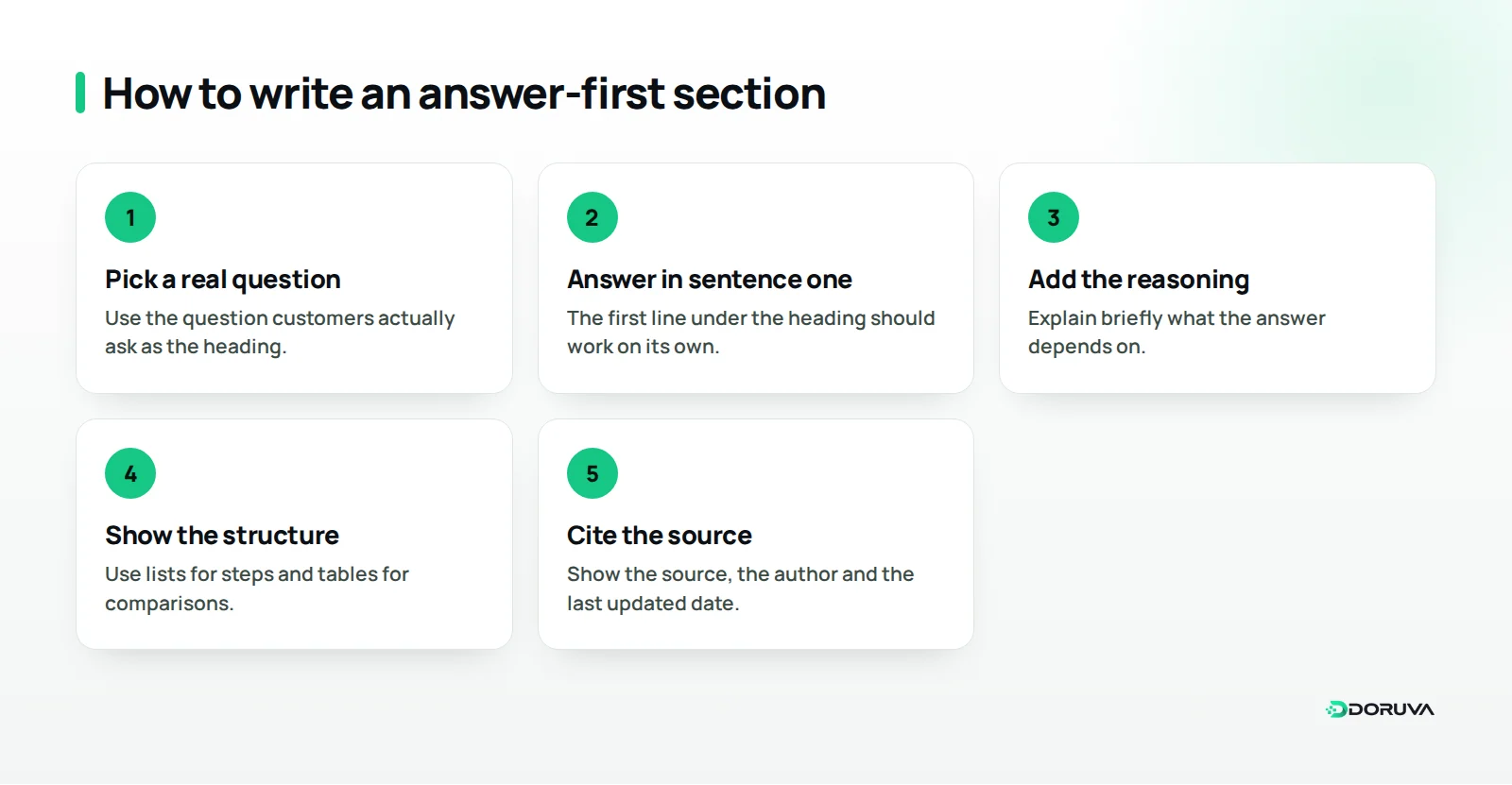
Answer-ready content answers the question directly in the first sentence of each section, then goes into detail. It follows the journalist's inverted pyramid: conclusion first, reasoning next, detail last. That structure serves both the reader in a hurry and the systems that pick out passages.
Take headings from real questions
Turn the questions people actually ask into headings. "How many weeks does a business website take?" tells both readers and machines far more than "Our services" about the intent and the scope of the answer. Questions your sales team hears most often, support tickets and queries in Search Console are all good raw material.
Answer in the first sentence
The sentence immediately below a heading should answer the question even when read on its own. If the honest answer is "it depends", say so, then list straight away what it depends on. A coffee roaster's section headed "How fine should I grind for pour-over?" becomes a quotable passage when its first sentence states the recommended grind and the next ones explain how it changes with the brewing method.
Keep paragraphs self-contained
Every paragraph should still make sense when pulled out of context. Cut back on references like "this" or "the method above", and name the subject again. Short paragraphs that carry a single idea split more cleanly into usable chunks.
Use lists, tables and definitions where they fit
Use a numbered list for steps, a table when comparing options and a definition in the form "X is..." when explaining a concept. These formats tell the system how the information is organised and help readers scan the page quickly.
Be specific and verifiable
Swap vague praise for statements people can check: the cities you serve, the process you follow, the standards you meet. If a claim relies on another source, cite it. Nobody quotes "the best in the industry"; a sentence like "we run an accessibility test on every project before launch" is something an answer engine can actually use.
Before and after: a small example
Picture a web agency's service page with the heading "How many weeks does a business website take?" followed by this: "Every project is unique to us, and we build the right plan together with each client." It may be sincere, but it doesn't answer the question, and no answer engine will use it as a source.
Now imagine the section opened like this instead: "How long a business website takes depends on the number of pages, whether the content is ready and which integrations you need. The process usually runs through discovery, design, development, content entry and testing." It still gives no figure, but it answers the question honestly, says what the answer depends on and sets up the detail that follows. Good AEO writing very often looks exactly like this.
Are your pages technically open to answer engines?
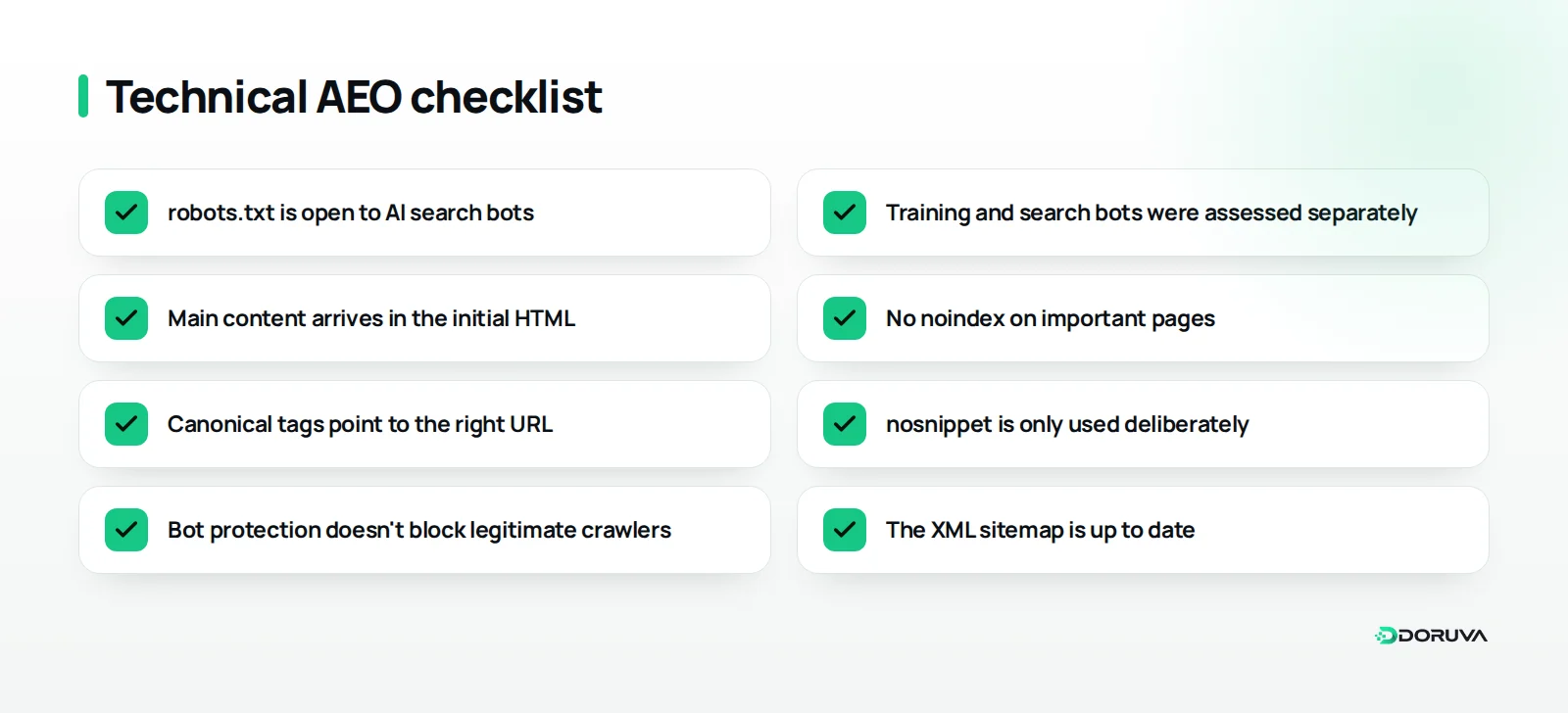
Before an answer engine can cite you, it has to be able to reach your page, read the content and be allowed to use it. If any of those three conditions fails, even the best-written passage stays invisible.
- robots.txt rules: AI companies run different crawlers for different purposes. OpenAI's GPTBot, for example, relates to model training, while OAI-SearchBot relates to ChatGPT's search feature. You can opt out of training and still stay open to search, but only if you write rules knowing what each AI crawler is for.
- Google-specific controls: the Google-Extended token governs whether your content is used for purposes such as training Gemini models, and Google says it does not affect your visibility in Google Search. Appearance in AI Overviews is governed by Googlebot access and snippet controls such as nosnippet.
- Server-rendered content: if key text only appears after JavaScript runs in the browser, not every crawler will see it. Delivering the main content in the initial HTML response is the safest option.
- Indexing: if a page carries a noindex tag, its canonical points elsewhere or it has never been crawled, answer engines that rely on a search index can't use it.
- A stable server: servers that time out frequently, or return errors to crawlers because of aggressive bot protection, quietly cut off access.
Most of these points are part of classic technical SEO; for a fuller list, see our technical SEO checklist.
What does structured data do for AEO?
Structured data describes the information on your page in a standard, machine-readable vocabulary, which helps systems interpret your content correctly. With structured data (schema markup) you can state explicitly whether a page is an article, a product or a local business, who wrote it and which organisation it belongs to.
It pays to set expectations carefully, though. Structured data on its own won't get you into an AI answer, and marking up information that isn't visible on the page breaks the guidelines. The visual payoff of some markup types has also changed over time: in 2023 Google limited FAQ rich results largely to well-known government and health websites. Even so, this kind of markup still describes the structure of your content to machines.
For AEO, a sensible order of priority is usually: Organization markup that defines your company, Article markup with author and date on content pages, the relevant types on product and service pages, and LocalBusiness markup with address and opening hours for local businesses. The rule that applies to all of them is that the markup must match what is visible on the page.
Which trust signals make a citation more likely?
Answer engines are more inclined to cite pages where it is clear who the information comes from and where other sources back it up. However well written, content with an anonymous or unclear source behind it is a risk for the system.
- Visible authorship and expertise: show who wrote the content, what experience it draws on and who reviewed it. A dental practice naming the dentist and their credentials on a treatment guide is a good example.
- Consistent business details: your name, address, phone number and service descriptions should match across your site, map listings and directories.
- External mentions: being mentioned in trade publications, professional bodies or reputable directories shows that you genuinely operate in the field.
- Original information: your own processes, observations and examples can't be found anywhere else, which is exactly what makes them worth quoting.
- Freshness notes: on time-sensitive pages, show the last updated date and what changed.
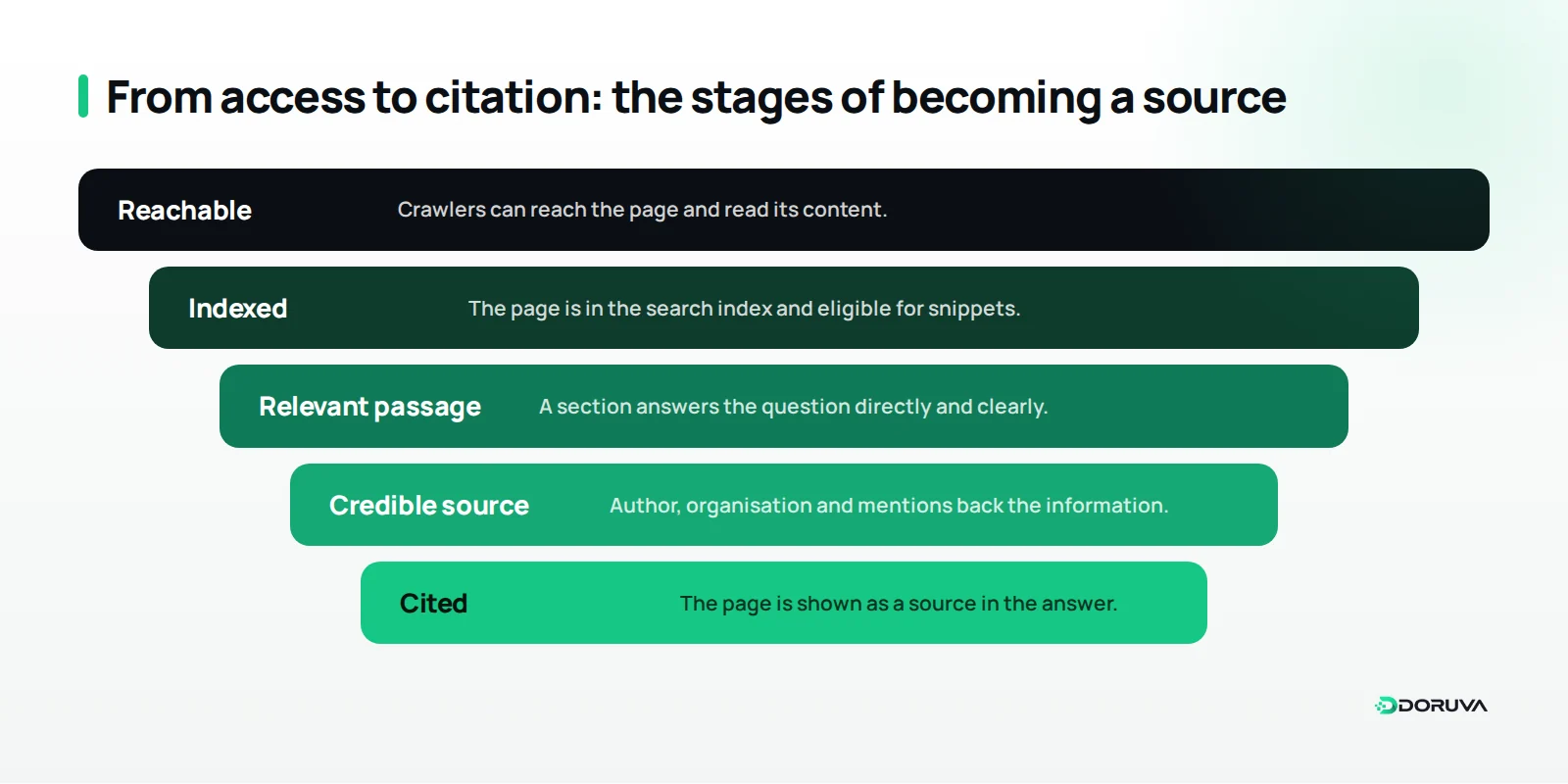
These signals work together rather than one by one. The diagram below shows the stages a page passes through on the way from being reachable to being cited; each stage builds on the one before.
How do you track the results of AEO work?
You track AEO by checking, at regular intervals, how often you are cited across a defined set of questions. Because AI answers can vary with time, user and location, repeated measurements tell you far more than any single test.
A simple way to start: list your target questions in a spreadsheet, put the same questions to a few answer engines every month, and record whether your brand is mentioned, which of your pages is cited and whether the answer is accurate. Add visits from AI platforms in your analytics to the picture. We'll cover how to set up this kind of measurement in detail in an upcoming post in this series.
Summary: where should you start if you want to be cited?
AEO is about organising your content so that answer engines can find it, understand it and quote it with confidence. Secure technical access first, then write answer-first sections for your most important questions, and back that content up with structured data and trust signals.
To see where your site stands, run a free readiness check with our GEO checker. If you'd like to work on your question set, content structure and technical setup together, explore our AI visibility service or contact us to plan your AEO work.
Frequently Asked Questions
Is AEO only worth it for large websites?
No. Answer engines look at how clearly and credibly a passage answers the question, not at the size of the site. A small business site that answers questions in its niche well can be cited too.
What does a page need to be cited in AI Overviews?
According to Google's documentation, the page must be indexed and eligible to be shown in Google Search with a snippet. Beyond that there is no special markup requirement; how well the content answers the question is what counts.
If I block GPTBot, can I still be cited in ChatGPT?
According to OpenAI's documentation, GPTBot relates to model training while OAI-SearchBot relates to ChatGPT's search feature. You can block GPTBot and allow OAI-SearchBot to remain eligible for search results.
Will adding an FAQ section get me cited?
Not on its own. A well-written FAQ that answers real questions can make passage selection easier, but clarity, accuracy and the credibility of the source have the bigger effect.
Should I make my content shorter for AEO?
No. What matters is giving a clear answer at the start of each section, not cutting length. Detailed content that is well sectioned can answer several different questions and gives readers more value.
How can I tell whether I'm being cited?
Put your target questions to answer engines regularly and record the sources they list. Tracking visits from these platforms separately in your analytics also hints at which of your pages are being cited.