SEO
What Is E-E-A-T? How to Show Google's Trust Signals on Your Site
E-E-A-T, short for experience, expertise, authoritativeness and trustworthiness, is the framework Google uses to describe reliable content. This guide explains each part, why it matters most for YMYL topics and how to reflect trust signals on your site, from author pages to structured data.
By Mehmet ÇalışırPublished 10 min read

Contents
This guide is for teams running a service site, a company blog or an online store who want to understand why their content is not earning trust. We cover what E-E-A-T is, what it is not, and what it should look like on your pages in practice. If you want to make sure the technical foundation is solid before working on content signals, start with our technical SEO checklist.
What is E-E-A-T? The four letters explained
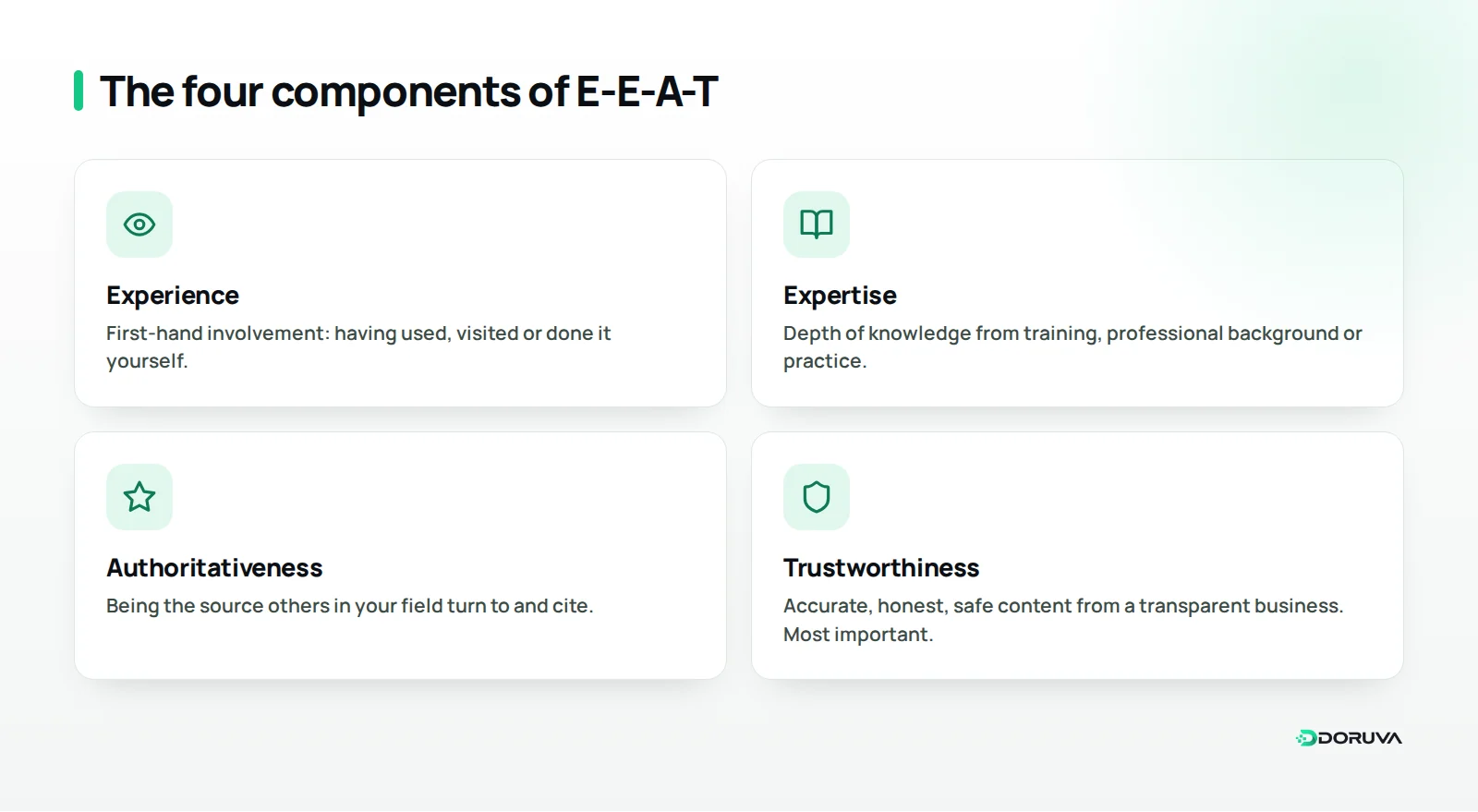
E-E-A-T is a set of four qualities used to judge how reliable a piece of content, and the person or organisation behind it, really is. The concept comes from Google's Search Quality Rater Guidelines, the handbook for the people who evaluate the quality of Google's search results. In December 2022, Google added "Experience" to what had previously been known as E-A-T.
- Experience
- The creator has first-hand experience of the topic: they have used the product, visited the place or done the work themselves.
- Expertise
- Knowledge and skill in the subject, whether from formal training, professional background or years of practice.
- Authoritativeness
- Recognition as a go-to source in the field: how far others cite and refer to you.
- Trustworthiness
- Content that is accurate, honest and safe, published by an organisation that behaves transparently.
According to Google, trust is the most important of the four. The other three contribute to it, but content does not need to demonstrate all of them. An honest product review based on a customer's own use, for instance, can be trustworthy without any expert credentials.
Is E-E-A-T a ranking factor?
No. E-E-A-T is not a single, measurable ranking factor; Google's systems use a mix of many signals to identify content that demonstrates these qualities. Google says so plainly in its guide to creating helpful, reliable, people-first content.
Quality raters' scores do not directly change how individual pages rank either. Their evaluations help Google understand whether its search systems are producing good results. So there is no "E-E-A-T score" to push up; the goal is for these qualities to genuinely exist and to be clearly visible to readers and search engines alike.
The distinction matters in practice. Adding an author box, or a line saying "written by our expert team" under every article, changes nothing on its own. What makes the difference is the real knowledge behind the content and the evidence for it.
Why does E-E-A-T matter more for YMYL topics?
For topics that could significantly affect people's health, finances or safety, or the welfare of society, Google gives even more weight to content with strong E-E-A-T signals. These topics are known as YMYL (Your Money or Your Life).
Health, finance, legal matters and safety are typical examples. A dental clinic's page about implant treatment is held to a different standard than a coffee brand's brewing guide. Because bad advice on the first could harm a reader, it matters far more who wrote or reviewed it, which sources it relies on and when it was last updated.
If you publish YMYL content, ask three questions of every page. Who wrote or approved this information? Which reliable sources does it rest on? Does it clearly tell readers to seek professional advice for their own situation?
How do you show experience and expertise in your content?
Experience and expertise are best shown through first-hand detail that no other source has. The moment a reader thinks "whoever wrote this really knows the subject", both qualities become visible.
Use first-hand evidence
Your own photos, process steps, the problems you ran into and how you solved them are the strongest signs of experience. A coffee brand's brewing guide, for example, can share its own tasting notes, grind settings and what happened when it tried different methods. That kind of detail never appears in content written by summarising other websites.
Make the author visible
Every piece of content should say clearly who wrote it. The author's name should link to a short bio covering their relevant background and to an author page that collects their other work. On YMYL topics, naming the expert who reviewed the content alongside the author adds further trust.
Add depth and originality
Expertise shows in the details, not the surface. After answering the reader's main question, address the second and third questions they are likely to have, and cover common mistakes and exceptions. Share observations from your own work, but use concrete, checkable information rather than figures and generalisations you cannot verify.
Apply Google's "Who, How and Why" questions
Google suggests asking three questions when you evaluate your own content:
- Who: Is it obvious to readers who created the content?
- How: Is it clear how the content was produced? If you tested a product, do you explain the method? If automation or AI was involved, is that disclosed where readers would reasonably expect it?
- Why: Was it created primarily to help people, or mainly to attract search traffic?
If you can honestly answer "yes, it is clear who we are; yes, we explain our method; yes, we wrote it to help the reader", you are on the right track.
Authority: what do others say about you?
Authority means your site and brand are recognised as a source others turn to, and it largely forms outside your own website. What others say about you counts for more than what you say about yourself.
- Topical focus: consistent, in-depth content in a defined field builds a stronger impression of expertise than covering everything.
- Mentions and links: your name and content appearing in industry publications, professional bodies' websites and other reliable sources.
- Genuine customer reviews: especially for local businesses, reviews on platforms such as Google Business Profile, and how you respond to them.
- Consistent brand information: the same company name, address, contact details and social profiles everywhere.
Authority cannot be bought; it is earned over time. Contributing expert commentary to industry publications, speaking at events, publishing thorough guides others want to cite and creating content with partners all lead to natural mentions. Paying for links, on the other hand, violates Google's spam policies and can harm your site in the long run.
The same signals can also help AI-powered answer engines treat you as a reliable source. We cover this in detail in our articles on how GEO differs from SEO and how to get cited in AI Overviews, ChatGPT and Perplexity.
Trustworthiness: how do you build trust signals into your site?
Trust starts with readers and search engines being able to confirm, easily, that a real, reachable and honest organisation stands behind your site. It is not built on one page but in small details across the whole site.
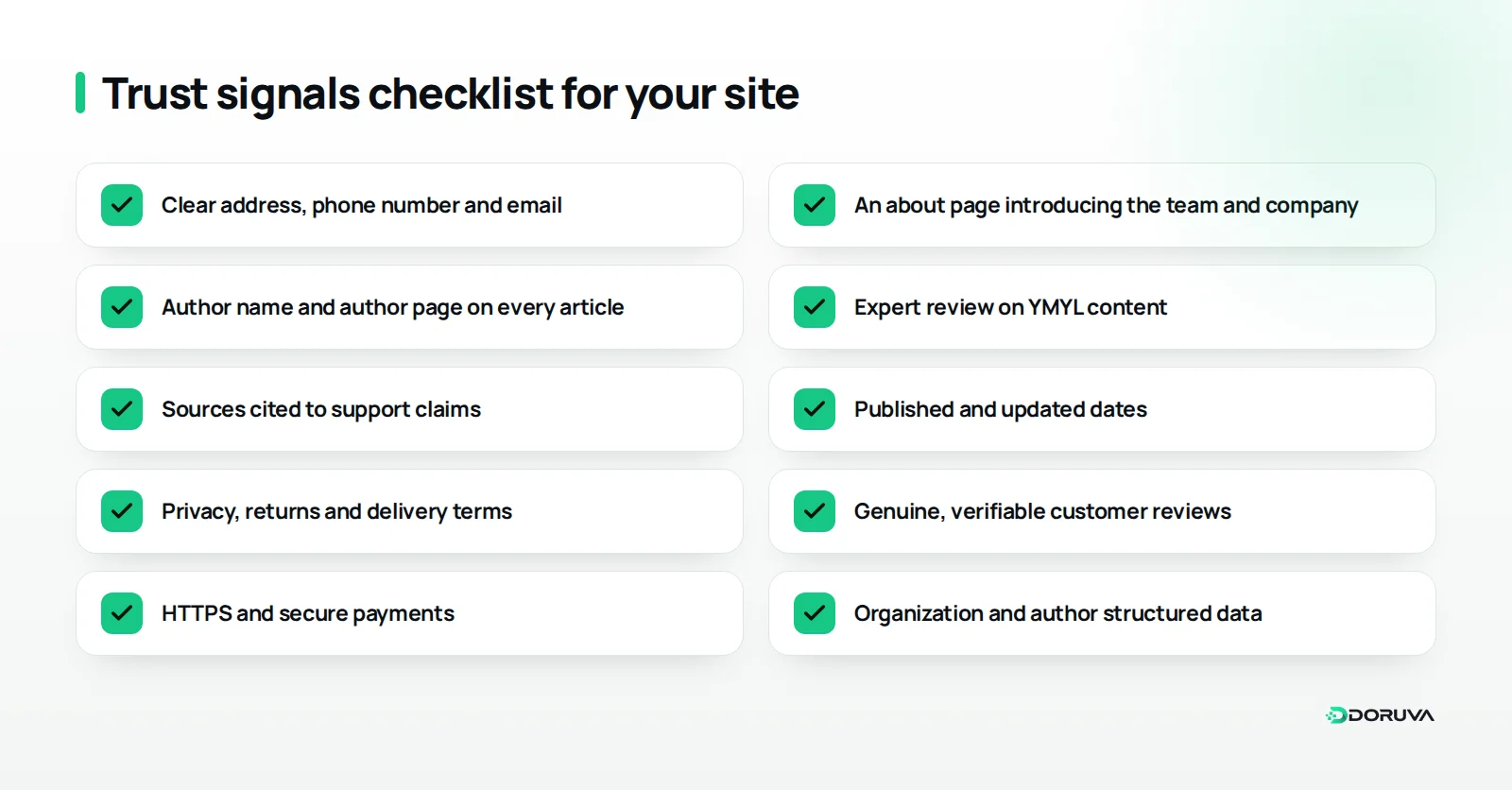
| Trust signal | Where it lives | Why it matters |
|---|---|---|
| Clear contact details | Contact page, footer | Shows readers they can reach you |
| About and team information | About page | Introduces the people and organisation behind the content |
| Author and reviewer details | Top or bottom of articles, author pages | Makes the source of information transparent |
| Cited sources | Within the content | Makes claims verifiable |
| Published and updated dates | Near the article title | Shows whether information is current |
| Privacy and sales terms | Legal pages, checkout | Builds confidence around data and money |
| HTTPS and secure payments | Site-wide | Shows connections and transactions are protected |
For a digital agency or consultancy, trust signals look slightly different: the names and roles of real team members, project examples shared with the client's permission, pages that spell out what each service covers, and a contact process that actually answers questions. Visitors want to see who they would be working with before they decide.
On online stores, easy-to-find returns, delivery and payment terms are a core part of trust. If you collect personal data, publish a privacy notice that meets the data protection law that applies to you; in Türkiye that is the Personal Data Protection Law (KVKK), Law No. 6698, with guidance available from the Personal Data Protection Authority. This article is not legal advice, so please consult a lawyer about your specific situation.
Nothing erodes trust faster than exaggerated promises, unsourced numbers, unverifiable testimonials and "up-to-date" guides that have not been touched in years. When you spot an error, correcting it and noting the correction on the page earns more trust than quietly deleting it.
Using structured data to explain E-E-A-T signals to machines
Structured data lets you mark up the author, organisation and content details already visible on a page in a format search engines and AI systems can read easily. It does not create E-E-A-T; it makes existing signals clear and consistent.
- Organization: use Organization schema to define your company name, logo and contact details, and list your official social profiles with the sameAs property.
- Article and author: in article markup, specify the author as a Person and include the URL of their author page.
- Person and ProfilePage: on author pages, mark up the person's name, role and relevant profiles.
- LocalBusiness: for businesses with a physical location, give the address, opening hours and contact details consistently.
The core rule never changes: only mark up accurate information that readers can also see on the page. Adding a title or award to the markup that the page itself does not mention creates risk, not trust.
Where should you start? A priority order
The fastest impact comes from closing trust gaps on the pages that get the most visits and matter most to your business. Rather than rewriting the whole site at once, work in this order:
- Make sure your about, contact and legal pages are complete and current.
- Add author details to your key content and create author pages.
- Have an expert review your YMYL pages, and add sources and update dates.
- Strengthen your highest-traffic content with first-hand examples, photos and original information.
- Add Organization and author markup, and align your brand details across every platform.
- Merge, update or remove outdated, thin or overlapping content.
This is not a one-off task. Reviewing key pages at regular intervals, refreshing their information and adding new first-hand experience is the most reliable way to keep trust intact.
Summary and next steps
E-E-A-T is Google's way of describing trustworthy content: real experience, demonstrable expertise, authority that others recognise and, above all, trust. Treat it not as a ranking score but as the quality of the promise you make to your readers, and you will stand on firmer ground in both search results and AI-generated answers.
To see how ready your site is for AI answer engines, try our free GEO checker. If you want your content and trust signals handled as part of a single strategy, take a look at our SEO service and our AI visibility service, which focuses on how your brand appears in AI answers. To review your site together, get in touch with our SEO team.
Frequently Asked Questions
What is the difference between E-E-A-T and E-A-T?
E-A-T covered expertise, authoritativeness and trustworthiness. In December 2022, Google added a second E for first-hand experience to its quality rater guidelines, updating the framework to E-E-A-T.
How can a small business website strengthen its E-E-A-T signals?
Real contact details, an about page that introduces the team, photos and examples from your own work, genuine customer reviews and consistent brand information are a strong start. None of these needs a big budget, and all of them make it easier for readers and search engines to verify you.
Does AI-generated content go against E-E-A-T?
Google does not treat the use of automation or AI as a problem in itself; what matters is whether content is made to help people or to manipulate rankings. Still, content without first-hand experience or expert review struggles to carry trust signals.
Will adding author pages directly improve rankings?
No, an author page does not boost rankings by itself. It does make it transparent who wrote the content and with what background, which supports both reader trust and Google's assessment of trust signals.
Is E-E-A-T only important for health and finance sites?
No, it matters for every site, but expectations are much higher for YMYL topics such as health, finance, law and safety. Because inaccurate information there can harm readers, Google gives strong trust signals more weight.