AI Visibility
How AI Understands Your Brand: Structured Data, Entity SEO and llms.txt
AI systems recognise your brand from what the web consistently says about you. Structured data defines your brand as a machine-readable entity, entity SEO keeps that definition consistent across external profiles, and llms.txt is an optional proposal. This guide shows what to do, and in what order.
By Mehmet ÇalışırPublished 11 min read

Contents
When someone asks ChatGPT or Perplexity "Which dentists near me do implants?", the model isn't matching your page to a keyword. It is trying to work out what kind of business you are: who you are, what you do, where you operate and what other people say about you. This guide is for business owners, marketing teams and agencies who want their brand described accurately in AI answers, and it covers structured data, entity SEO and llms.txt in the order that actually pays off. If the terminology is new to you, start with our explainer on what GEO is and how it differs from SEO.
How does AI "recognise" a brand?
AI learns about a brand in two ways: from what the model absorbed during training, and from the sources it retrieves while it answers. The first is the model's memory, and it is frozen at a point in time; if your brand is young or rarely mentioned, that memory may be thin, out of date or simply wrong. The second is retrieval: systems such as ChatGPT search, Perplexity and Google's AI Overviews fetch current pages from the web and summarise them on the spot.
Both routes share one habit. The model reads your pages not as bags of words but as a set of connected entities. An entity is a thing that can be told apart from everything else by its name, type and attributes: a company, a person, a product, a city, a service. "Example Coffee Co." on its own is just a string of characters. Described as a specialty roaster in Bristol that sells beans online, it becomes an entity.
Take that fictional roaster. When a model comes across the name, it wants answers to a handful of questions. Is this a café, a roastery, or a different business with the same name? Which website is the official one? Which city? What do independent sources say about it? The clearer and more consistent those answers are across the web, the better your chances of being described correctly. Ambiguity leads to one of two outcomes: you are left out, or you are mistaken for someone else.
What is entity SEO, and how is it different from keyword SEO?
Entity SEO is the work of defining your brand, and the people, products, services and locations connected to it, as entities that search engines and language models can identify without guessing, and then keeping that definition consistent everywhere it appears. Keyword SEO starts with "Which queries do I want to show up for?". Entity SEO starts with "Who do machines think I am?".
Google has long stored entities and the relationships between them in its Knowledge Graph. If you have ever searched for a company and seen a knowledge panel beside the results, you have seen it at work. Language models do something similar when they infer, from context, which real-world thing a name refers to. Your job is to make that inference easy.
| Criterion | Keyword SEO | Entity SEO |
|---|---|---|
| Core question | Which queries should I rank for? | Who and what do machines think I am? |
| Unit of work | Query and page | Brand, people, products, places and how they relate |
| Main tools | Content, headings, internal links | Structured data, consistent profiles, off-site mentions |
| Sign of success | Rankings, impressions and clicks | Correct identification, a knowledge panel, accurate AI descriptions |
| Scope | Mostly individual pages | The brand's identity across the web |
The two aren't alternatives. Keyword research tells you what to write about; entity work makes it clear to machines who is doing the writing. The author bios, company details and proof of expertise we covered in our guide to E-E-A-T are, in effect, entity signals too.
What does structured data tell AI?
Structured data labels the information on your page with the Schema.org vocabulary, so machines are told outright: this is a company, here is its name, its logo and its official profiles. Google recommends the JSON-LD format, which sits in the page source as a separate block and doesn't change what visitors see. The ground rules are set out in Google's introduction to structured data.
One distinction matters here. Google uses structured data for rich results such as review stars, product details and event dates, and it says plainly that markup doesn't guarantee a rich result. How AI systems use schema when they compose an answer is mostly not documented in public. Even so, schema is the tidiest signal you have for reducing ambiguity: it states your name, type, address and official profiles in one place, so nothing has to be guessed.
sameAs: the property that connects your entity to the web
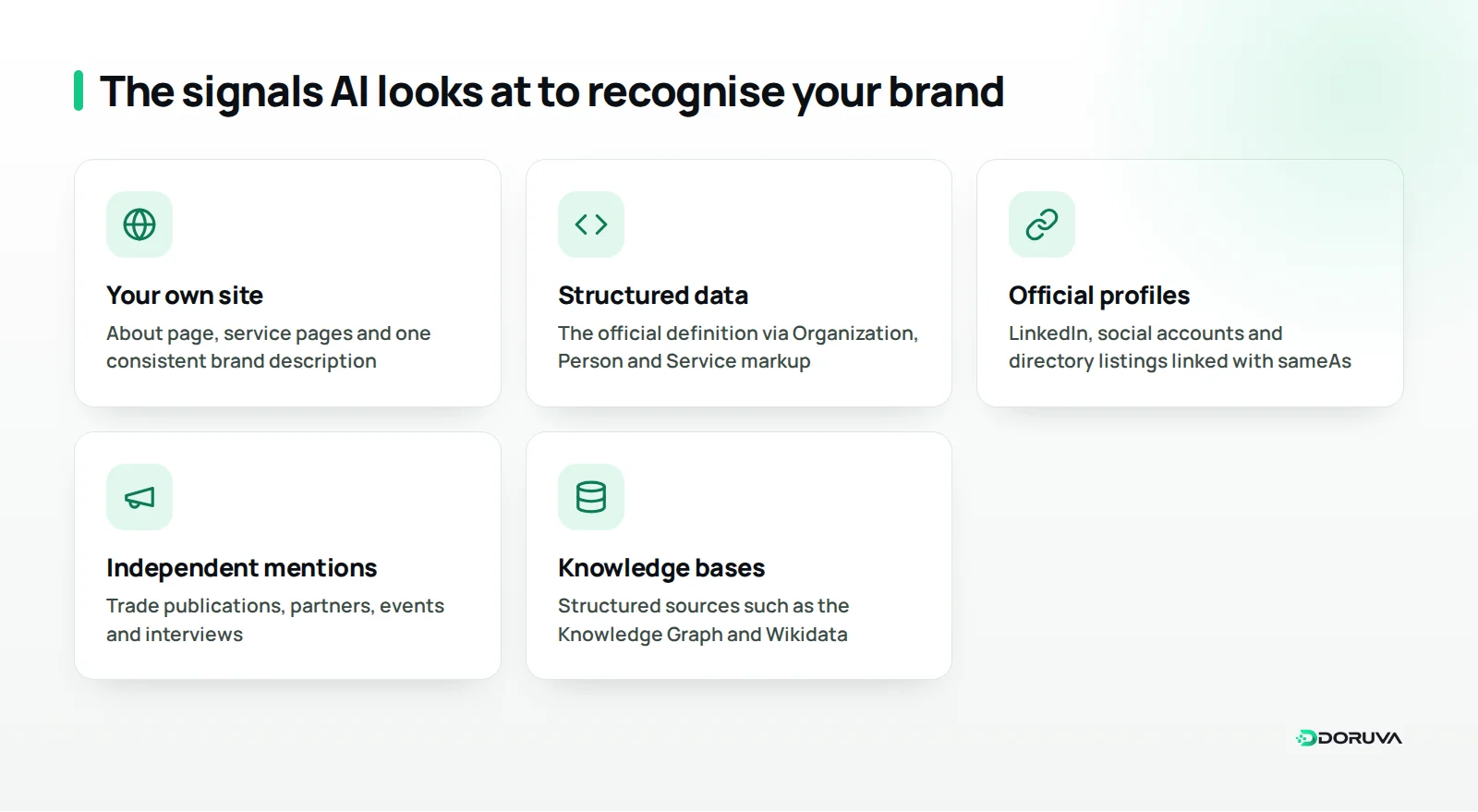
The sameAs property in Organization or Person markup says "this entity is the same one described at these URLs". You list your LinkedIn company page, your Instagram and YouTube accounts, your Wikidata item if you have one, and your official listings in industry directories. That lowers the risk of being confused with a namesake and pulls scattered profiles together under a single identity.
Markup and visible content must agree
What your schema says has to match what the page shows. Adding an address, a review rating or a service that doesn't appear on the page goes against Google's guidelines and erodes trust. The rule is simple: schema repeats what the page says in machine language, and nothing more.
Which schema types should you start with?
For most businesses the right starting point is Organization markup that describes the brand itself. If customers visit you in person, LocalBusiness with a fitting subtype (Dentist or CafeOrCoffeeShop, for example) is more precise. Your website, your people and what you offer come next.
- Organization or LocalBusiness: name, logo, official URL, a short description, contact details, address and sameAs links. Usually defined once, on the home page or the about page.
- WebSite: the site's name and main URL. Google draws on this markup when it decides which site name to show in search results.
- Person and ProfilePage: founders, specialists and authors. For a dental practice, this is where each dentist's specialism and training belong.
- Service and Product: what you sell. On an online store, Product markup carries price, availability and variants.
- Article or BlogPosting: author, publication date and last-updated date on blog posts.
- BreadcrumbList: where the page sits in your site hierarchy.
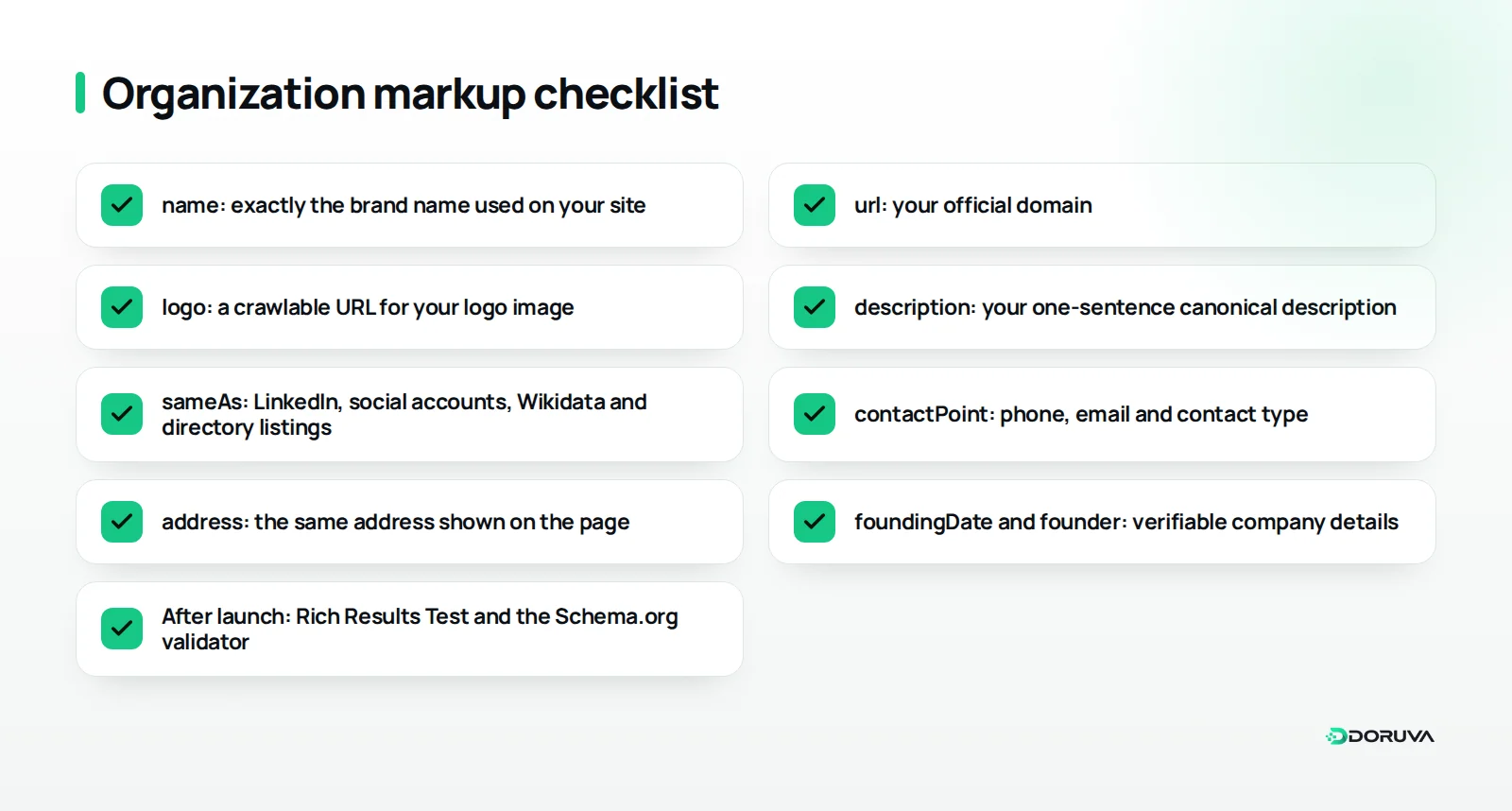
A word of caution: Google has narrowed the rich result display for some types over the years, FAQPage among them. A type that no longer earns a rich result isn't useless, but don't add markup purely for a visual win; focus on marking up what is genuinely on the page. Once it's live, check it with Google's Rich Results Test and the Schema.org validator. For the full list of types and properties, the Organization page on Schema.org is a good reference.
What is llms.txt, and does it actually help?
llms.txt is a proposed text file, placed at the root of your site, that summarises in Markdown what the site is and which pages matter most, written for language models. It was put forward in 2024 and the proposal is documented at llmstxt.org. It isn't an established standard in the way robots.txt or an XML sitemap is.
To be frank, it is unclear which AI systems read the file regularly or use it in their answers. Google says that appearing in its AI features needs no special files or markup beyond normal SEO best practice. So treat llms.txt as cheap, optional housekeeping rather than a ranking lever. It earns its keep mainly on software products with large documentation sets, where it helps developers point their own AI tools at the right pages.
If you decide to add one, keep it plain:
- Your brand name and the same one-sentence description you use on your site.
- Links to your main service or product pages, each with a short note on what it covers.
- Core reference pages: about, contact and frequently asked questions.
- Documentation, policies and technical resources, if you have them.
The rule that matters: whatever the file says must match the rest of your site and your schema. Three different descriptions in three places are worse than none at all. And the file doesn't decide whether AI crawlers can access your site; that is the job of robots.txt.
In short, the three tools play different roles:
- Structured data
- The official, machine-readable definition at page level. Documented and supported by Google, and the place to invest first.
- Entity SEO
- Ongoing work that keeps the brand's identity consistent across the web. The slowest layer to show results, and the most durable.
- llms.txt
- A proposed summary file for language models. Not a standard and of uncertain effect; treat it as a low-cost extra.
How do you make your brand consistent across the web?
AI doesn't learn about your brand from your own site alone. What builds confidence is other sources saying the same things your site says. If a dental practice calls itself "Riverside Dental" on its website, "Riverside Dental Care and Implant Centre" on Google Business Profile and appears on Instagram only as a handle, a model may struggle to see that these are one business.
Work through these areas:
- One brand description: write a single sentence that says what you do, for whom and where, and use it word for word on your site, LinkedIn, Google Business Profile, directory listings and press kit.
- Consistent name, address and phone number: for local businesses, these three details should be written the same way on every platform. Old addresses and closed branches need cleaning up.
- A concrete about page: when you were founded, who runs the company, the team, the area you serve and what you actually do. Verifiable facts, not slogans.
- Mentions in independent sources: trade publications, partner websites, events and interviews. Even mentions without a link help a model associate your brand with the right context.
- People profiles: your specialists' bios on the site should describe the same person, with the same title and expertise, as their LinkedIn and speaker profiles.
Be careful with Wikipedia and Wikidata. Wikipedia has notability rules, and articles created for promotion tend to be deleted; Wikidata has its own inclusion criteria. Both are a natural next step once independent sources already cover your brand, not a shortcut to get there.
What are the six steps to introduce your brand to machines?
The most efficient order is to look at where you stand, write your canonical description, and only then roll it out to schema and external profiles. Starting with schema and rewriting the description later means doing the job twice.
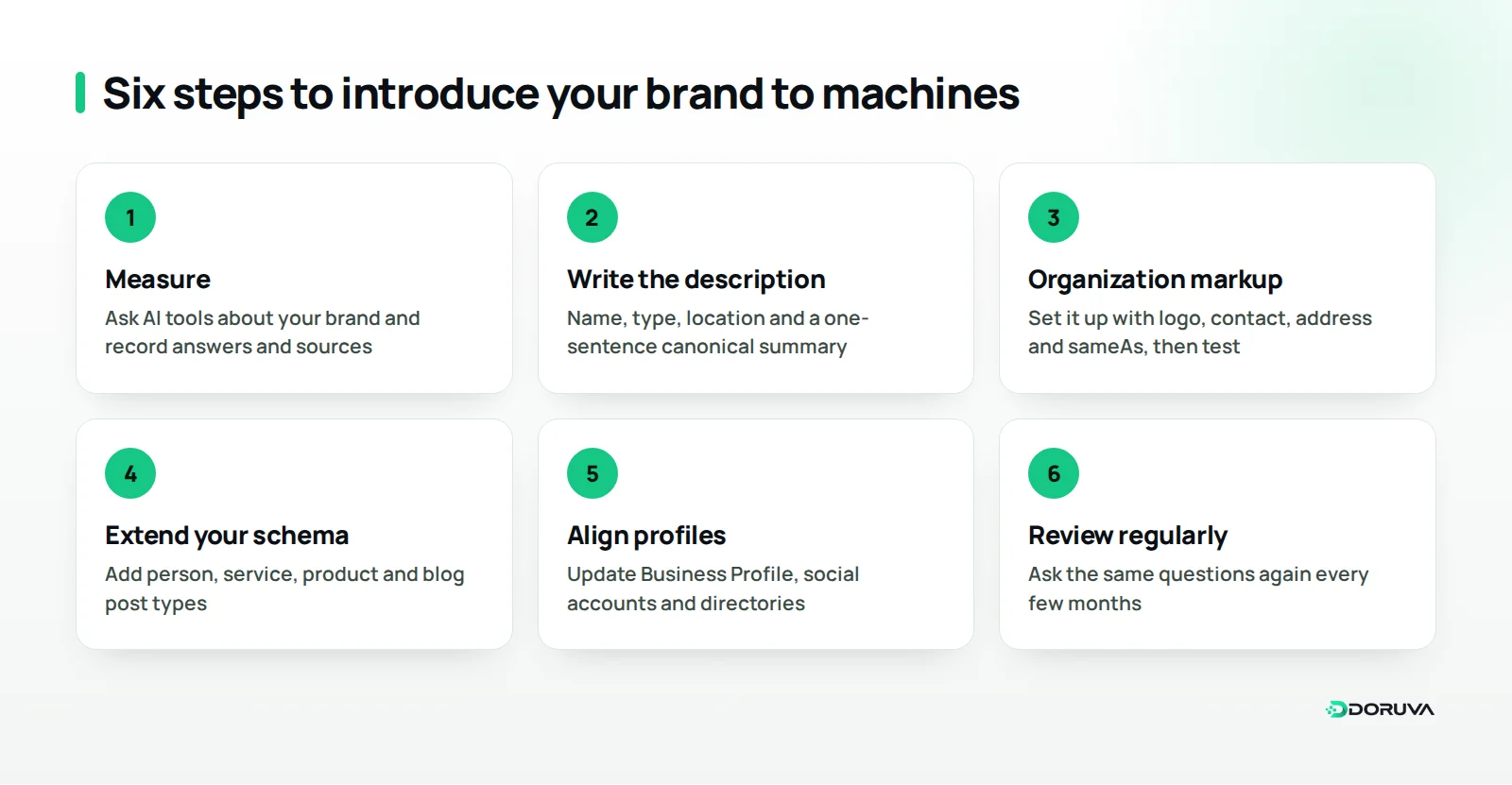
- Measure where you stand. Ask ChatGPT, Perplexity, Gemini and Google about your brand and your category, and note what they say and which sources they cite. We cover the methods in our guide to measuring AI visibility; for a quick first check, try our free GEO checker.
- Write the canonical description. Name, type, location, services and a one-sentence summary. Everything else is derived from this text.
- Set up Organization markup. Add it to the home page or about page with your logo, contact details, address and sameAs links, then test it.
- Add people, service and content markup. Use the right types for specialist bios, service pages and blog posts.
- Align external profiles. Update the name, description and contact details on Google Business Profile, social accounts and directory listings to match the canonical text.
- Optionally add llms.txt, and review regularly. Ask the same questions again every few months and track what changes; when a service, address or team member changes, update it everywhere at once.
Summary: tell machines plainly who you are
AI describing your brand accurately isn't luck; it is the result of clear, consistent signals. Structured data provides the official definition, entity SEO confirms it across the web, and llms.txt is an optional extra. Order matters: one canonical description first, then schema, then external profiles.
The hardest part is usually organisational rather than technical: finding out who manages which profile, clearing out stale information and getting everyone to use the same description. Through Doruva's AI visibility (GEO/AEO) service, we map how your brand currently appears in AI answers and handle the schema and entity work across your site and external profiles together. If you'd like to talk through where your brand should start, get in touch with our team.
Frequently Asked Questions
Will adding structured data get my brand into ChatGPT answers?
Not on its own. Structured data makes your brand clearer to machines and reduces ambiguity, but no markup guarantees a place in an AI answer. Visibility also depends on the quality of your content, mentions in independent sources and how each system selects its sources.
Where should a small business start with schema markup?
For most small businesses, the most valuable first step is Organization or LocalBusiness markup with sameAs links, added to the home page or about page. Service, person and blog post markup can be layered on top later.
Is a site without an llms.txt file at a disadvantage?
There is no reliable evidence of that today. llms.txt is a proposal rather than a standard, and Google says no special file is needed to appear in its AI features, so adding one does no harm but shouldn't be a priority.
How long does entity SEO take to show results?
Schema changes on your site can be read once pages are recrawled, but the way AI answers describe you can take longer to shift. Answers that rely on a model's memory only update with new training runs, so track progress by asking the same questions at regular intervals.
What should I do if an AI tool gets facts about my brand wrong?
Find where the wrong information comes from first: an old directory listing, a closed branch or a different business with the same name are common culprits. Fix that source, make the correct facts clear on your site and in your schema, and use the tool's own feedback option as well.