Technology
Client Onboarding for Agencies: A First-30-Days Checklist
Client onboarding is the first stretch after signing, when an agency brings a new client into its way of working. This guide gives you a checklist that splits the first 30 days into an internal prep phase and four weeks, with a clear output for each stage.
By Mehmet ÇalışırPublished 10 min read
Contents
This guide is for agency owners, account managers and project managers. Winning a client ends the sales process, but the real test of the relationship starts in the first few weeks: access requests stall, the brief has gaps, and promises made during the pitch never reach the delivery team. The 30-day checklist below gives you a week-by-week framework so every new client gets the same quality of start.
What is client onboarding, and why do the first 30 days matter?
Client onboarding is the structured start-up period in which a new client gets to know the agency, and the agency learns the client, the brand and the goals. Its purpose is to align both sides on information, access and expectations before regular work begins.
The first 30 days carry so much weight because this is when the client first experiences what working with you is actually like. Showing up prepared, hitting the dates you promised and asking each question only once builds trust. Being asked for the same information by three different people, or watching weeks pass while access is pending, wears the relationship down before the first piece of work ships.
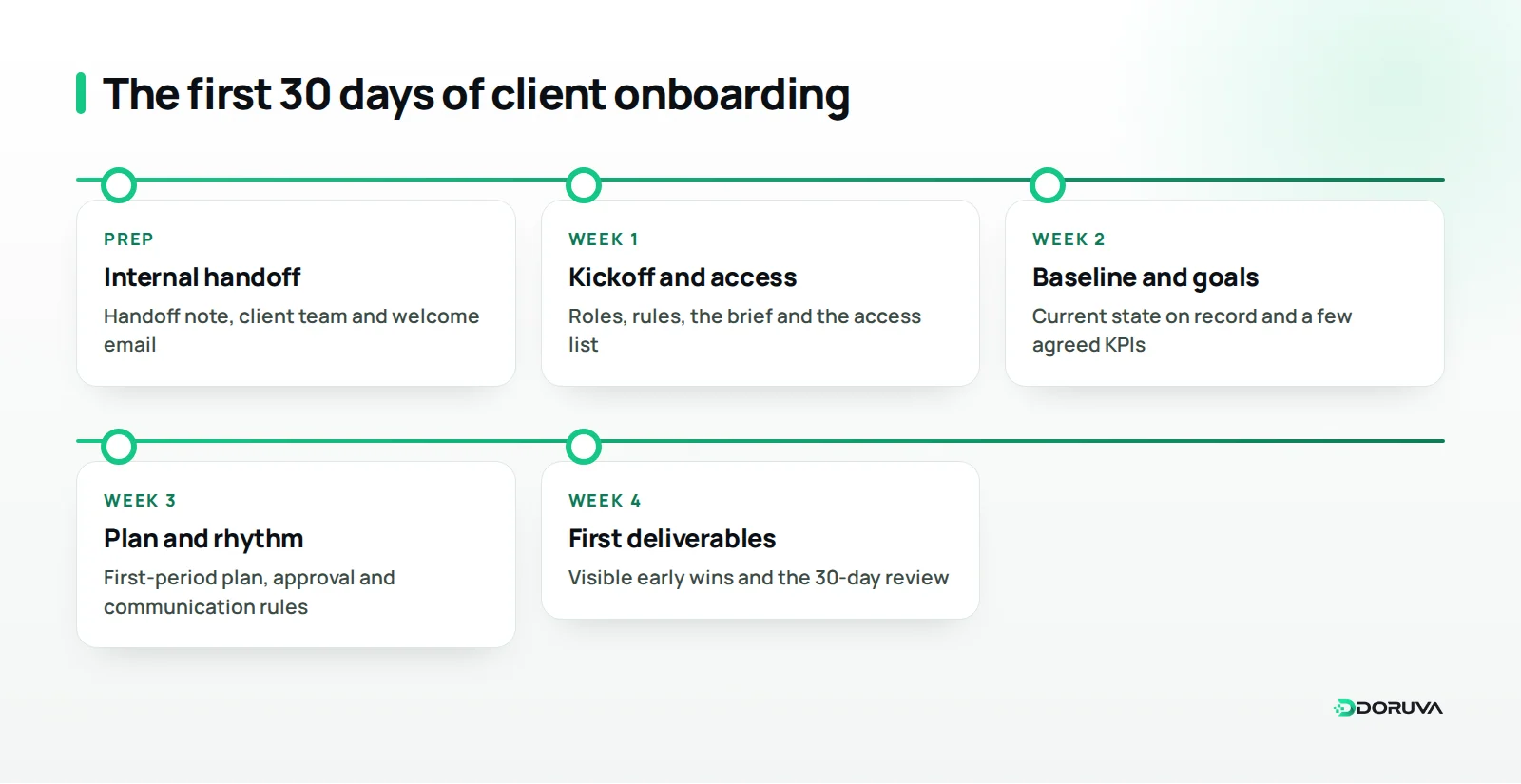
The table below summarizes the focus and the output of each stage.
| Stage | Focus | Key output |
|---|---|---|
| Prep (after signing) | Internal handoff and team setup | Handoff note, assigned team, welcome email |
| Week 1 | Introductions, brief and access | Kickoff notes, access list |
| Week 2 | Current state and goals | Baseline audit, agreed KPIs |
| Week 3 | Plan and working rhythm | First-period plan, approval and communication rules |
| Week 4 | First deliverables and review | First deliverables, 30-day review meeting |
What should be ready inside the agency before onboarding starts?
Before the first client meeting, there should be a written handoff from sales to delivery and an assigned client team. The most fragile moment in onboarding is exactly this transition, when the person the client has been talking to changes.
Promises made on sales calls, the client's sensitivities and their expectations often live in one person's head. A short handoff note fixes that:
- The services purchased and where the scope ends
- The concrete result the client expects from the work
- Promises made and dates discussed during the sales process
- The decision-maker, the day-to-day contact and the approver
- Past agency or in-house experience, and what did not work
Next, set up the client team. Every client needs one accountable account manager, with design, content, ads and SEO specialists organized around that person. The "one owner per task" principle from our agency project management guide applies to the client relationship itself, too.
Finally, send a welcome email. It should include the kickoff date, what you need from the client beforehand (for example, a short brief form) and a rough outline of the first 30 days. A client who knows what happens next has no reason to fill the uncertainty with a stream of messages.
Week 1: How do you run a kickoff meeting?
A kickoff meeting is the first formal working session in which the agency and client teams agree on goals, roles and ways of working. A good kickoff answers most of the questions that would otherwise surface over the following weeks.
Read the brief form answers before you walk in; asking a client questions they have already answered in writing is the quickest way to look unprepared. Share the agenda in advance and run the meeting in this order:
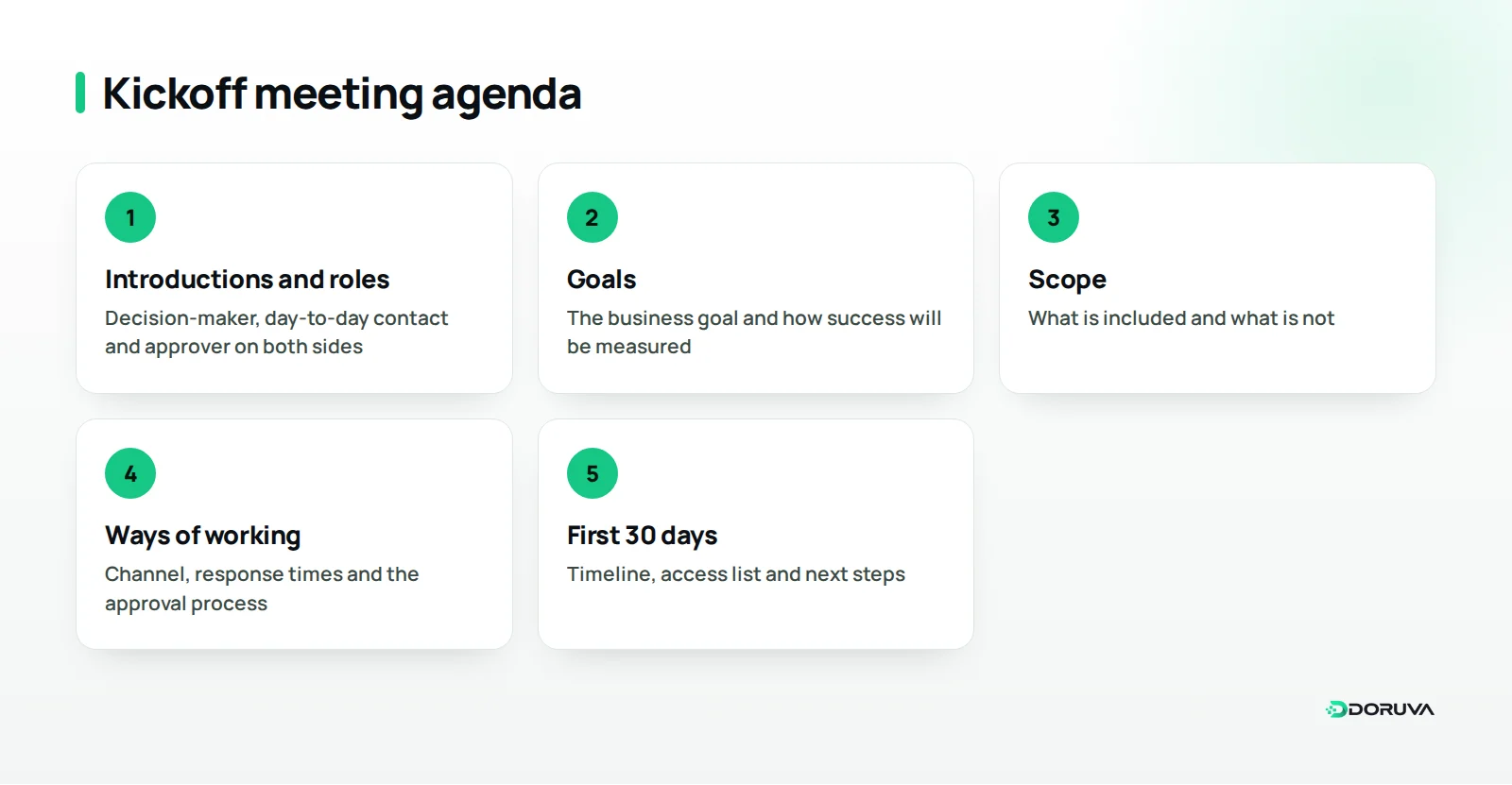
Write down both sides' roles by name: who on the client side makes decisions, who handles day-to-day communication, and who approves the work? At a coffee brand, the marketing manager might make the strategic calls while the social media specialist signs off on daily posts. Knowing that stops you from waiting on approval from the wrong person.
Send the meeting notes, decisions and open questions to the client the same day. That short recap catches misunderstandings early and shows the client you are taking the work seriously.
How do you collect access and brand assets safely?
Access should be granted by adding the agency's own users to the client's accounts, with ownership staying with the client. Sharing passwords over chat, or the agency opening accounts in its own name on the client's behalf, creates serious problems when the engagement ends.
The access you typically need in week one includes the Google Analytics 4 and Google Search Console properties, the tag manager, ad accounts, social media accounts, the website's CMS and hosting, and domain and DNS management. Add brand assets such as the logo, fonts, brand guidelines and image library to the same list.
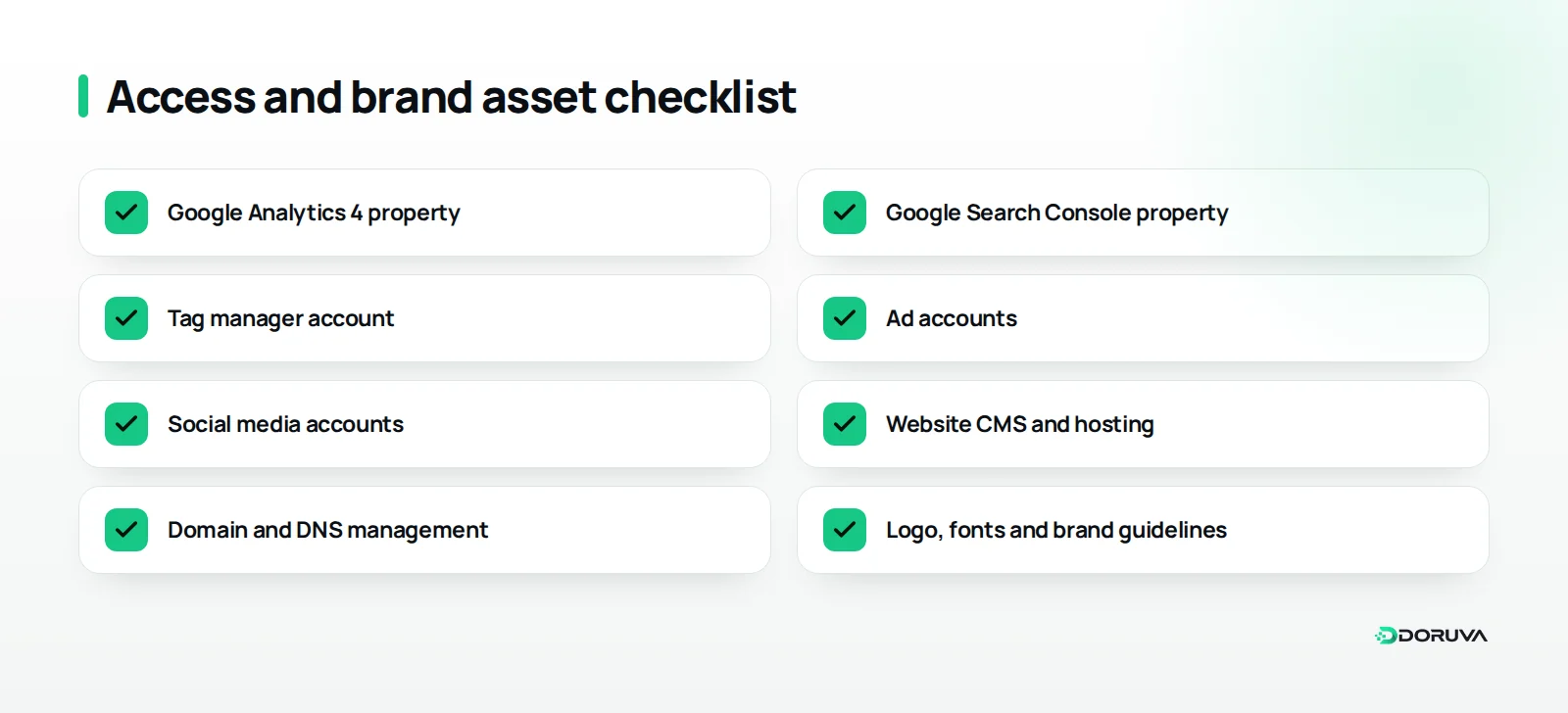
Follow three rules when collecting access:
- Ask only for the access you need: under the principle of least privilege, each person gets just enough access to do their job. Someone preparing reports does not need admin rights.
- Keep passwords out of chat: use a password manager for shared accounts, and if a new account is needed, create a hard-to-guess password with a strong password generator.
- Keep an access register: record who has access to which account and at what level. It is the only reliable way to revoke everything when someone leaves or the engagement ends.
If you will process personal data on the client's behalf, such as form submissions or email lists, clarify each party's roles and responsibilities in writing during onboarding. For clients in Turkey, that means working within Law No. 6698 on the Protection of Personal Data (KVKK), and the Personal Data Protection Authority publishes general guidance. This article is not legal advice, so get a lawyer's view on your specific situation.
Week 2: How do you capture the current state and set goals?
Week two is about recording the current state before you change anything, and agreeing with the client how success will be measured. An agency without baseline data cannot prove progress three months later.
The baseline depends on the service. For SEO, run a quick scan of the site with our free SEO checker, then do a detailed review using a technical SEO checklist. For paid media, check the account structure and whether conversion tracking is set up correctly; for social, review recent content performance; for web projects, assess the current site's speed and usability. Date your findings and share them with the client.
Then make the goals measurable. It helps to keep four ideas apart:
- Business goal
- The result the client actually wants, for example more appointment requests for a dental clinic.
- Indicator (KPI)
- The measure that shows how close you are to that goal, for example the number of booking forms submitted through the website.
- Baseline
- Where the indicator stands today, measured and recorded in week two.
- Data source
- Where the indicator is read from, for example the analytics tool, the ad platform or the client's own records.
Agree on a small number of indicators. Trying to measure everything ends up the same as focusing on nothing. For a realistic start, one primary indicator per service and a few supporting ones are usually enough.
Week 3: How do you set the first plan and working rhythm?
In week three, the brief, access and baseline come together and the plan for the first period is approved with the client. That plan shows clearly what the agency will, and will not, do during the first month.
The first-period plan should cover priority work and its order, the content or campaign calendar, an owner and date for each item, and the inputs you need from the client. Set the plan up as tasks inside the agency as well, and make sure everything discussed at kickoff is tied to an owner.
Keep first-month capacity realistic. The team is still learning the brand, the audience and the client's approval habits, so allowing slightly longer preparation and approval windows in month one beats a relationship that opens with missed dates. For a cosmetics brand, for instance, submitting the monthly content calendar for approval in two-week batches during the first month gets you feedback early.
Agree on the working rhythm in the same week:
- Communication channel: where do everyday questions go, and who do you contact in an emergency?
- Response time: how quickly will each side reply to messages?
- Approval rule: who approves work, how many working days do they have, and how many revision rounds are included?
- Meeting and reporting cadence: a short weekly update, a monthly review meeting, or both, and what format will reports take?
Week 4: How do you handle first deliverables and the 30-day review?
Week four is when the client sees the first concrete results and onboarding is formally closed. The aim is to finish the first month with a review meeting and move into regular work in a controlled way.
Including a visible, low-risk task among the first deliverables speeds up trust. For an online store, fixing a broken contact form spotted in the baseline audit or filling in missing product descriptions creates a sense that "this team knows what it is doing" before the bigger strategic work lands.
In the 30-day review, answer these questions together:
- Which items in the first-month plan are done, and why did any slip?
- Is any access, information or approval still missing?
- Is the working rhythm working for both sides, and what should change?
- What are the priorities for the next 60 days?
Ask the client for candid feedback and fold what you hear back into your onboarding checklist. The list gets a little better with every new client.
When you close onboarding, update the client file as well: kickoff notes, the access register, the baseline audit, the agreed KPIs and the approved plan should all sit in one place. That file lets anyone who joins the account later get up to speed in minutes.
What are the most common onboarding mistakes?
Most onboarding mistakes come not from carelessness but from reinventing the process for every client. The ones that come up most often are:
- Lost sales promises: without a handoff note, the delivery team never hears what the client was promised.
- Access that takes weeks: if the access list is not sent on day one, work cannot really start.
- No baseline: progress cannot be proven later.
- Too many KPIs: a goal list with fifteen metrics means none of them gets real attention.
- Unclear communication channels: the client messages everyone everywhere, and requests scatter.
- Trying to do everything in month one: the team burns out, quality drops and expectations are set at an unrealistic level.
Summary and next steps
Good client onboarding starts with a written internal handoff, lays its foundations with the kickoff and access in week one, sets the baseline and KPIs in week two, builds the plan and working rhythm in week three, and closes with first deliverables and a review meeting in week four. Writing this framework down once lets you repeat the same quality with every new client.
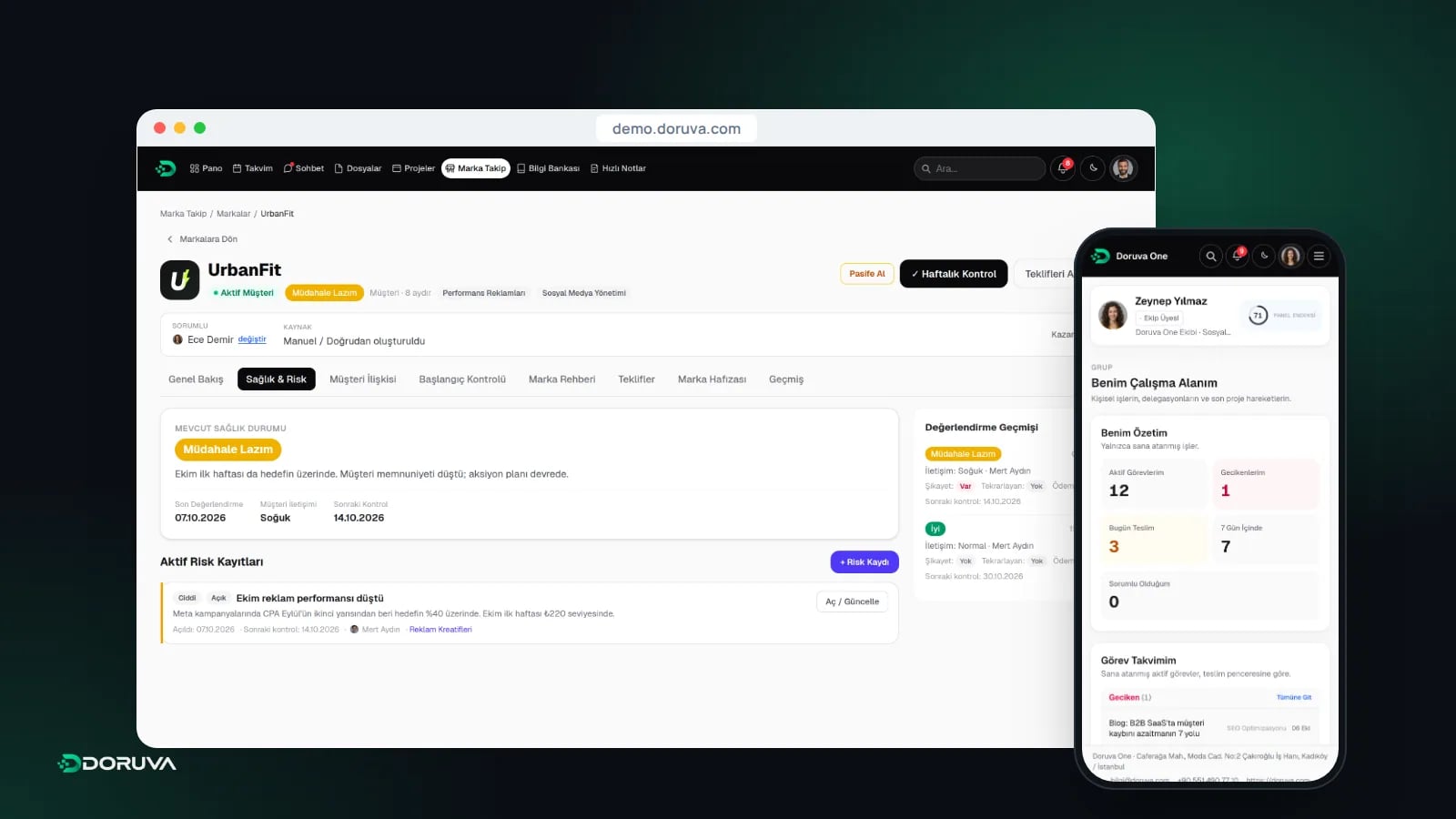
If you want to track this checklist client by client, Doruva One can help. In Brand Tracking, every client brand has an Onboarding Checklist tab (Başlangıç Kontrolü) with a 10-item onboarding list, covering steps such as completing the contract, receiving brief forms and scheduling the first meeting; you can add items and change their order. To talk through your team's onboarding process, get in touch with us.
Frequently Asked Questions
How long should client onboarding take?
For most agency services, 30 days is a realistic window to settle access, goals and a working rhythm. Larger web or software projects may need a longer discovery phase; what matters is having a clear start and end point.
Who should attend the kickoff meeting?
On the agency side, the account manager and the relevant specialists; on the client side, the decision-maker, the day-to-day contact and whoever approves the work. Decisions made without the decision-maker in the room tend to change later.
What access should an agency request from a new client?
It depends on the service, but usually analytics and Search Console properties, the tag manager, ad and social accounts, the CMS, hosting and domain management. Access should be granted by adding agency users to the client's own accounts.
Why is a baseline audit so important?
Recording the current state before changing anything is the only way to show concrete progress in the months that follow. Without baseline data, reports have nothing meaningful to compare against.
When is onboarding finished?
Onboarding can be considered complete when all access is in place, KPIs and baselines are recorded, the first-period plan is approved and the 30-day review meeting has taken place. From there, the account moves into its regular working rhythm.