

What is Wikidata?
Definition
Wikidata is a free, multilingual knowledge base hosted by the Wikimedia Foundation and edited collaboratively by volunteers. Every concept, person or organization is stored as an item with a permanent identifier beginning with Q (a QID) and connected to other items and external databases through properties. Because its structured data is released under CC0, search engines, knowledge graphs and AI systems can reuse it freely.
Also known as: QID, Wikidata item, Wikidata Q-ID, Q identifier
Items, properties and statements
Where an encyclopedia stores knowledge as prose, Wikidata stores it as small facts a machine can read directly. Each record is an item with an identifier that starts with Q: Earth is Q2, the writer Douglas Adams is Q42. Labels, short descriptions and aliases are entered per language, while the QID stays the same in every language. A Turkish label and an English label can differ completely and still point at the same thing.
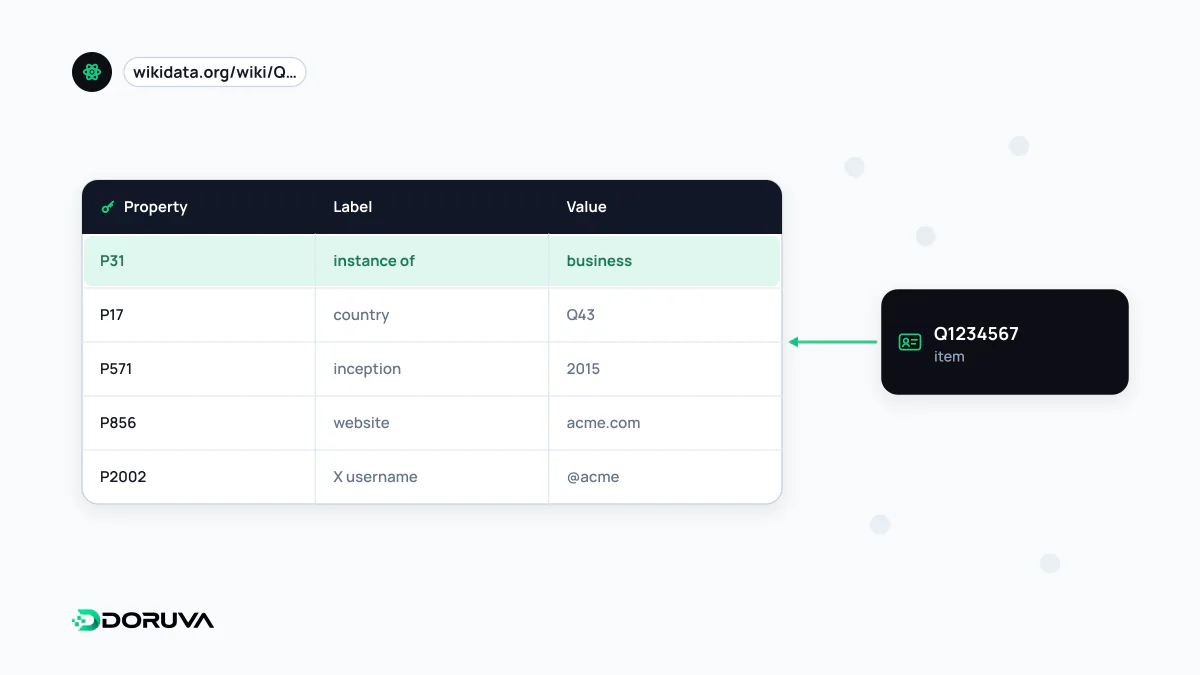
Facts are recorded as statements: a property, identified by a number starting with P, paired with a value. A simplified view of one item:
Q42  Douglas Adams
  P31  (instance of)      → Q5 (human)
  P214 (VIAF cluster ID)  → library authority record
  P345 (IMDb ID)          → film database record
  sitelinks               → Wikipedia articles in many languages
For organizations, P856 (official website) is one of the most used properties. External identifier properties gather the same entity's records in library catalogs, film databases or company registers into a single item, which makes Wikidata a kind of switchboard that lets different systems confirm they are talking about the same thing.
Why search and AI systems care
A name alone is ambiguous. “Mercury” might be a planet, a chemical element or a singer, and on Wikidata each has its own QID. Linking a mention in text to the right entity is called entity disambiguation, and an open identity hub like Wikidata makes that job easier.
Since the structured data is dedicated to the public domain under CC0, search engines, voice assistants, research projects and companies building a knowledge graph can use it without asking. Which products rely on it, and how heavily, is mostly undocumented, and Google does not describe a Wikidata item as a ranking factor or a prerequisite for a knowledge panel. The realistic expectation: a well-maintained item is one more place where other systems can confirm who you are. It is not a visibility guarantee.
Who qualifies: the notability policy
Under Wikidata's notability policy, an item must meet at least one of three criteria:
- It has a valid sitelink to a page on a Wikimedia project such as Wikipedia, Wikivoyage, Wikisource or Wikimedia Commons.
- It refers to a clearly identifiable conceptual or material entity that can be described using serious, publicly available references.
- It fulfils a structural need, for example because statements on other items depend on it.
The community essay on self-promotion, which reflects common views rather than formal policy, strongly discourages creating items about yourself, your organization or your work: Wikidata should hold information about people and companies, not by them. Paid editing is covered by a formal policy based on the Wikimedia Terms of Use: anyone paid to contribute must disclose who pays them. Items that fail the criteria can be deleted after a community request.
A sound approach for organizations
- Search first. An item about your company may already exist. Check basics like the official website and founding date; if something is wrong, propose a correction with a source and disclose your connection.
- No independent coverage, no item. An item supported only by your own site and press releases is likely to be deleted and can put your account at risk. Services that sell “Wikidata listings” deserve suspicion for exactly that reason.
- Fix your own site first. Your website is the primary source for your identity. A consistent name, a clear about page and Organization schema are always within your control.
- Connect an existing item. If an item exists, adding its Wikidata URL as a sameAs value in your markup tells machines explicitly that both records describe the same organization.