

What is SKU (Stock Keeping Unit)?
Definition
An SKU (stock keeping unit) is an internal code a business assigns to each product, and to each variant of a product, so its inventory, ordering and sales systems can tell items apart. The seller defines SKUs and they only have meaning inside that seller's systems, which is what separates them from global identifiers such as GTINs printed under barcodes.
Also known as: Stock Keeping Unit, stock code, item code, SKU number, product code
Designing a readable SKU
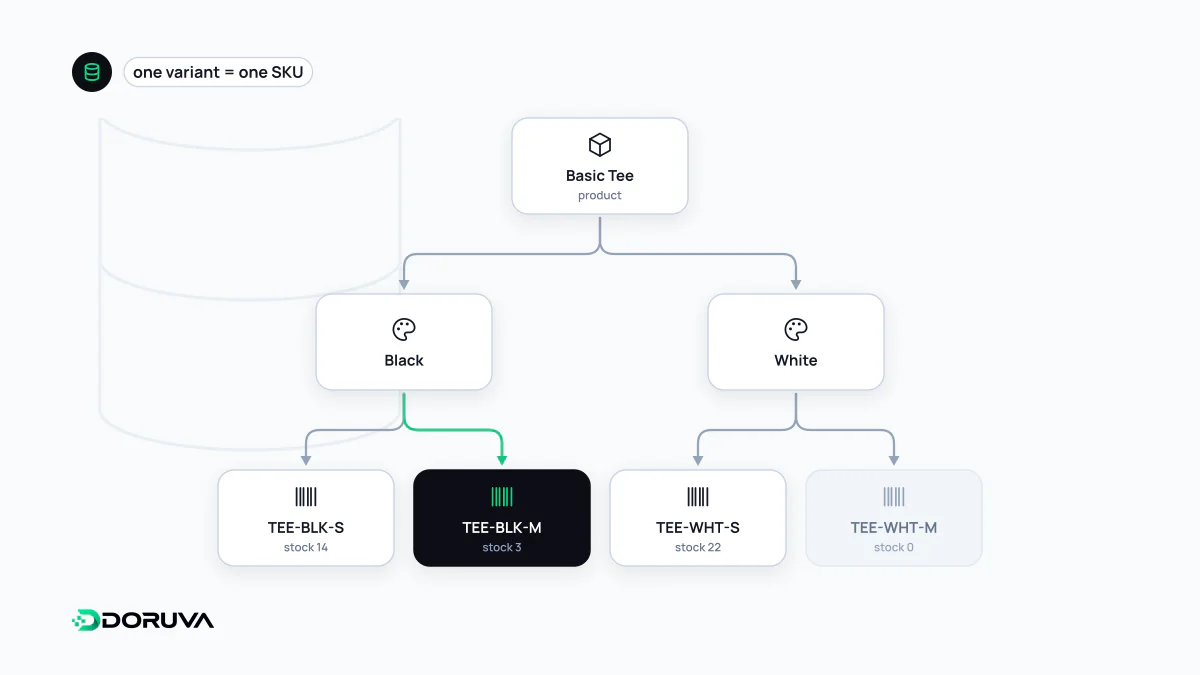
An SKU exists so that the warehouse, the order screen and the accounts all point at the same physical item with one value. That is why every sellable version, meaning every variant, gets its own SKU: a red medium T-shirt and a red large one sit in different bins and are counted separately. A readable scheme lets staff decode a code without a lookup:
| Segment | Example | Meaning |
|---|---|---|
| Product family | TEE | T-shirt |
| Model | CTN | Cotton basic |
| Colour | RED | Red |
| Size | M | Medium |
Put together, that is TEE-CTN-RED-M, and the shared stem TEE-CTN often serves as a "parent SKU" that groups the variants. Only encode attributes that will never change. Price, supplier or season do not belong in an SKU: once they change, the code either has to change too or starts telling a lie.
SKU, GTIN and MPN compared
| SKU | GTIN | MPN | |
|---|---|---|---|
| Assigned by | The seller | The manufacturer, via GS1 | The manufacturer |
| Scope | One business's systems | Global | The manufacturer's catalogue |
| Same item at two retailers | Different codes | Same number | Same number |
| Example | TEE-CTN-RED-M | A 13-digit EAN | A manufacturer part number |
GTIN is the family of global trade item numbers, including UPC (12 digits), EAN (13 digits), JAN, ISBN for books and ITF-14 for multipacks; it is the number printed beneath a barcode. Google Merchant Center currently recommends submitting a GTIN for every product that has one assigned by its manufacturer and warns that missing or incorrect GTINs can limit visibility. The same documentation is explicit that you should not guess or make up a value, and custom-made items simply have no GTIN. An SKU is never a substitute for a GTIN; they answer different questions.
SKUs in feeds and structured data
Many shops reuse the SKU as the id in their product feed, which keeps an item's history intact in shopping channels as long as the code stays stable. In on-page Product markup, sku and identifiers such as gtin13 are separate properties. For products with variants, giving each variant its own sku is what allows search engines to tell the variants apart.
Stock-coding mistakes that bite later
- Recycling codes: handing a discontinued item's SKU to a new product links old orders and reports to the wrong thing.
- Losing leading zeros: spreadsheets happily turn
00451into451, and imports stop matching. - Special characters: slashes, spaces or accented letters break URLs, file names and some integrations; uppercase letters, digits and hyphens are a safe set.
- Inconsistent case: one system treats
tee-ctnandTEE-CTNas equal, another does not.
The shared language between systems
An order travels from the storefront to the ERP, then to warehouse and shipping systems, and each step recognises the item by its SKU. In database design the SKU is usually stored as a unique business key, while the row's technical primary key is a separate surrogate ID. That way, correcting a mistyped SKU does not mean rewriting every related record.