

What is Landing Page?
Definition
A landing page has two meanings: in analytics it is the first page of a session, and in marketing it is a page built specifically to turn traffic from an ad, email or campaign into one goal, such as a form submission, sign-up or purchase. A campaign landing page uses a headline that matches the message that brought the visitor, a single primary call to action, and a layout with fewer distractions.
Also known as: lander, campaign landing page, campaign page, LP
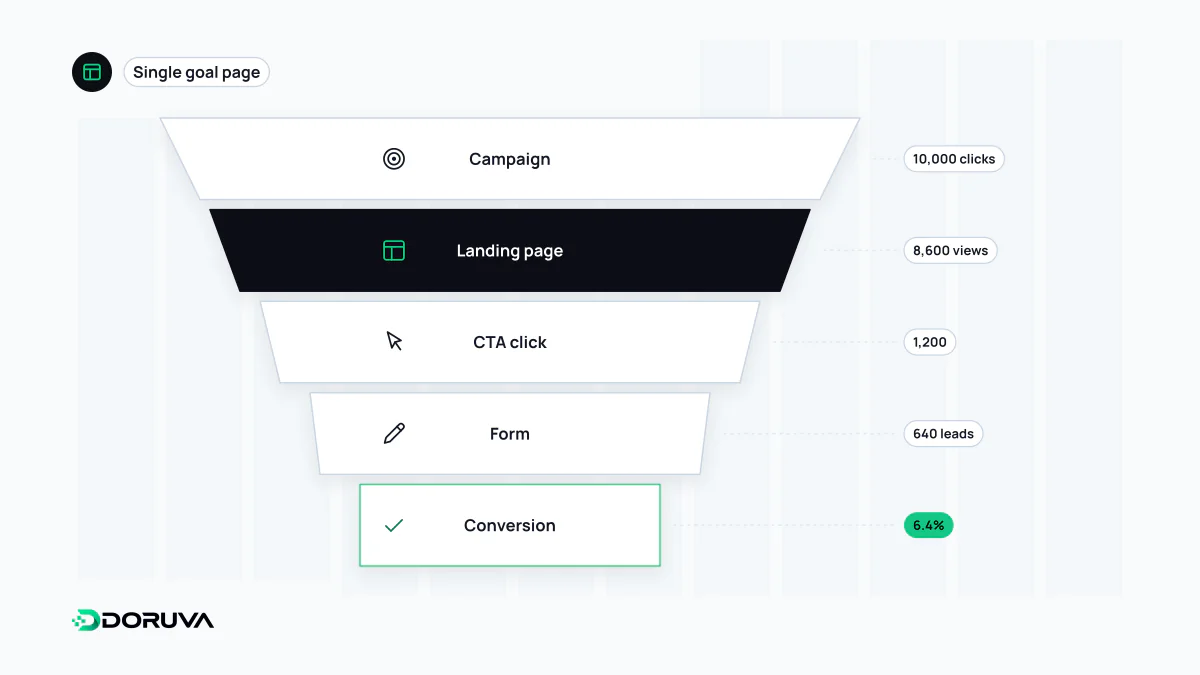
Two meanings of one term
In analytics, a landing page is simply the first page viewed in a session. Google Analytics 4's Landing page dimension is exactly that: the page path of the first page view in a session. By that definition a blog post, a product page or the home page can all be landing pages.
In marketing, the term is narrower: a page built for a particular campaign, ad group or email, with one conversion goal. The rest of this entry is about that second meaning. Keeping the two apart avoids confusion when someone asks how "landing pages" are performing.
Message match and a single goal
If an ad promises "e-invoicing integration for accounting firms", the person who clicks should land on a headline that repeats that promise in the same words, not on a generic "Solutions" page. This is message match, and it is what tells visitors they are in the right place. The same principle applies to organic traffic, where the page has to answer the visitor's search intent.
The second principle is one goal. A campaign page usually has a single primary call to action and returns to it as the visitor scrolls. Some teams remove the main navigation for that reason. It is a trade-off: fewer distractions, but less room for a cautious visitor to look around and build trust. Leaving a few minimal exits, such as a linked logo, a short footer and contact details, is often the balanced choice.
How a campaign page usually flows
- A hero section with a headline that matches the ad, a one-line benefit and the main action.
- Problem and solution: a short section describing the visitor's situation and what the offer changes.
- Proof: testimonials, numbers, client logos, certifications.
- How it works: a three- or four-step process.
- Objection handling: a brief FAQ on price, timing, contracts and cancellation.
- The form or a repeated call to action, asking only for what is genuinely needed.
The number of form fields is one of the most frequently tested variables, and every extra field needs a reason. Anything the sales team can ask later does not belong in the first form.
Ad quality and speed
Google Ads calculates Quality Score from three components: expected click-through rate, ad relevance and landing page experience. Google describes Quality Score as a diagnostic tool rather than an input to the ad auction, but a weak landing page experience rating is a sign the page is not delivering on the ad's promise. Campaign pages also slow down easily under heavy images, video and tracking tags, and a slow page means part of every paid click is lost before anything renders.
Tracking and SEO considerations
To see which channel and which ad produced a conversion, campaign links carry UTM parameters. Changes to the headline, imagery or form are measured with controlled tests as part of conversion rate optimisation. On the SEO side, two cases stand out. Dozens of near-identical variants built only for paid campaigns are usually not meant to be indexed and can be kept out with noindex. A permanent service page aimed at organic traffic, by contrast, should live at one canonical URL with content substantial enough to deserve a place in search results.