

What is Engagement Rate?
Definition
Engagement rate is the share of sessions in Google Analytics 4 that count as engaged sessions. GA4 treats a session as engaged if it lasts longer than 10 seconds, includes at least one key event, or has two or more page or screen views. The metric is a rough summary of whether visitors showed real interest in a site, and it is the exact inverse of bounce rate.
Also known as: engaged session, engaged sessions, GA4 engagement rate, engaged sessions rate
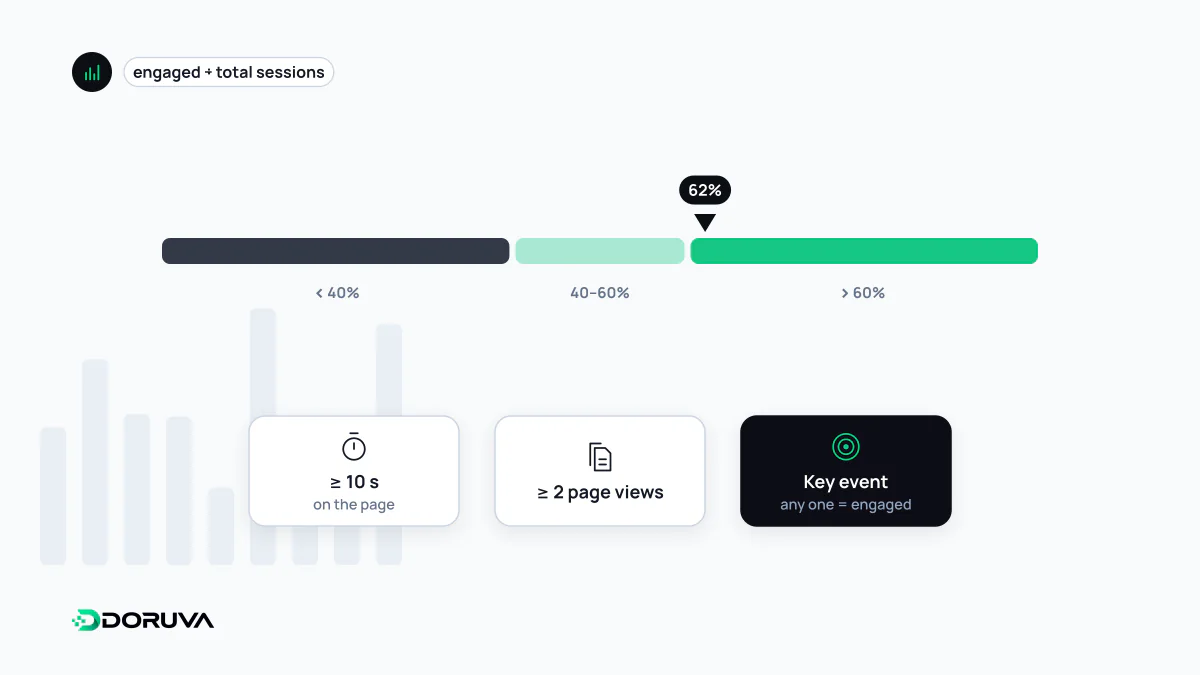
What makes a session "engaged"
Google Analytics 4 marks a session as engaged when it meets any one of three conditions:
- it lasts longer than 10 seconds;
- it contains at least one key event, meaning an event the business has flagged as important;
- it includes two or more page or screen views.
Engagement rate is engaged sessions divided by all sessions. If 6,200 of 10,000 monthly sessions qualify, the rate is 62%. Related metrics such as engaged sessions per user and average engagement time are built on the same foundation.
The 10-second timer is a setting
Ten seconds is only the default. In the Google tag settings of a GA4 web data stream, the "adjust timer for engaged sessions" option lets you raise it. A publisher expecting long reads might choose a higher value. Changing it breaks comparability with earlier periods, though, so record the date of the change and never compare properties measured with different thresholds as if they were equivalent.
Time is counted while the page is in the foreground. A visitor who opens your page in a tab and switches to another one is not accumulating engagement time in the background.
Reading it without fooling yourself
Engagement rate is a coarse filter, not a measure of quality. A few patterns that come up often:
- The quick lookup. Someone lands on a contact page, finds the phone number and calls within eight seconds. GA4 counts an unengaged session even though the visit succeeded. Track the phone-link click as an event, mark it as a key event, and the session becomes engaged.
- Channel comparisons. A poorly targeted ad campaign often sits far below organic traffic. That gap is a fast warning about targeting.
- Inflated numbers. A misconfigured setup that fires a second page view on load, or an autoplaying video that triggers events, can push the rate up without any real interest behind it.
Not the social media metric
On social platforms, "engagement rate" means likes, comments and shares relative to reach or followers. It is an unrelated calculation that happens to share the name, which causes confusion in cross-channel reports. The true counterpart of the GA4 metric is bounce rate: a site with 62% engagement has a 38% bounce rate.
Engagement rate is not something Google Search uses to rank pages, and GA4 data does not feed into ranking systems. Its value is in understanding how well the site serves the people who already arrive.