

What is Bounce Rate?
Definition
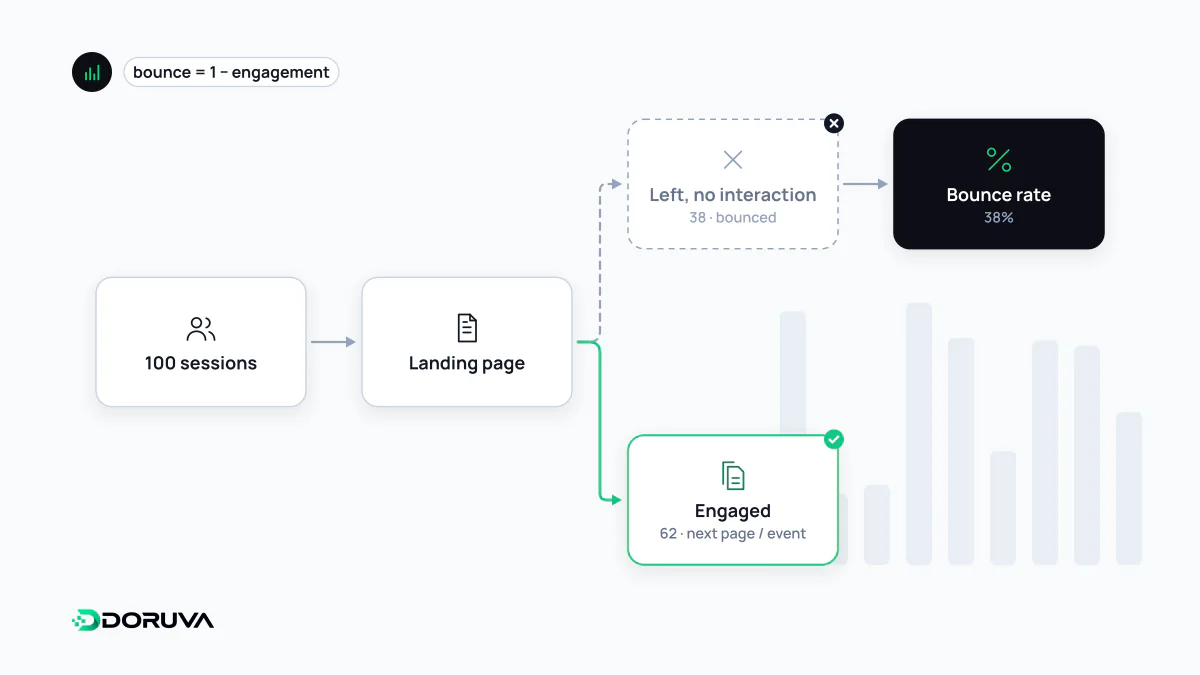
Bounce rate is the percentage of sessions on a site that end as a bounce. In Google Analytics 4 it is defined as the share of sessions that were not engaged, which makes it the exact inverse of engagement rate. In the older Universal Analytics it was the share of single-page sessions that sent no further request to the analytics server. Because the definitions differ, values from the two cannot be compared directly.
Also known as: bounce, bounces, GA4 bounce rate, single-page session rate
One name, two calculations
For years the term meant the Universal Analytics version: a session counted as a bounce when the visitor opened a single page and left without triggering any other request to the analytics server. The flaw was obvious. Someone who read a long article for four minutes and closed the tab was recorded exactly like someone who hit the back button after two seconds.
Google Analytics 4 rebuilt the metric. In GA4, bounce rate is the percentage of sessions that were not engaged. The conditions for an engaged session (time, a key event, a second page view) are set out in the engagement rate entry; the short version is that the two metrics always add up to 100%.
Four visits, scored both ways
| Visit | Universal Analytics | GA4 |
|---|---|---|
| Reads a blog post for 3 minutes, then leaves | Bounce | Engaged, not a bounce |
| Opens the homepage and returns to search after 3 seconds | Bounce | Bounce |
| Stays 5 seconds on one page and submits a quote form (key event) | Not a bounce if the form event is tracked | Engaged |
| Views two pages in 6 seconds | Not a bounce | Engaged |
That is why sites migrating from Universal Analytics usually saw their bounce rate drop sharply. The site had not improved; the ruler had changed.
When a high bounce rate is fine
Whether a bounce is good or bad depends on the page's job. A glossary entry, a weather page or a contact page with an address exists to answer one question and let the visitor go. A high rate there can even signal success. On a checkout step, or on a paid-traffic landing page, a high rate points to a mismatch between what the visitor expected and what they found.
Break the figure down by page type, channel and device before drawing conclusions. A mobile rate far above desktop usually suggests a technical cause, such as slow loading or a component that renders badly on small screens.
Bounce rate and rankings
A persistent claim says Google demotes pages with high bounce rates. Google Analytics data is not used in Google's ranking systems, and millions of sites without any analytics tool rank perfectly well. Visitors who arrive from search and leave unsatisfied are still a problem worth solving, but the fix lies in whether the page meets the search intent, not in the analytics number.