

What is Citation Readiness?
Definition
Citation readiness describes how well a web page meets the preconditions for being selected and shown as a source by AI-powered search and answer systems. It covers access for crawlers, passages that make sense on their own, claims backed by named sources, a proper reference section and a clearly identified publisher. Readiness does not guarantee that a page will be cited; it only removes the obstacles to being a candidate.
Also known as: citability, AI citation readiness, reference section, citation-ready content
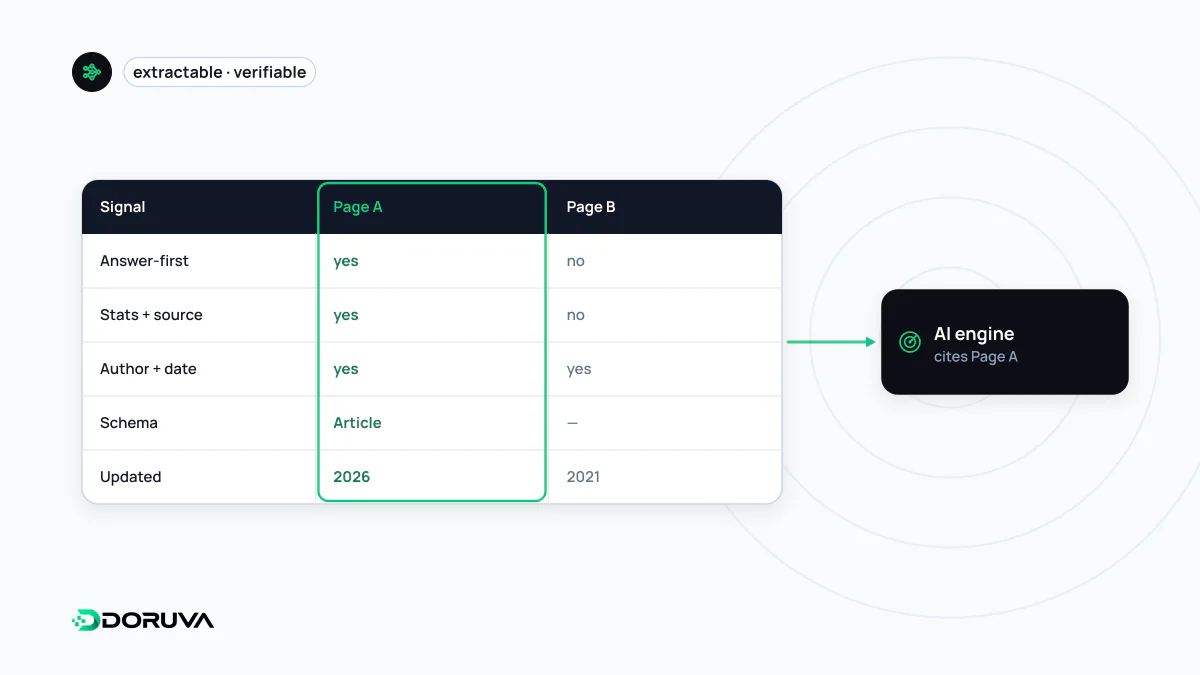
Readiness is an input, citation is an outcome
An AI citation is a result: for a given question, an answer system either lists your page as a source or it does not. Citation readiness looks at the page itself and asks a narrower question: if a system wanted to use this page, would anything technical or editorial stand in the way? Keeping the two apart avoids a lot of confusion. A ready page may never be cited because the question went elsewhere or other sources fit better. An unready page often never makes it into the running at all.
Google is explicit about its own AI features: to appear as a supporting link in AI Overviews or AI Mode, a page must be indexed and eligible to be shown in Google Search with a snippet, and there are no additional requirements or special optimizations. Readiness work is therefore not a new trick. It is a review of solid fundamentals through the lens of what an AI answer needs.
Four layers to check
| Layer | The question | What usually goes wrong |
|---|---|---|
| Access | Can the page be crawled, is it indexed, may it be shown with a snippet? | Search-oriented bots blocked in robots.txt, a stray noindex, unnecessary nosnippet |
| Passages | Is the answer given in a short section that works when read alone? | Long preambles, sections that open with “as mentioned above” |
| Evidence | Are claims backed by a source, a date and a method? | Unsourced statistics, vague undated statements |
| Identity | Is it clear who wrote and who published it? | Articles without bylines, pages with no organization details |
The passage layer has its own entry under answer extractability. The identity layer overlaps with the “who, how and why” questions of Google's E-E-A-T guidance.
Building a reference section
A reference section lists the primary sources a piece of content relies on, usually at the end of the page. It looks like an academic habit, but it does two practical jobs: it makes claims verifiable for readers and machines alike, and it signals that the page was put together with care. A useful one follows a few rules:
- Inline first. Link a statistic's source in the sentence that uses it. The list at the end complements inline links; it does not replace them.
- Go to the origin. Link the organization that published the report, the official document or the standard, not the news site that summarized it.
- Name, title, date. Spell out who published the source, and add the date you checked it when the source can change.
- Maintain it. Prune broken links and sources that have been superseded.
<h2>References</h2>
<ol>
  <li><a href="https://agency.example/report-2026">Agency Name — Report Title</a>
      (published March 2026, checked 3 October 2026)</li>
</ol>
Do not pad the list. Loosely related links that the text never uses add noise, not trust.
A claim, rewritten
Before: “Orders usually arrive very quickly.” Nobody can quote this: it does not say what was measured, by whom or when.
After: “Across 1,240 orders placed in September 2026, median delivery time was two business days (our own order records, cancellations excluded).” The figures are only an illustration; the pattern is what matters: what was measured, over which period, on what sample, from which source and how. For facts that change, a visible last-updated date matters just as much, which is the subject of content freshness.
Auditing a page
Readiness can be measured at page level: bot access, indexability, the number of self-contained answer blocks, sourced versus unsourced statistics, author information and reference sections. Doruva's GEO Checker reports these signals for a URL. Whether you are actually being cited is a separate question, answered only by asking your target questions on the relevant systems regularly and recording the sources they show.