

What is Bingbot?
Definition
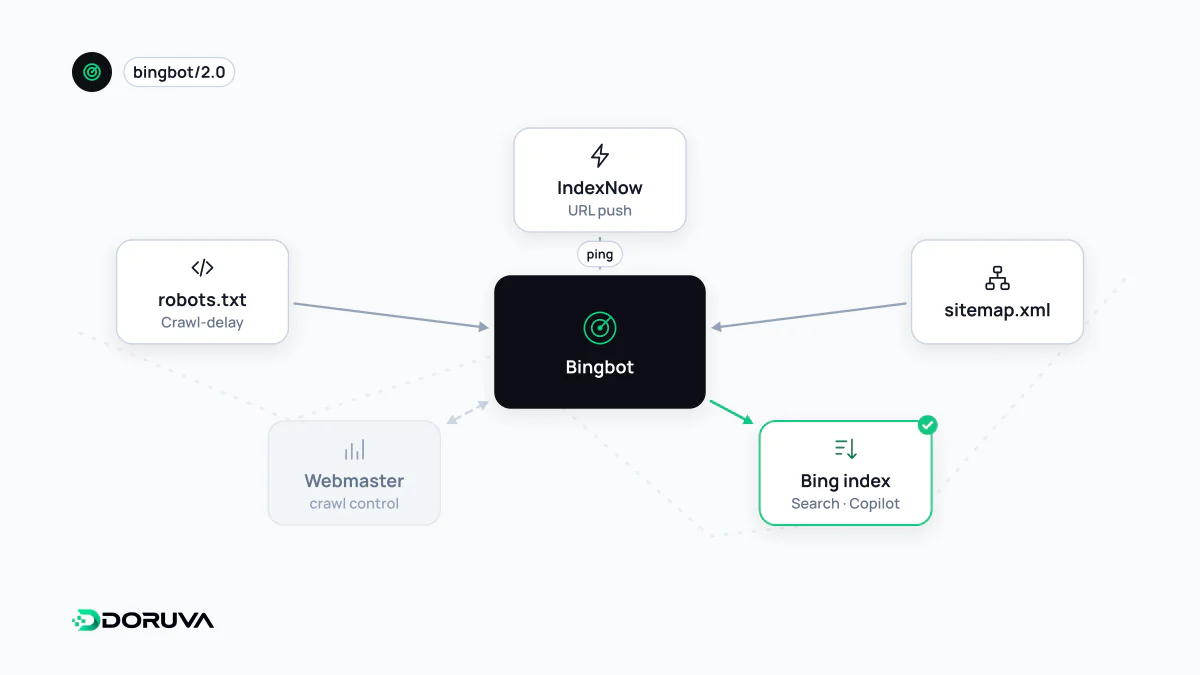
Bingbot is Microsoft's main web crawler for the Bing search engine. It identifies itself with a user-agent containing bingbot/2.0, renders pages with an engine based on the latest stable Microsoft Edge, and obeys the bingbot token in robots.txt. Because Microsoft Copilot uses the Bing search service when it needs web information, content Bingbot crawls can also become a source for those answers.
Also known as: Bing bot, Bing crawler, bingbot/2.0, Microsoft Bing crawler
Identity: user-agents and rendering engine
In 2022 Bing moved its crawler to "evergreen" user-agents, one for desktop and one for mobile:
# Desktop
Mozilla/5.0 AppleWebKit/537.36 (KHTML, like Gecko; compatible; bingbot/2.0;
+http://www.bing.com/bingbot.htm) Chrome/W.X.Y.Z Safari/537.36

# Mobile
Mozilla/5.0 (Linux; Android 6.0.1; Nexus 5X Build/MMB29P) AppleWebKit/537.36
(KHTML, like Gecko) Chrome/W.X.Y.Z Mobile Safari/537.36
(compatible; bingbot/2.0; +http://www.bing.com/bingbot.htm)
W.X.Y.Z stands for the Microsoft Edge version Bing currently renders with, and it changes as Edge updates. The robots.txt side stayed the same: the bingbot token works exactly as before. Bing runs other crawlers too, such as AdIdxBot for ad quality checks, but for the organic index Bingbot is the one that matters. It resembles Googlebot in structure, yet the controls available to site owners differ in important ways.
Controlling crawl rate, Bing-style
The Crawl Control feature in Bing Webmaster Tools lets you ask Bingbot to crawl faster or slower than normal for each of the 24 hours in a day, so you can ease off during peak traffic and let it work harder overnight. Unlike Google, Bing also honours the Crawl-delay directive in robots.txt:
User-agent: bingbot
Crawl-delay: 5
When present, the directive takes precedence over Crawl Control settings. Use it sparingly: a high delay on a large site can mean new and updated pages reach Bing very late.
Notify instead of waiting
Bing supports IndexNow, a protocol for telling search engines directly that a URL was added, updated or removed, so Bingbot can fetch it without waiting for its next routine visit. Bing Webmaster Tools adds a URL submission API, sitemap reports and live URL inspection, which is where crawl and indexing problems on Bing get diagnosed.
Verifying genuine Bingbot
Bing's recommended check has two steps: run a reverse DNS lookup on the IP from your logs and confirm the hostname ends in search.msn.com, then run a forward lookup on that hostname and confirm it resolves to the same IP. The Verify Bingbot tool inside Bing Webmaster Tools does this in one go, and for bulk checks Bing publishes its IP ranges as bingbot.json. Hard-coded, hand-maintained IP lists go stale and can end up blocking the real crawler.
Bing's index and AI answers
Microsoft's documentation explains that when web search is enabled, Microsoft Copilot turns the user's prompt into a short search query, sends it to the Bing search service and uses the results to ground its response. The AI Performance report, opened in Bing Webmaster Tools as a public preview in February 2026, shows how often a site is cited in Microsoft Copilot, AI-generated summaries in Bing and select partner integrations. Blocking Bingbot, or ignoring indexing problems on Bing, can therefore affect visibility not only in classic Bing results but also on the AI search surfaces built on Bing.