

What is Custom Software?
Definition
Custom software is software designed and built for a specific organization's processes, users and integration needs, either from scratch or on top of existing components. Unlike off-the-shelf packages and subscription SaaS products sold identically to everyone, it is shaped around how the business actually works. The organization usually controls the source code and the roadmap, and in exchange carries responsibility for development, hosting and ongoing maintenance, directly or through a chosen team.
Also known as: bespoke software, custom software development, tailor-made software, custom application
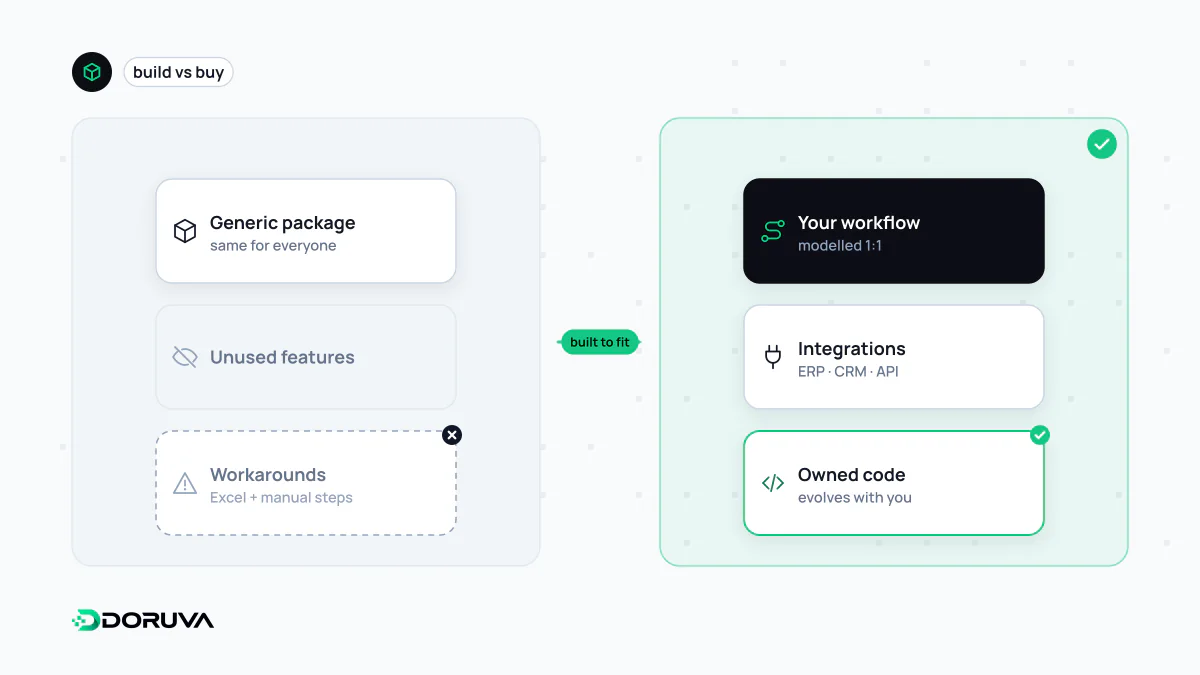
The software fits the process, not the other way round
When you buy a packaged product, your team adapts to the workflow it was designed around. For most standard tasks that is the sensible trade. Custom software reverses the direction: screens, permission rules, reports and integrations follow how the organization actually operates. A portal that unifies a dealer network's orders, stock and commission calculations, a laboratory's flow from sample intake to signed report, or an offline-capable app for field crews are typical examples.
The second difference is ownership. Source code, data model and roadmap are under the organization's control, so feature priorities follow the business rather than a vendor's product plan.
Build, buy or subscribe?
A line-by-line comparison of off-the-shelf, subscription and custom options on cost, maintenance and data location lives in the SaaS entry. The more useful questions for the decision itself are these:
- Does this process differentiate us? If not, building it is usually an expensive way to get something you could rent.
- How hard are we bending the existing tool? Piles of plugins, manual exports and spreadsheets bridging the gaps are signs the product no longer carries the process.
- What must it talk to? Heavy data exchange with accounting, ERP, CRM, e-commerce and shipping systems can make the integration layer a project in its own right.
- Who maintains it in five years? An internal team, an agency, nobody yet? An unanswered question here is a risk before work begins.
There are middle paths: extending a SaaS product through its API only where it falls short, or building simple internal tools on a low-code platform.
How a custom build typically runs
Healthy projects open with discovery before any code: interviews with users, a map of the current process and data flows, and a prioritized scope. The first target is a minimum viable product that solves the most critical job end to end; real usage then decides what comes next. Budgets should cover more than the build: hosting, monitoring, security updates and small improvements form a recurring cost every year the software is in use.
What the contract should spell out
- Who owns the source code and intellectual property, which repository holds it, and who has access.
- Servers, domains and third-party accounts registered in the client's name.
- Documentation to be delivered: setup, architecture and user guides.
- Post-launch support period, response times and pricing.
Leave these vague and an organization escaping lock-in to a software vendor can end up locked in to its development agency instead.
Where projects usually struggle
Scope that keeps growing, a single developer holding all the knowledge, and technical debt piling up under deadline pressure are the usual suspects. Clear prioritization, code review, automated tests and frequent small releases are the most reliable defenses. It also helps if someone on the client side stays close enough to the project to read the code and infrastructure, so a change of team later does not mean starting over.