

What is SaaS (Software as a Service)?
Definition
SaaS (Software as a Service) is a delivery model in which software runs on the provider's infrastructure and customers access it over the internet, usually through a subscription. The provider is responsible for hosting, updates, backups and security, and a single application instance typically serves many customers at once. CRMs, accounting tools, email suites and project management apps are common examples.
Also known as: Software as a Service, cloud software, on-demand software
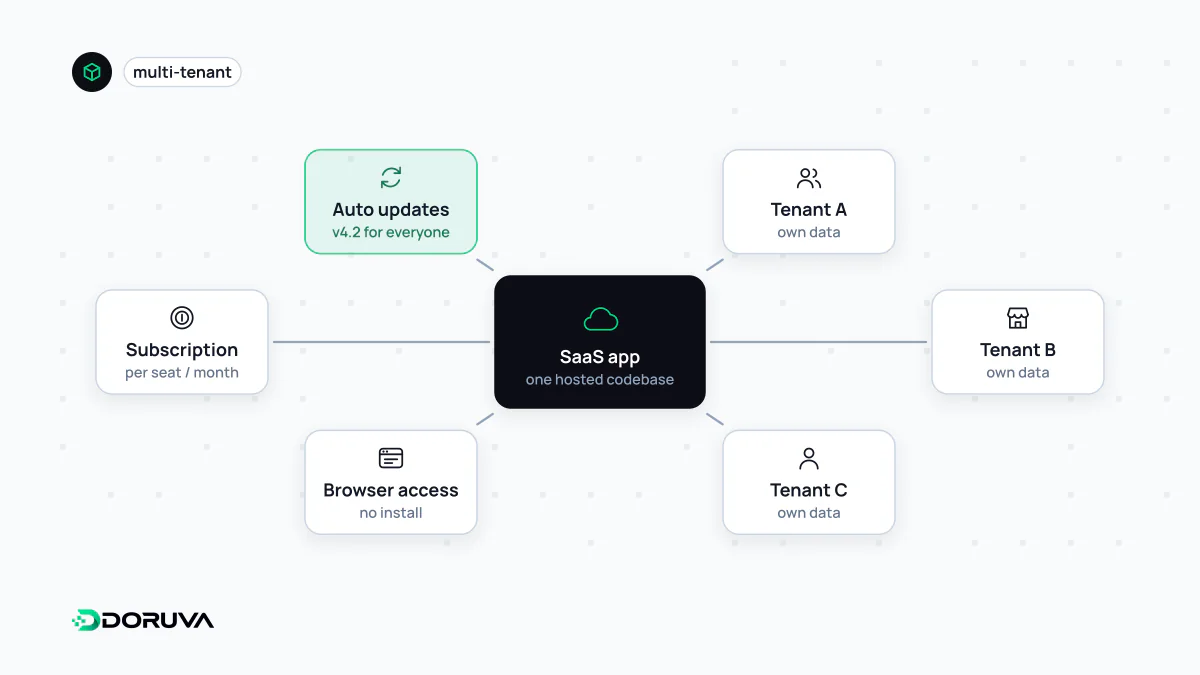
Using software instead of owning it
In the traditional model a company buys a licence, installs the software on its own servers and handles updates and backups itself. With SaaS the software runs on the provider's infrastructure; customers reach it through a browser, a mobile app or an API and pay a recurring fee for the right to use it. The NIST definition of cloud computing (SP 800-145) describes SaaS as the model in which the consumer manages neither the infrastructure, the operating system nor the application itself, apart from limited user-specific settings.
Email and office suites, CRMs, accounting and invoicing tools, project management apps and hosted e-commerce platforms are mostly sold this way today.
Multi-tenancy
What makes SaaS economical is that one deployment serves many customers, or tenants, at the same time. Each tenant sees only its own data while code and servers are shared. There are three common ways to separate tenant data:
- Shared schema: every tenant lives in the same tables, with a
tenant_idcolumn on each row. Cheapest to run, but every single query must apply that filter. - Schema per tenant: each customer gets its own schema inside the same database.
- Database per tenant: the strongest isolation, with the highest cost and operational overhead.
Whatever the approach, one customer seeing another customer's data is among the worst failures a SaaS product can have. Tenant isolation should be enforced systematically in the authorization layer and covered by tests, not left to individual screens.
Subscription pricing
SaaS is usually billed monthly or yearly, priced per user, by usage (transactions, storage, API calls) or by feature tier. For the customer that turns a large upfront investment into a predictable operating expense. The flip side is that payments never stop: the bill grows with headcount, and the provider decides on price and plan changes.
SaaS, on-premise and custom software
| SaaS | On-premise | Custom software | |
|---|---|---|---|
| Upfront cost | Low | Licences and hardware | High development cost |
| Time to start | Fast | Installation and configuration | Analysis and development |
| Maintenance and updates | Provider | In-house IT | Development team |
| Where data lives | Provider's infrastructure | Company servers | Your choice |
| Fit to your process | As far as the product allows | Within configuration limits | Designed around it |
When SaaS wins, and when custom software makes sense
For processes that work much the same everywhere (accounting, email, payroll, calendars), a mature SaaS product is almost always the sensible choice. Building the same thing from scratch is expensive, and matching the detail a good product has accumulated over years is hard. Custom software starts to make sense when:
- the process is what sets the business apart, and off-the-shelf tools only support it with workarounds;
- staff are copying data between several SaaS tools by hand and no ready-made integration fills the gap;
- per-seat subscription costs clearly outgrow the cost of running your own system as you scale;
- regulation or customer contracts impose requirements on where and how data is stored that a provider cannot meet.
The right answer is often a mix: SaaS for standard work, API integrations tying the tools together, and custom software only for the processes that genuinely differentiate. When choosing a SaaS product, asking up front about data export, API coverage and what happens to your data when the contract ends reduces the risk of vendor lock-in later.