

What is Software Development?
Definition
Software development is the process of turning a need into working, maintainable software. Beyond writing code, it covers requirements analysis, design, testing, release and the maintenance and improvement that continue after launch. Teams organize these activities either sequentially, as in the waterfall model, or in short iterative cycles, as in Agile methods such as Scrum and Kanban, with analysts, designers, developers, testers and operations engineers working together.
Also known as: software engineering, SDLC, software development life cycle, application development
Writing code is the smaller part
From the outside, software development looks like hours at a keyboard. In practice, projects succeed or fail mostly on whether the team understood what to build and why. A misunderstood requirement implemented with flawless code still produces a product nobody uses. Good teams therefore start with “which problem are we solving, and how will we know it worked?” long before “what do we code?”
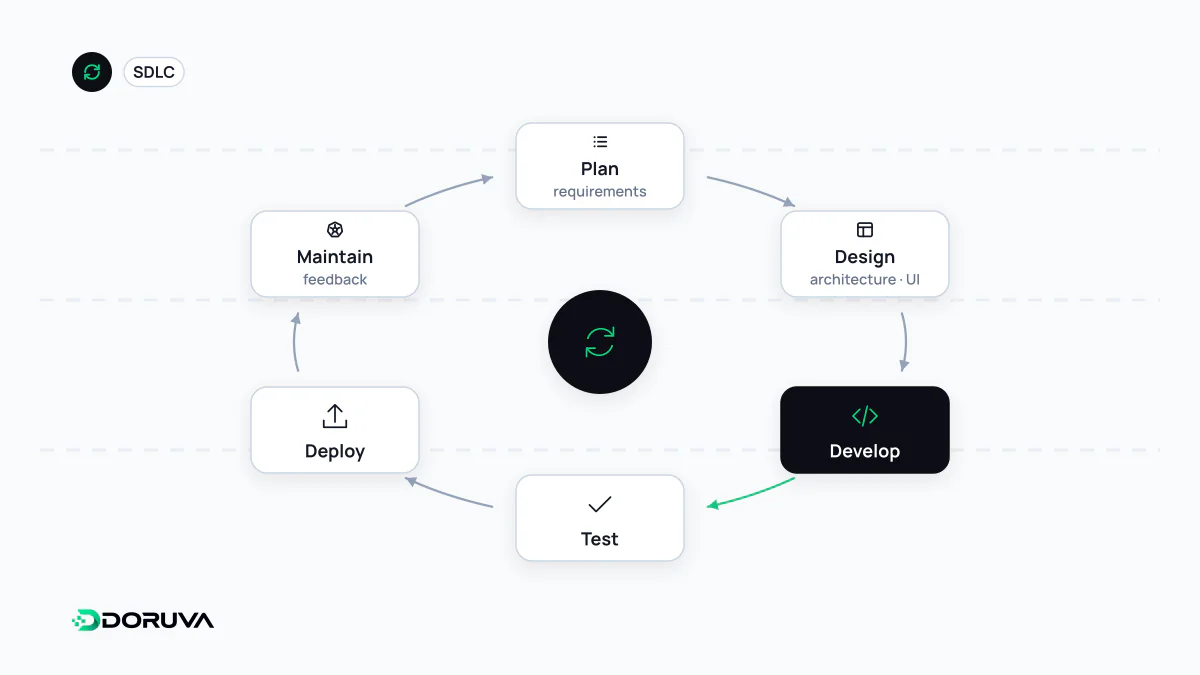
The life cycle, stage by stage
- Discovery and requirements: users, business rules, integrations and constraints are pinned down, producing user stories, acceptance criteria and a prioritized backlog.
- Design: screen flows and UI on one side; data model, service boundaries and infrastructure decisions on the other.
- Implementation: code is written in small, reviewable increments and kept in version control such as Git.
- Testing: unit tests, integration tests and user acceptance testing catch defects before users do.
- Release: changes are verified in a staging environment, then deployed to production.
- Maintenance and evolution: security patches, bug fixes, performance work and new requirements. This is where most software spends most of its life, and most of its budget.
Waterfall, Agile and what teams actually do
In the waterfall model each phase waits for the previous one to finish and scope is fixed up front. It suits work whose requirements truly do not move, such as processes defined by regulation. Its weakness is timing: a wrong assumption tends to surface at the end, when it is most expensive to fix.
The Agile Manifesto of 2001 reordered priorities: individuals and interactions over processes and tools, working software over comprehensive documentation, customer collaboration over contract negotiation, responding to change over following a plan. Scrum applies this with fixed-length sprints, usually two to four weeks; Kanban visualizes the flow of work and caps how much is in progress at once. Most real projects blend the two. Budget and core scope are agreed early, details are settled in short cycles, and the first milestone is often a minimum viable product.
Who does what
- Product owner or business analyst: defines and prioritizes the need and decides what “done” means.
- UX/UI designer: shapes flows and interfaces around how people actually work.
- Front-end and back-end developers: build the interface, business logic, data layer and integrations.
- QA engineer: designs test cases, automates them and reports on quality.
- DevOps or operations: owns infrastructure, deployment pipelines, monitoring and backups.
On small teams one person often wears several of these hats. What matters is that no hat is left on the shelf: if nobody owns testing, your users end up doing it.
Habits that decide quality
- Code review: having a second developer read every change catches defects and spreads knowledge.
- Automated pipelines: a CI/CD pipeline runs the tests on every change and makes releases repeatable instead of heroic.
- Visible debt: shortcuts taken under deadline pressure are recorded as technical debt and paid down on purpose.
- Written knowledge: setup steps, architecture decisions and configuration live in documentation, so one person leaving does not stall the project.