

What is Sitemap Index?
Definition
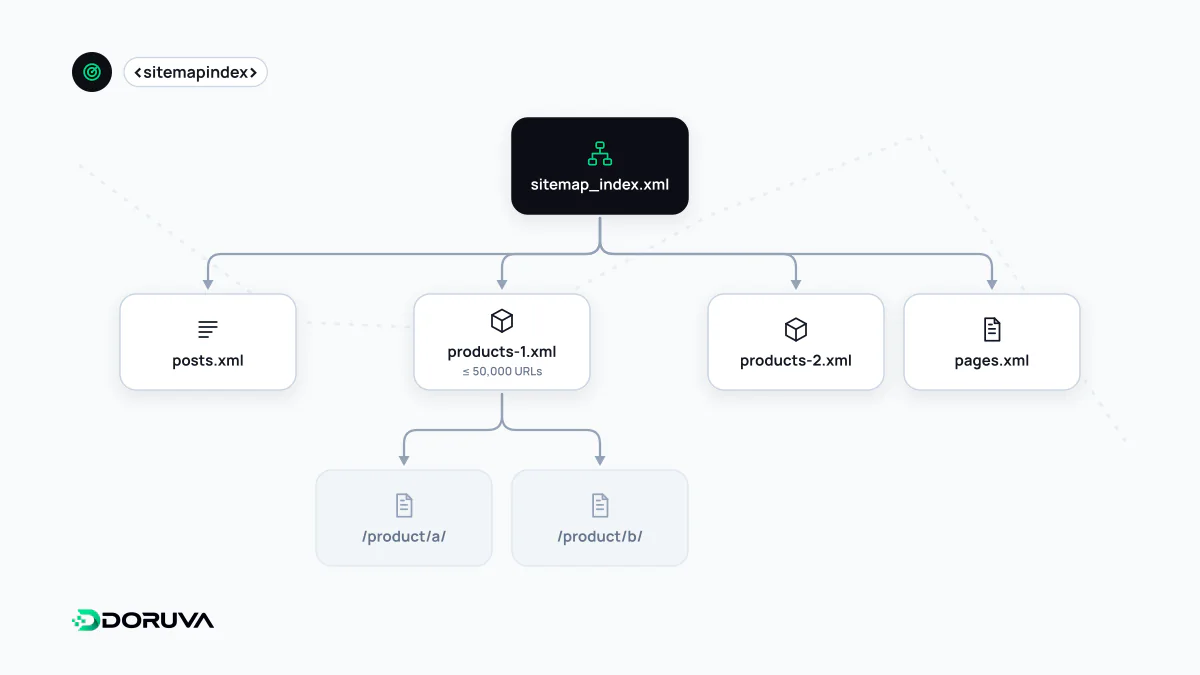
A sitemap index is an XML file that lists the locations of several XML sitemap files. Because a single sitemap is limited to 50,000 URLs and 50 MB uncompressed, large sites split their URLs across multiple sitemaps and submit them all at once through an index file whose root element is sitemapindex.
Also known as: sitemap index file, sitemapindex, sitemap_index.xml
When one file is not enough
An XML sitemap may hold at most 50,000 URLs and must not exceed 50 MB uncompressed. A store with hundreds of thousands of products, or a publisher with years of archives, passes those limits easily. The answer is to spread the URLs over several sitemaps and keep a list of them in an index file. Even sites well under the limits often benefit from splitting: it becomes easier to see which section has problems, to regenerate only the part that changed and to keep files small.
What the file looks like
<?xml version="1.0" encoding="UTF-8"?>
<sitemapindex xmlns="http://www.sitemaps.org/schemas/sitemap/0.9">
  <sitemap>
    <loc>https://example.com/sitemaps/products-1.xml</loc>
    <lastmod>2026-10-02</lastmod>
  </sitemap>
  <sitemap>
    <loc>https://example.com/sitemaps/blog.xml.gz</loc>
  </sitemap>
</sitemapindex>
The root element is sitemapindex rather than urlset, and each entry points to a sitemap file, not a page. Here lastmod states when that sitemap file last changed, not when the pages inside it did, which lets a search engine re-read only the sitemaps that have changed. The rules for page-level dates are covered under lastmod.
Limits and rules
- An index file may contain up to 50,000
locentries and, under the sitemaps.org protocol, must stay within 50 MB. - Listed sitemaps must live on the same site as the index, in the same directory or deeper. An index at
/public/sitemap_index.xmlcannot reference files under/sitemaps/. The same-site requirement is waived if cross-site submission is set up. - Google allows up to 500 sitemap index files per site in Search Console.
- Use fully qualified, absolute URLs and UTF-8 encoding. Sitemaps may be gzipped; the size limit applies to the uncompressed file.
- The protocol defines an index as a list of sitemaps. An index pointing to another index is not a defined use, so keep the structure to a single level.
Ways to split
Split in a way that makes reporting useful, not at random. Common approaches:
- By content type: products, categories, articles, store pages. This is the most practical division in ecommerce SEO.
- By date: monthly or yearly sitemaps for news and blogs; old files rarely change while the current one is updated often.
- By ID range: fixed-size chunks for programmatic SEO projects that generate large numbers of templated pages.
The real payoff of a sensible split is diagnosis. The Page indexing report in Search Console can be filtered by sitemap, so if most URLs in the product sitemap are not indexed while the blog sitemap looks healthy, you know immediately where to look.
Submitting it
An index file is submitted like any sitemap: reference it in robots.txt and submit it in the Sitemaps section of Google Search Console.
Sitemap: https://example.com/sitemap_index.xmlGoogle retired the unauthenticated sitemap "ping" endpoint in 2023; robots.txt and Search Console submissions still work. Details are in Google's guide to managing large sitemaps.