

What is International SEO?
Definition
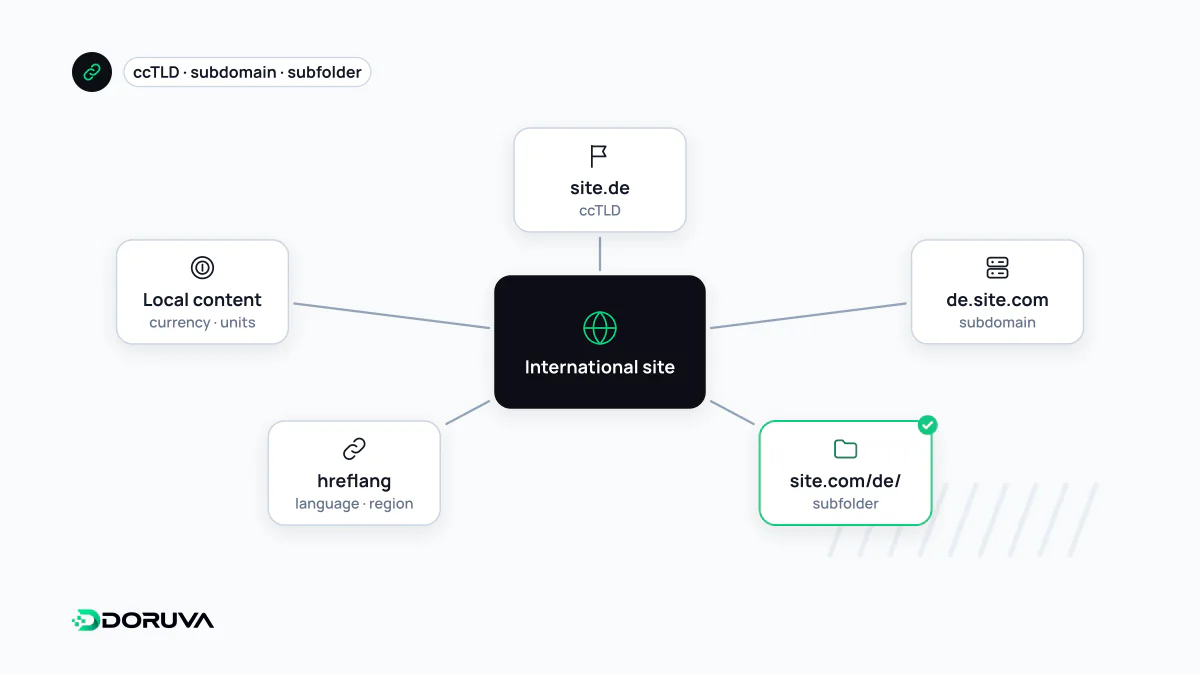
International SEO is the technical and content work that makes a website show the right language or country version to the right audience in search. It covers choosing between country-code domains, subdomains and subdirectories, annotating language and regional versions with hreflang, signalling a target country (geotargeting) and localising content rather than merely translating it.
Also known as: international targeting, geotargeting, ccTLD, multi-regional SEO, multilingual SEO
Multilingual and multi-regional are different problems
A Canadian business with English and French pages runs a multilingual site; Google tries to match the searcher's language. A retailer shipping to both the United States and Canada with different prices runs a multi-regional site; both versions may be in English, but each country should get its own. Many sites are both: a Swiss version in German and French alongside a German-only version for Germany.
Picking a URL structure
Google recommends locale-specific URLs and lays out the trade-offs:
| Structure | Example | Pros | Cons |
|---|---|---|---|
| Country-code domain (ccTLD) | example.de | Clear targeting; server location irrelevant; easy separation | Expensive; more infrastructure; some registries have strict rules; one country only |
| Subdomain on a generic domain | de.example.com | Easy to set up; allows different server locations | Users cannot tell whether "de" means a language or a country |
| Subdirectory on a generic domain | example.com/de/ | Easy to set up and maintain on one host | Single server location; harder to separate |
| URL parameter | example.com?loc=de | — | Not recommended by Google |
One catch: Google treats some country codes, such as .io, .co, .me and .tv, as generic because people use them that way. Regional endings like .eu and .asia are also treated as generic.
How Google infers the target audience
- ccTLDs: a strong signal that a site is meant for one country.
- Hreflang: language and region annotations in HTML, HTTP headers or sitemaps.
- Server location: a hint at most, because CDNs and remote hosting are common.
- Other signals: local addresses and phone numbers, local language and currency, links from local sites and, where available, a Business Profile.
Google ignores location meta tags such as geo.position. It also works out a page's language from its visible content, not from the lang attribute or the URL, so each page should use one language for both content and navigation. The details are in Google's guide to managing multi-regional and multilingual sites.
The automatic redirect trap
Redirecting visitors by IP address or browser language feels helpful but causes two problems. Most Googlebot requests originate from the US and carry no Accept-Language header, so a crawler that is always sent to the same version may never see the others. And a person who lands on the wrong version loses the ability to choose. The safer pattern is to publish every version at its own URL, annotate them with hreflang and offer visible links to switch locale:
<link rel="alternate" hreflang="en-US" href="https://example.com/us/" />
<link rel="alternate" hreflang="en-CA" href="https://example.com/ca/" />
<link rel="alternate" hreflang="fr-CA" href="https://example.com/ca-fr/" />
<link rel="alternate" hreflang="x-default" href="https://example.com/" />
Same language, different countries
When the US and Canadian pages carry almost the same text, Google may cluster them as duplicates and favour one. For this case Google advises picking a preferred version and combining canonical tags with hreflang. The real differentiation belongs in the content: currency, prices, shipping and returns, local contact details and examples that fit the market. Versions produced only by machine translation add little for users or search engines.