

What is Generative AI?
Definition
Generative AI is the umbrella term for AI models that learn patterns from training data and use them to produce new content: text, images, audio, video or code. What separates them from models that classify existing data or predict a value is that their output is new material. Large language models, diffusion-based image models and speech synthesis systems are well-known examples. Their output can be fluent and still wrong, so it needs checking.
Also known as: GenAI, gen AI, generative artificial intelligence, generative models
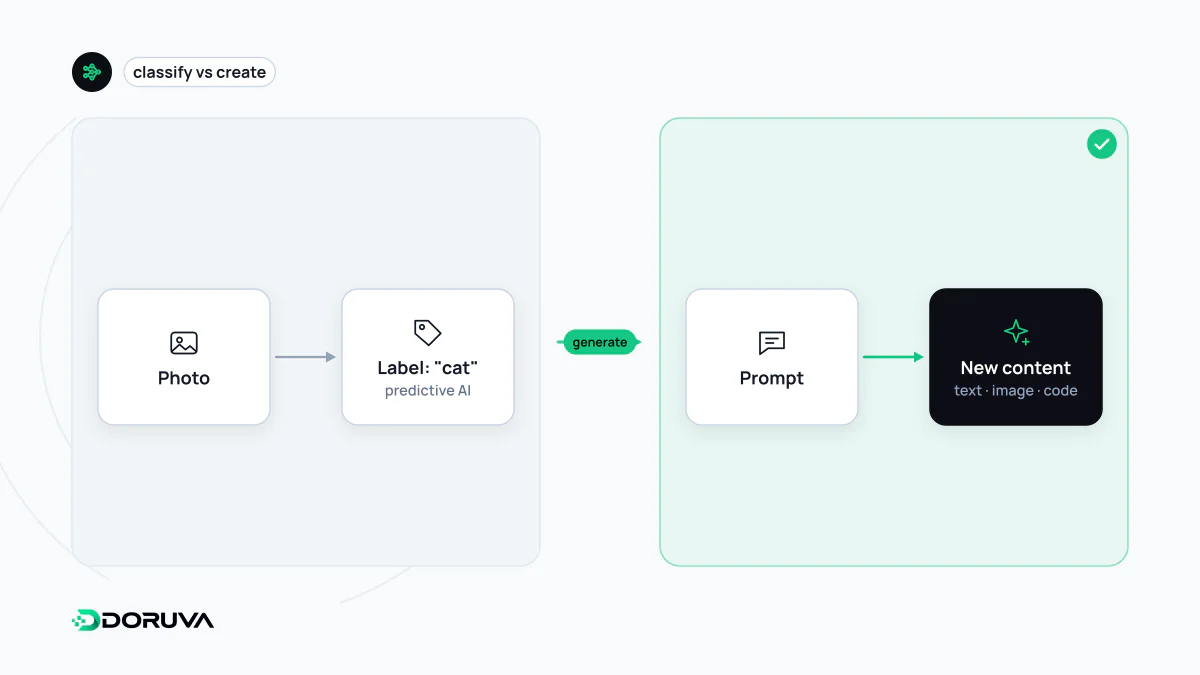
Deciding versus producing
Much of machine learning is discriminative. A model decides whether an email is spam, flags a transaction as suspicious or forecasts next month's sales. Generative models produce new examples that resemble their training data. In the same inbox, the discriminative model says “spam”; the generative one drafts a reply to the customer.
| Question | Discriminative model | Generative model |
|---|---|---|
| What comes out? | A label, probability or number | Text, an image, audio, code |
| How is quality measured? | Against labelled test data, with a clear right or wrong | Often by human judgement or task-based tests |
| Typical failure | Misclassification | Fluent content that is wrong or inappropriate |
The main model families
- Language models: large language models generate text and code one token at a time, each conditioned on what came before.
- Diffusion models: the common approach for images. Generation starts from random noise and removes it step by step, guided by the text description, until a picture emerges.
- Audio and speech models: text-to-speech, music and sound effects.
- Multimodal models: multimodal models that handle several data types at once are blurring the lines between these families.
Most of these are foundation models, trained broadly and then adapted. What they share is that they sample from a learned probability distribution, which is why the same request does not always produce the same output.
What it changed for search and publishing
The first shift is in how people find information. More questions now go to assistants or to AI-generated answer features in search engines, and AI search responds with a synthesised answer rather than a list of pages. Work aimed at being one of the sources behind those answers is grouped under GEO.
The second shift is in production. Google's guidance on generative AI content focuses on whether content is useful rather than on how it was made, but warns that generating many pages without adding value for users may violate its spam policy on scaled content abuse. It also asks publishers to fact-check AI-generated material before publishing, including titles, meta descriptions, structured data and alt text.
Risks worth managing
- Accuracy: where a model lacks knowledge it can invent plausible detail, known as hallucination. Figures, dates, quotes and citations always need checking.
- Rights and licensing: the copyright status of generated output and the use of training data are still contested, including in court, in many jurisdictions. For commercial work, read the provider's terms.
- Personal data: customer details pasted into a prompt may count as data shared with the provider.
- Transparency: telling readers how content was produced protects trust, especially for images and news-like material.