

What is Hybrid Search?
Definition
Hybrid search is an approach that runs lexical search, such as BM25 keyword matching, and vector search over embeddings for the same query, then merges both result lists into a single ranking. Lexical search catches exact matches like product codes and precise phrases, while vector search catches the same meaning expressed in different words. The lists are usually combined with Reciprocal Rank Fusion (RRF) or a weighted score combination.
Also known as: hybrid retrieval, lexical and semantic search, BM25 plus vector search
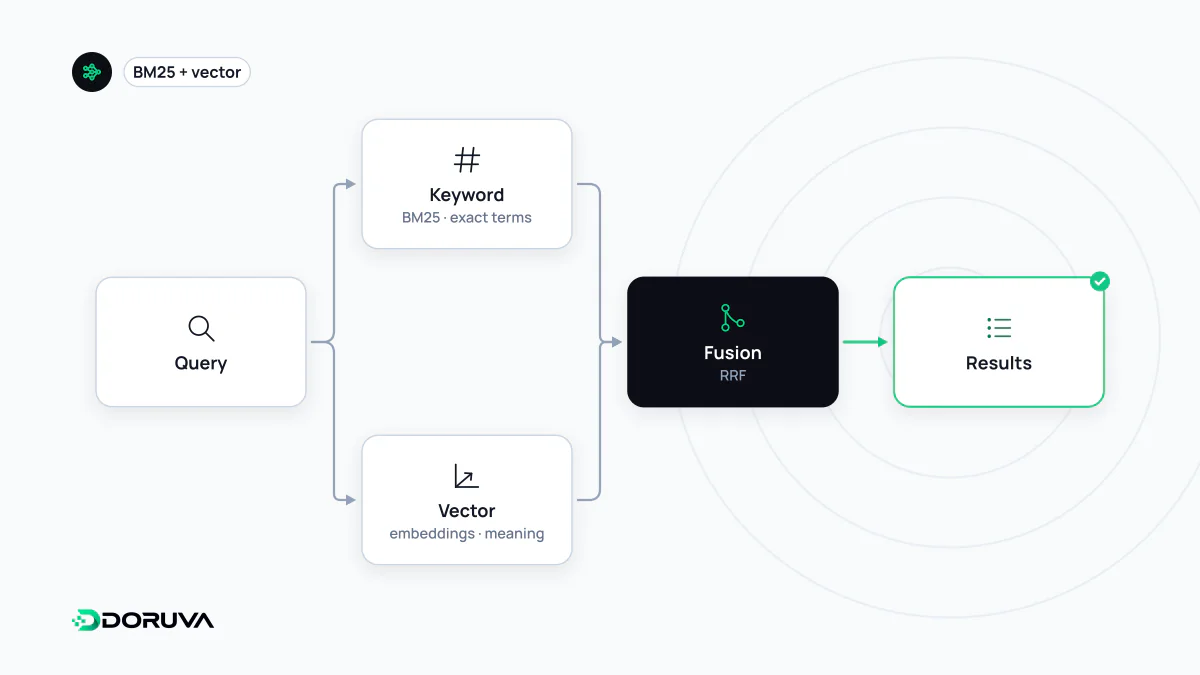
Where each method covers the other's blind spot
Picture two searches on a help center. In one, the user pastes the exact error their browser shows: ERR_SSL_PROTOCOL_ERROR. In the other, they describe the problem in their own words: “my site says it can't make a secure connection”. Lexical search wins the first, because the code is a string rather than a meaning and needs an exact match. Vector search wins the second, because the user's words do not overlap with the document's, but the meaning does.
Real users ask both kinds of question. Hybrid search runs both methods in parallel for each query and merges the results, so that whichever one falls short is covered by the other.
The lexical side: BM25
BM25 is the most widely used scoring function in lexical search. It rests on three ideas: a term that appears more often in a document raises its score, with diminishing returns; terms that are rare across the collection count for more; and long documents are normalized so they do not win simply by being long. Because it runs on an inverted index, it is very fast.
The quality of this side depends heavily on the language analyzer. In a morphologically rich language such as Turkish, a setup that does not reduce a word's many suffixed forms to a common stem will miss relevant documents. Embeddings cope with that variation more gracefully, which is part of why hybrid setups are popular for Turkish content.
Merging the lists: RRF and weighted fusion
The core difficulty is that the two scores are not comparable: BM25 scores have no upper bound, while cosine similarity lives in a narrow range. There are two common answers.
Reciprocal Rank Fusion (RRF) ignores scores entirely and looks only at rank positions. Each document earns 1 / (k + rank) for every list it appears in, and the contributions are summed. The method was proposed by Cormack, Clarke and Büttcher in 2009, and in systems such as Elasticsearch k defaults to 60. A small example:
| Document | BM25 rank | Vector rank | RRF score (k = 60) |
|---|---|---|---|
| A | 1 | 3 | 1/61 + 1/63 ≈ 0.03227 |
| B | 2 | 1 | 1/62 + 1/61 ≈ 0.03252 |
| D | — | 2 | 1/62 ≈ 0.01613 |
| E | 3 | — | 1/63 ≈ 0.01587 |
The fused order is B, A, D, E. Documents ranked well in both lists rise to the top; those found by only one method fall back but stay in. RRF's appeal is that it needs no tuning.
Weighted fusion first brings both scores to the same scale, for example with min-max normalization, then combines them with something like α × lexical + (1 − α) × vector. It offers more control, but α has to be tuned on real queries, and normalization can behave differently from one query to the next.
What happens after fusion
Hybrid search is a retrieval technique: its job is to avoid missing relevant candidates. The top few dozen fused results are usually passed to a more expensive model for re-ranking, where the final relevance scoring happens. Which configuration works best is settled by measuring recall on a test set of real questions, not by intuition.
When it is not worth it
Running two indexes side by side has a cost. If nearly every query is a product code or ID lookup, lexical search alone may be enough. If queries are almost entirely natural-language questions without codes or proper names, vector search alone can do well. Hybrid search pays off where the query mix is genuinely mixed.