

What is Parametric Knowledge?
Definition
Parametric knowledge is the information an AI model absorbed during training and now holds in its weights (parameters). The model reaches it from the inside, without consulting any outside source. Information that arrives at answer time through search, document retrieval or a tool call is called retrieved, or non-parametric, knowledge. Parametric knowledge is frozen when the training data was collected, cannot be traced to a source and can be recalled wrongly.
Also known as: parametric memory, model-internal knowledge, knowledge in the weights, closed-book knowledge
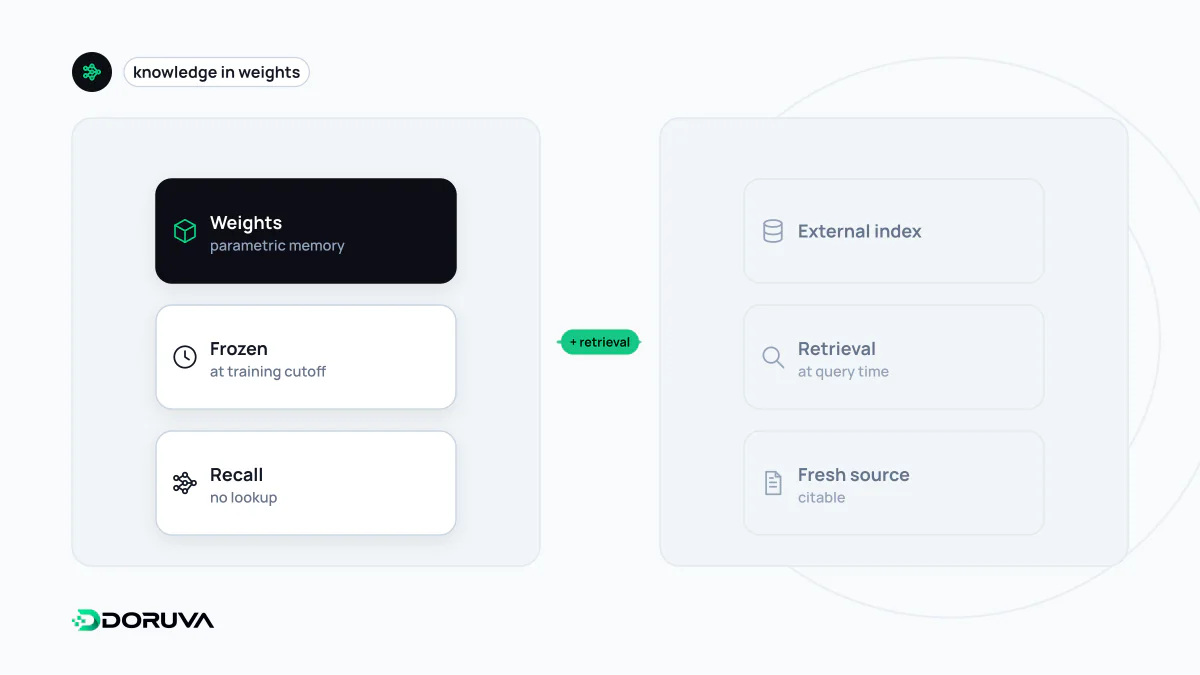
How facts end up in the weights
During pre-training, a language model tries to predict the next token across billions of sentences and nudges its parameters every time it gets one wrong. Facts that appear often and consistently, such as “Paris is the capital of France”, settle into the weights as statistical associations spread over many parameters. There is no record or row to look up. The knowledge exists only as the model's tendency to produce a particular answer to a particular question.
That is why the quality of parametric knowledge tracks how often, and how consistently, a fact showed up in the training data. A large city's population may be recalled well. A small company's phone number, a branch that opened last spring or a price that changed last month has probably never been learned, or has been learned wrong.
Closed-book versus open-book
Researchers often describe the difference as closed-book versus open-book question answering. A closed-book model answers from memory alone; an open-book system is handed relevant documents first.
| Aspect | Parametric (closed-book) | Retrieved (open-book) |
|---|---|---|
| Where it lives | In the model's weights | In an index, the web, a database or a document store |
| Freshness | Fixed at the training cutoff | As current as the source |
| Attribution | Usually impossible | The retrieved passage can be cited |
| How to update it | Retraining or fine-tuning | Edit the source |
| Typical failure | Stale or invented detail | Wrong or irrelevant document retrieved |
The freshness row is the whole story behind the knowledge cutoff: nothing that happened afterwards is in the parameters. The usual fix is a retrieval-based design such as RAG, and tying the answer to the retrieved sources is known as grounding.
When memory and context disagree
A retrieved document can contradict what the model “remembers”. The model may know the former CEO's name while today's press release in its context names someone else. Models generally favour the context, but not reliably: when the memorised association is strong or the passage is ambiguous, they can slide back to what they learned in training. Production systems reduce the risk with explicit instructions (“answer only from the sources provided”) and by testing answers against those sources.
An empty memory causes its own trouble. Asked about something it never learned, a model may fill the gap with plausible but false specifics, the behaviour known as hallucination.
What it means for brands and publishers
- Answers without search can be out of date. When an assistant describes your company without running a web search, it is drawing on parametric knowledge, so anything that changes (address, product range, pricing) may be wrong.
- Consistency helps, but guarantees nothing. If your name, what you do and where you operate are stated the same way across the web, future models are more likely to learn that association correctly. You cannot know from the outside which data any given model was trained on.
- Current facts travel through retrieval. The dependable way to get a new service into AI answers is to publish it on a crawlable, plainly written page that a search-backed assistant can fetch and cite at answer time.
A common mistake: “the model read my site, so it knows”
A training crawler visiting your page does not mean the page will leave a recallable trace in the next model. Training data is filtered, deduplicated and diluted in an enormous corpus. Making a fact findable at answer time is usually a more realistic goal than hoping a model memorises it. You can write domain knowledge into a model directly through fine-tuning, but that only affects a model you control.