

What is Full Stack?
Definition
Full stack refers to every layer of a web application taken together: the frontend users interact with, the backend that runs business logic, the database, and the infrastructure that deploys it. Full stack development means being able to build a feature end to end across all of those layers. The term describes both a technology stack and a developer role with that breadth.
Also known as: full-stack, fullstack, full stack development, full stack developer
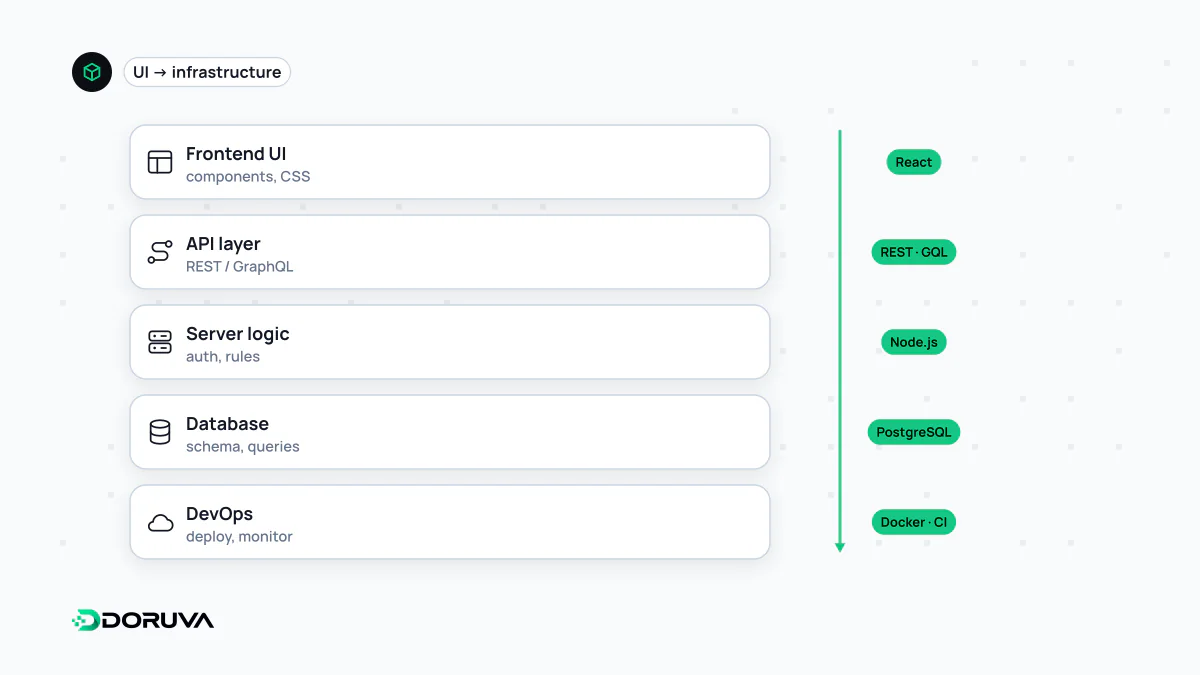
What a "stack" is
In software, a stack is the set of technologies layered on top of one another to make an application run: operating system, web server, database, server-side language and frontend library. Some stacks became common enough to earn acronyms. LAMP is Linux, Apache, MySQL and PHP; MERN is MongoDB, Express, React and Node.js. A frequent modern combination is a Next.js application backed by PostgreSQL and shipped in containers.
"Full" means covering all of it, from the frontend a visitor clicks on, through the backend that enforces the rules, down to where the data lives.
One feature, every layer
The practical meaning of full stack is being able to finish a feature without handing it off. Take a newsletter sign-up:
- Database — a table for addresses with a unique constraint so nobody gets subscribed twice.
- Backend — an endpoint that validates the address, stores it and queues a confirmation email.
- Frontend — an accessible form with a loading state and helpful error messages.
- Tests and release — a test for the duplicate case, a migration for the new table, and the deployment itself.
When one person owns all four steps, there is no hand-off between layers. When two teams split the work, the API contract between them has to be agreed before either side starts.
Breadth, not universal expertise
The most common misreading of the role is that a full stack developer is a deep expert in everything. In practice the profile is T-shaped: depth in one area and enough competence elsewhere to work independently. A developer who came from the frontend will usually design a sensible schema; tuning query plans or setting up replication for a high-traffic system is still a job for someone who specialises in databases.
Frameworks that span the stack
Some frameworks let you write server and client code in a single project. Ruby on Rails, Django and Laravel have done this for years with server-rendered templates. Newer tools such as Next.js go further and run part of one component tree on the server and part in the browser, which thins the boundary between layers even more. That speeds up small teams, but it also means paying close attention to which code runs where, and therefore what ends up shipped to the browser.
When breadth wins and when it doesn't
- Full stack shines for an MVP or early-stage product, in small teams, and for features that touch every layer and change often.
- Specialists earn their place in complex interfaces with demanding accessibility and performance targets, in data-heavy or tightly regulated systems, and at a scale where infrastructure is a full-time job.
Many teams combine the two: full stack developers carry features end to end, while specialists review and guide the parts where depth matters.